
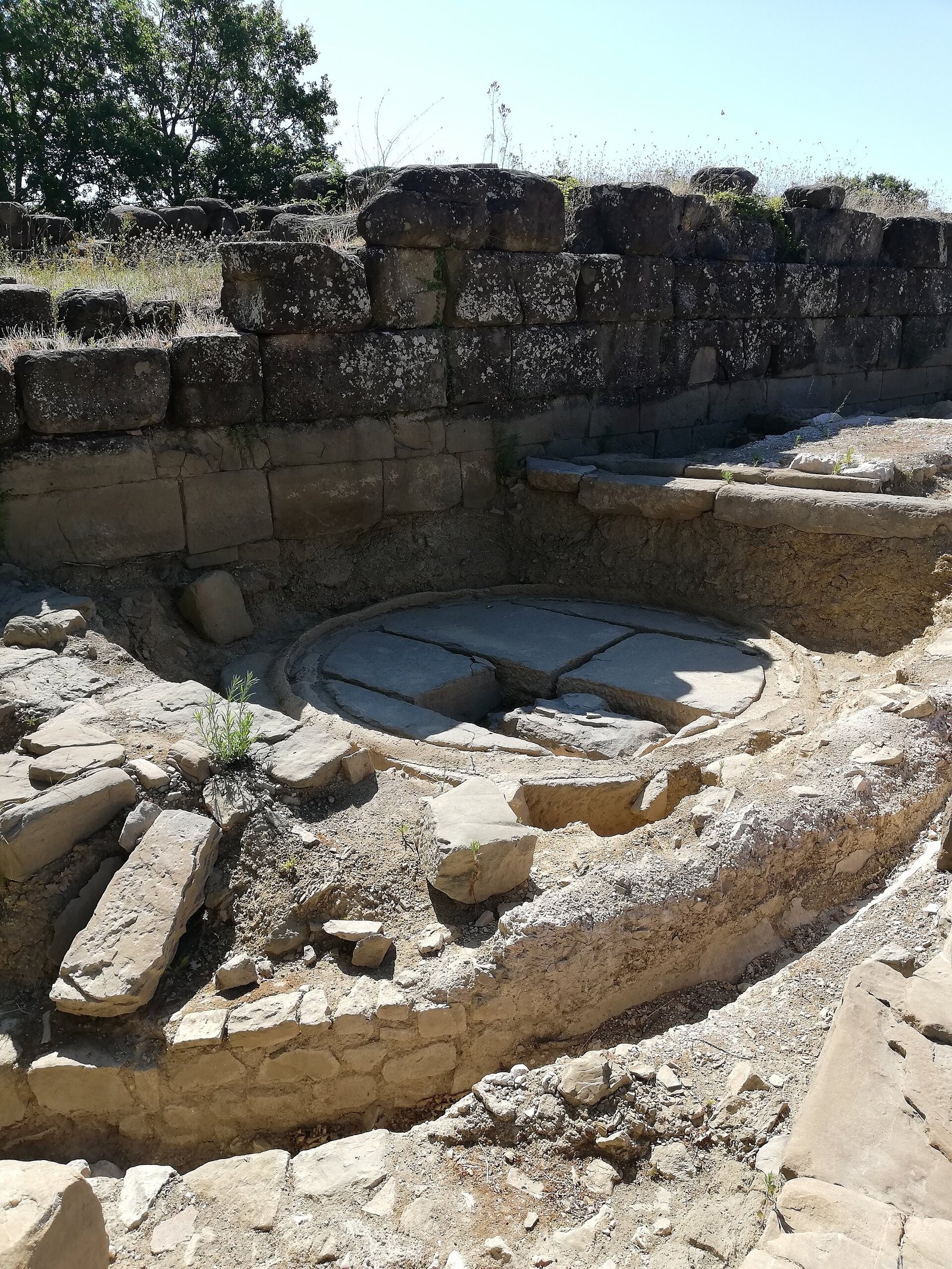
Urvinum Hortense was an ancient Roman municipal town located near modern Collemancio, in the territory of Cannara, Umbria. Occupied from at least the Republican period, the site preserves significant subsurface remains and fragmentary above-ground evidence of Roman civic life in the Umbrian interior.
At a glance
- Type
- Ancient Roman town (municipium)
- Period
- 1st century BC – 4th century AD
- Style
- Roman urban planning; Republican and Imperial phases
- Location
- Near Collemancio, Cannara, Province of Perugia, Umbria, Italy
- Coordinates
- 42.9844° N, 12.5253° E
Overview
Urvinum Hortense was a Roman town situated in the heart of ancient Umbria, close to the Topino River valley. The settlement served as a local administrative and commercial centre during the Roman Imperial period. Today the area around Collemancio preserves the memory of this ancient municipality through archaeological finds and ongoing research.
History
The site was inhabited from at least the late Republican period, becoming a full Roman municipium likely during the 1st century BC after Roman citizenship was extended to Umbrian communities. The town flourished during the Imperial era, maintaining civic institutions, public buildings, and a local economy tied to agriculture and trade along the Umbrian road network. Gradual decline followed in Late Antiquity, and the site was eventually abandoned, leaving its remains buried beneath the agricultural landscape now centred on Collemancio.
What you see
Surface evidence at Urvinum Hortense is largely limited to dispersed architectural fragments, ceramic scatters, and tesserae visible in ploughed fields around Collemancio. Archaeological surveys and targeted excavations have documented the outlines of a Roman street grid, foundations of public buildings, and funerary inscriptions. The medieval village of Collemancio itself incorporates spoliated Roman stone, offering a living palimpsest of occupation across centuries.
Cultural significance
Urvinum Hortense contributes to understanding the dense network of Roman towns that civilised central Italy during the Imperial centuries. Its study illuminates how smaller municipalities functioned within the broader Roman administrative system and how Umbrian communities were integrated into Roman culture after the Social War.
Practical information
The archaeological area is in open countryside near Collemancio, a hamlet of Cannara (PG). There is no formal visitor centre on site. The Museo Civico di Cannara in the town holds related local finds and can provide orientation. Check with the museum or the Comune di Cannara for current access conditions.
Getting there
From Foligno or Assisi, take the SP403 toward Cannara (approximately 8 km from Foligno). Collemancio is a further short drive uphill from Cannara. The area is best reached by private car; there is no regular public transport to the site. Parking is available in Collemancio village.
Sources and resources
Find it on the map
See this place and what’s around it →📷 Become a Cultural Heritage Online photographer
Share your photos of places: they stay published under your name as the author. The more they're seen, the more you get noticed — and soon a contest will reward the most appreciated photos.
Log in or sign up free to add a photo