
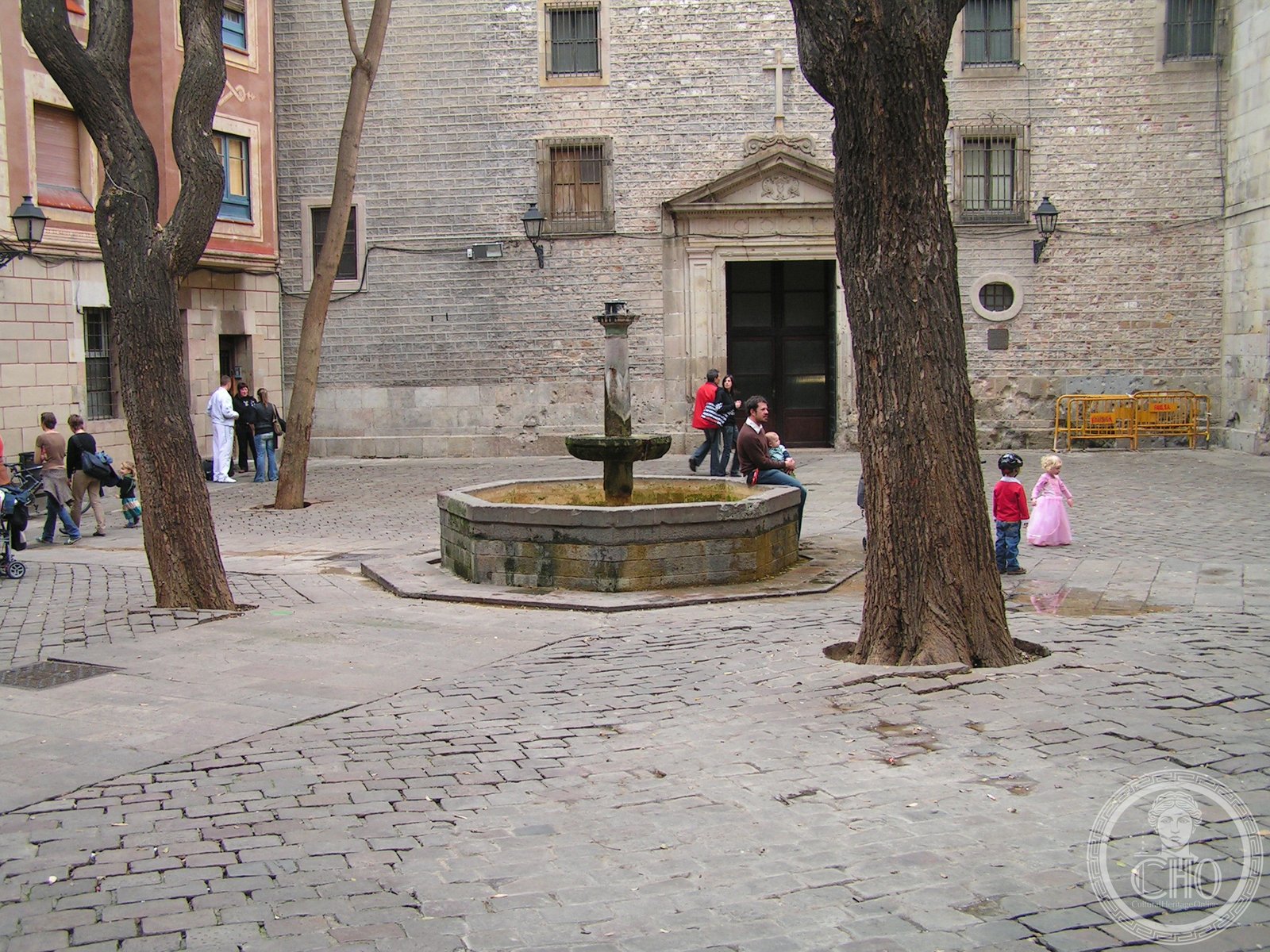
A hotel built from two merged palaces, one of them medieval, on the quietest square in the Gothic Quarter.
At a glance
Hotel Neri occupies a palace complex on Plaça de Sant Felip Neri, a small square tucked inside Barcelona’s Barri Gòtic that most visitors to the nearby cathedral never find. The building is the result of merging two palaces in the 18th century, one of them dating to the 12th century, and the hotel’s restoration uncovered a medieval courtyard and sgraffito wall decoration considered among the most important surviving examples in the city. Next door stands the Baroque church of Sant Felip Neri, its facade still marked by shrapnel from a 1938 air raid.
Key facts
- Origins: two palaces merged in the 18th century, one of medieval (12th-century) origin
- Setting: Plaça de Sant Felip Neri, Barri Gòtic
- Notable features: restored medieval courtyard, sgraffito wall decoration, stone vaults
- Adjacent landmark: Church of Sant Felip Neri, built c. 1721–1752
- Historic scars: the church facade retains shrapnel damage from a 30 January 1938 bombing
History
The building that now houses Hotel Neri traces its origins to a medieval palace, later joined in the 18th century to a neighbouring palau to form the single complex that stands today. No individual architect is recorded for either structure, as is typical for Barcelona’s old aristocratic townhouses, whose builders are usually known only through the noble families who commissioned them. The 18th-century restoration work revealed stone vaults, including a Romanesque vault, and walls roughly three hundred years old, alongside the older palace’s courtyard and its sgraffito decoration — a technique of incised, layered plaster ornament that the hotel now presents as among the finest examples surviving in Barcelona.
The square onto which the hotel opens, Plaça de Sant Felip Neri, took its present form around the Baroque church built between 1721 and 1752, one of the few Baroque buildings to survive intact in the old city. On 30 January 1938, during the Spanish Civil War, a Francoist air raid struck the square directly, killing forty-two people, many of them children sheltering in the church basement. The pockmarks left by the bomb’s shrapnel were deliberately left unrepaired on the church facade, and remain visible today as a quiet memorial.
What you see
The square itself is the architectural experience: an octagonal fountain, a canopy of trees, and facades on every side that read as a single enclosed room rather than a street junction. The hotel’s own palace fabric shows through in the restored courtyard and the sgraffito-decorated walls, while the stone vaulting inside recalls the building’s earlier, pre-hotel life as a private residence.
Walk the square slowly and the shrapnel scars on the church facade become visible — small, irregular pockmarks left exactly as the 1938 bombing left them, a deliberate act of memory in a city that rebuilt almost everything else around them.
Practical information
- Address: Carrer de Sant Sever 5, 08002 Barcelona
- Access: the square is open to the public at all times; the hotel interior is accessible to guests
- Best viewed: early morning or evening, when the square is at its quietest
Getting there
The square sits a short walk from Barcelona Cathedral, reachable on foot from the Jaume I or Liceu metro stations in under ten minutes. The narrow streets of the Barri Gòtic make it easiest to arrive on foot rather than by car.
Nearby
- Barcelona Cathedral — two minutes on foot
- Plaça del Rei and the Royal Palace complex — a short walk east
- La Rambla — ten minutes west through the Gothic Quarter’s narrow lanes
Sources
- Hotel Neri, official site — hotelneri.com
- CC Magazine, “Neri and the Wittmore: two unique hotels in the Gothic Quarter” — ccmagazine.es
- Ajuntament de Barcelona, Memòria Democràtica, “Plaça de Sant Felip Neri” — ajuntament.barcelona.cat
Find it on the map
See this place and what’s around it →📷 Become a Cultural Heritage Online photographer
Share your photos of places: they stay published under your name as the author. The more they're seen, the more you get noticed — and soon a contest will reward the most appreciated photos.
Log in or sign up free to add a photoIs this page about you?
This page is read by travellers and heritage enthusiasts who find it on Google. Tell us how you are connected to this place and we will take it from there.