
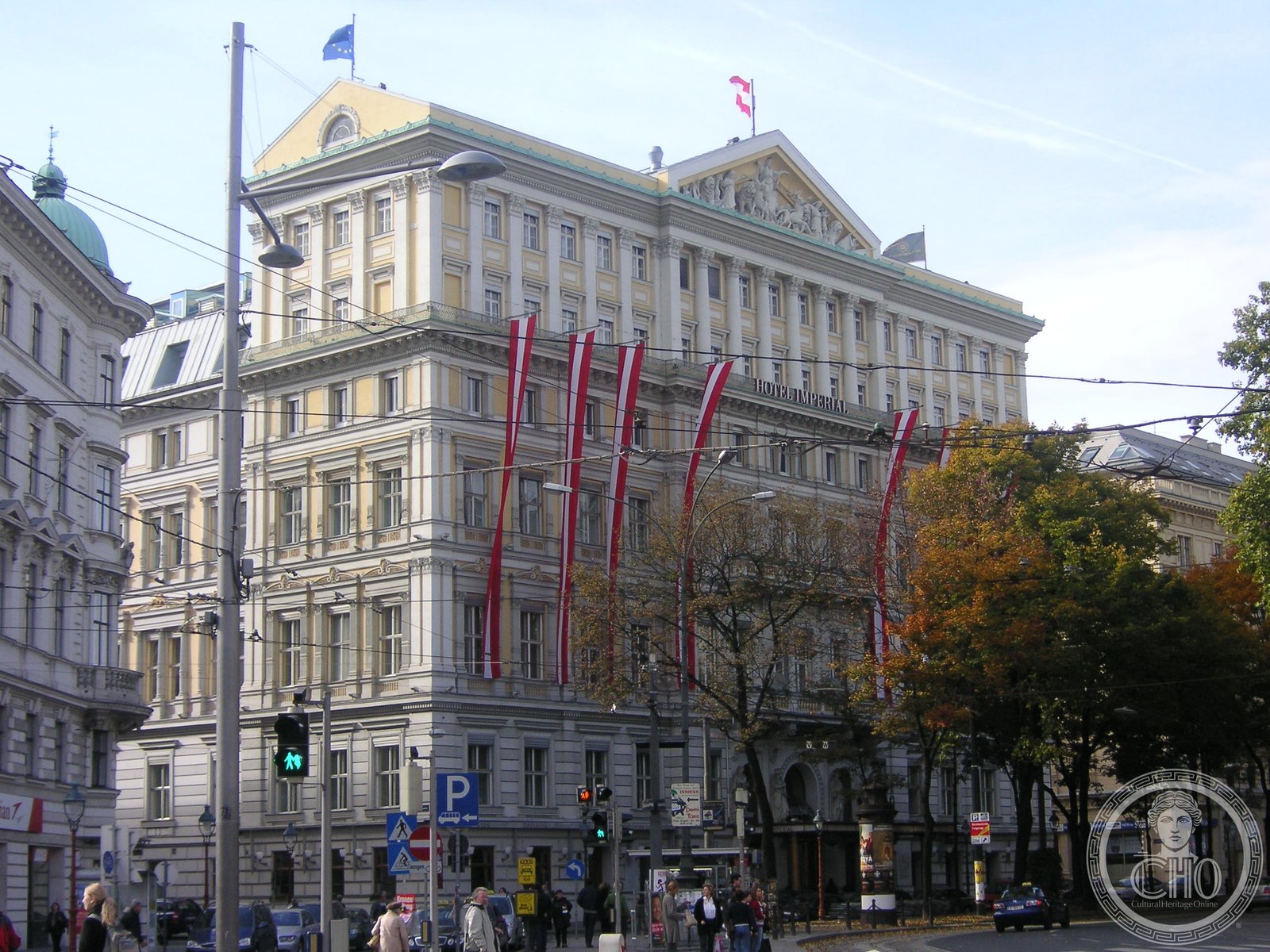
A Ringstrasse palace built for a duke who barely lived in it, opened as a hotel in time for an empire’s world fair.
At a glance
The Hotel Imperial occupies Kärntner Ring 16, on one of the most prominent curves of Vienna’s Ringstrasse. It began life not as a hotel but as a private palace, commissioned by Duke Philipp Alexander of Württemberg and his wife, Archduchess Maria Theresia, and completed in 1865. The building’s Italian Neo-Renaissance front, crowned by four allegorical figures over its carriage portal, still faces the boulevard exactly as it did when the Ringstrasse was new. Converted into a hotel in 1873, it has hosted emperors, heads of state, and touring musicians for a century and a half without a break in service.
Key facts
- Original name: Palais Württemberg
- Architects: Arnold Zenetti and Heinrich Adam (palace, 1863–1865)
- Hotel conversion architects: Ludwig Tischler and Carl Gangolf Kayser (1872–1873)
- Style: Ringstrasse Historicism, Italian Neo-Renaissance
- Opened as a hotel: 28 April 1873, for the Vienna World Exhibition
- Sculpture: Four allegorical portal figures by Franz Melnitzky
History
Duke Philipp Alexander of Württemberg commissioned the palace in 1863, at a moment when the newly demolished city walls had just opened the Ringstrasse for building. The Munich architect Arnold Zenetti, working with master builder Heinrich Adam, gave the duke a residence in the Italian Neo-Renaissance manner then favoured by Vienna’s new aristocratic boulevard: a projecting central bay, balconied windows, and a carriage entrance framed by four allegorical figures carved by Franz Melnitzky, representing wisdom, honour, justice, and strength.
The duke made little use of so lavish a residence, and the palace passed to other owners within a few years. In 1872, with Vienna preparing to host the 1873 World Exhibition and needing accommodation fit for visiting royalty, Emperor Franz Joseph had the interior adapted for hotel use under architects Ludwig Tischler and Carl Gangolf Kayser. The Hotel Imperial opened its doors on 28 April 1873, days before the exhibition itself, and has operated continuously as a hotel ever since.
What you see
The Ring-facing facade reads as a single, symmetrical composition rather than a converted private house: a rusticated ground floor, a piano nobile marked by pedimented window surrounds, and the carriage portal at its centre, still watched over by Melnitzky’s four stone figures. The scale and formality belong to the palace, not the hotel that came after — the building was designed to impress a duke’s guests, and it still does.
Inside, the grand staircase and the sequence of reception rooms preserve the proportions of a Ringstrasse palace: high ceilings, generous window bays, and a processional route from entrance to salon that no ordinary hotel of the period would have needed to build from scratch.
Practical information
- Address: Kärntner Ring 16, 1015 Vienna
- Access: the facade and portal are visible from the Ringstrasse sidewalk at any time; the interior is accessible to hotel guests
- Best viewed: late afternoon, when the low sun catches the Ring-facing facade
Getting there
The hotel sits directly on the Ringstrasse tram line (Kärntner Ring/Oper stop), a few minutes’ walk from the Vienna State Opera and Karlsplatz. Vienna International Airport connects to the city centre by City Airport Train or S-Bahn in under 20 minutes.
Nearby
- Vienna State Opera — three minutes on foot along the Ringstrasse
- Karlskirche and Karlsplatz — a short walk south
- Musikverein, home of the Vienna Philharmonic — two minutes away
Sources
- Planet Vienna, “Palais Württemberg / Hotel Imperial” — planet-vienna.com
- Wien Geschichte Wiki (City of Vienna), “Hotel Imperial” — geschichtewiki.wien.gv.at
- burgen-austria.com, “Palais Württemberg” — burgen-austria.com
Find it on the map
See this place and what’s around it →📷 Become a Cultural Heritage Online photographer
Share your photos of places: they stay published under your name as the author. The more they're seen, the more you get noticed — and soon a contest will reward the most appreciated photos.
Log in or sign up free to add a photoIs this page about you?
This page is read by travellers and heritage enthusiasts who find it on Google. Tell us how you are connected to this place and we will take it from there.