
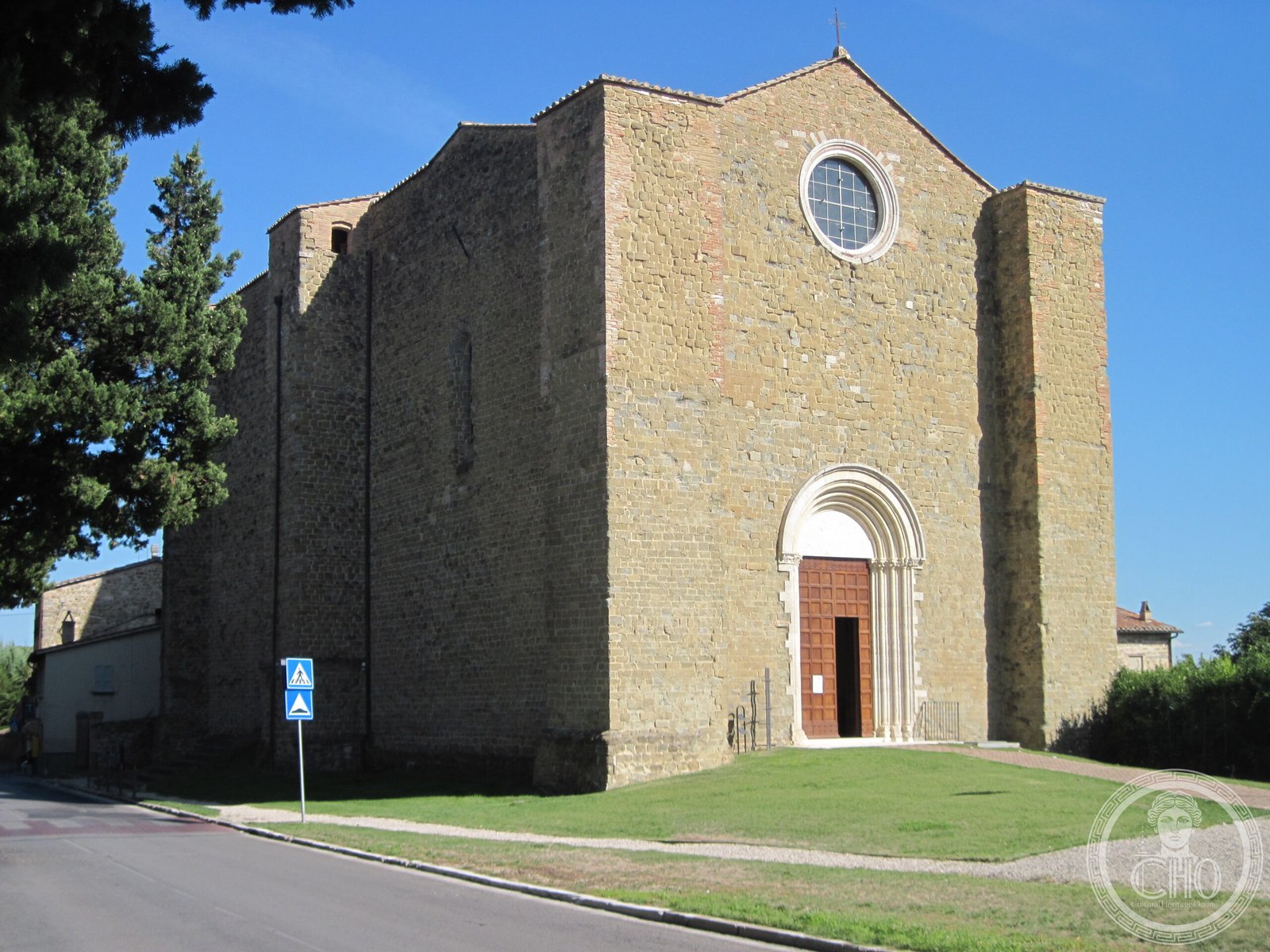
San Bevignate is a 13th-century church in Perugia, Umbria, one of the most complete Templar sacred buildings surviving in Italy. Begun in the mid-13th century and expanded by the Knights Templar in the 1280s, it is named for San Bevignate, the local patron saint of the flagellant movement, and is celebrated for its rare cycle of 13th-century frescoes depicting Templar imagery, crusading scenes, and devotional subjects — among the most important examples of Templar iconography preserved anywhere in Europe.
At a glance
- Type
- Templar church with 13th-century fresco cycle
- Period
- Mid-13th century; expanded by the Knights Templar c. 1280s
- Style
- Umbrian Romanesque-Gothic; Templar military-religious architecture
- Location
- Via del Tempio, Perugia, Umbria — 43.1107° N, 12.4094° E
Overview
San Bevignate stands outside the medieval walls of Perugia, in a position typical of Templar foundations, which were often placed at the periphery of urban settlements along major pilgrimage or trade routes. The church is named for a local Perugian penitent saint associated with the flagellant confraternities that flourished in central Italy during the 13th century, a devotional movement with which the Templars maintained complex relationships. After the suppression of the Templar Order in 1312, the church passed to the Hospitallers and later to other custodians, eventually falling into partial disuse before modern conservation efforts restored it to accessibility.
History
Construction of San Bevignate began in the mid-13th century, probably around 1256–1262, under Templar patronage and with significant local civic support from the Perugian commune. The Knights Templar expanded and embellished the building in the 1280s, adding the fresco cycle that covers the interior walls. When the Order of the Temple was dissolved by Pope Clement V at the Council of Vienne (1312), its properties were formally transferred to the Knights Hospitaller, who held San Bevignate for subsequent decades. The church’s relative isolation and modest post-Templar use preserved its medieval fabric from the heavy baroque remodelling that transformed most Umbrian churches in the 17th–18th centuries.
What you see
The church presents a sober single-nave plan characteristic of Templar military-religious architecture, with a plain exterior of local pink-white stone and a modest rose window above the portal. The interior walls carry the celebrated fresco cycle: scenes of Templar knights in battle dress, the cross pattee (the distinctive Templar cross), flagellant processions associated with the Bevignate cult, and narrative scenes from the life of Christ and the saints. The painting style reflects central Italian Byzantine-influenced conventions of the late 13th century, closely related to contemporary Umbrian work visible in Assisi and Spoleto. The relatively unaltered interior allows visitors to read the building’s spatial logic — nave, chancel, apse — as the Templars intended.
Cultural significance
San Bevignate is internationally significant as one of the best-preserved Templar churches in Europe with an intact iconographic programme, making it an essential reference for scholars of crusading culture, military religious orders, and 13th-century Italian painting. Its combination of Templar military imagery and local flagellant devotion offers a unique documentary window into the religious and social landscape of 13th-century Umbria.
Practical information
- Address
- Via del Tempio, 06122 Perugia PG
- Coordinates
- 43.1107° N, 12.4094° E
Getting there
San Bevignate is located on the eastern outskirts of Perugia, reachable on foot (approximately 20–25 minutes from the city centre) or by city bus. From the Minimetro terminal at Pian di Massiano, local buses connect to the area. By car, the church is accessible from the eastern ring road with parking nearby. The Minimetro rail connects Pian di Massiano to the historic centre in under five minutes.
Sources & resources
See the place
Find it on the map
See this place and what’s around it →📷 Become a Cultural Heritage Online photographer
Share your photos of places: they stay published under your name as the author. The more they're seen, the more you get noticed — and soon a contest will reward the most appreciated photos.
Log in or sign up free to add a photo