
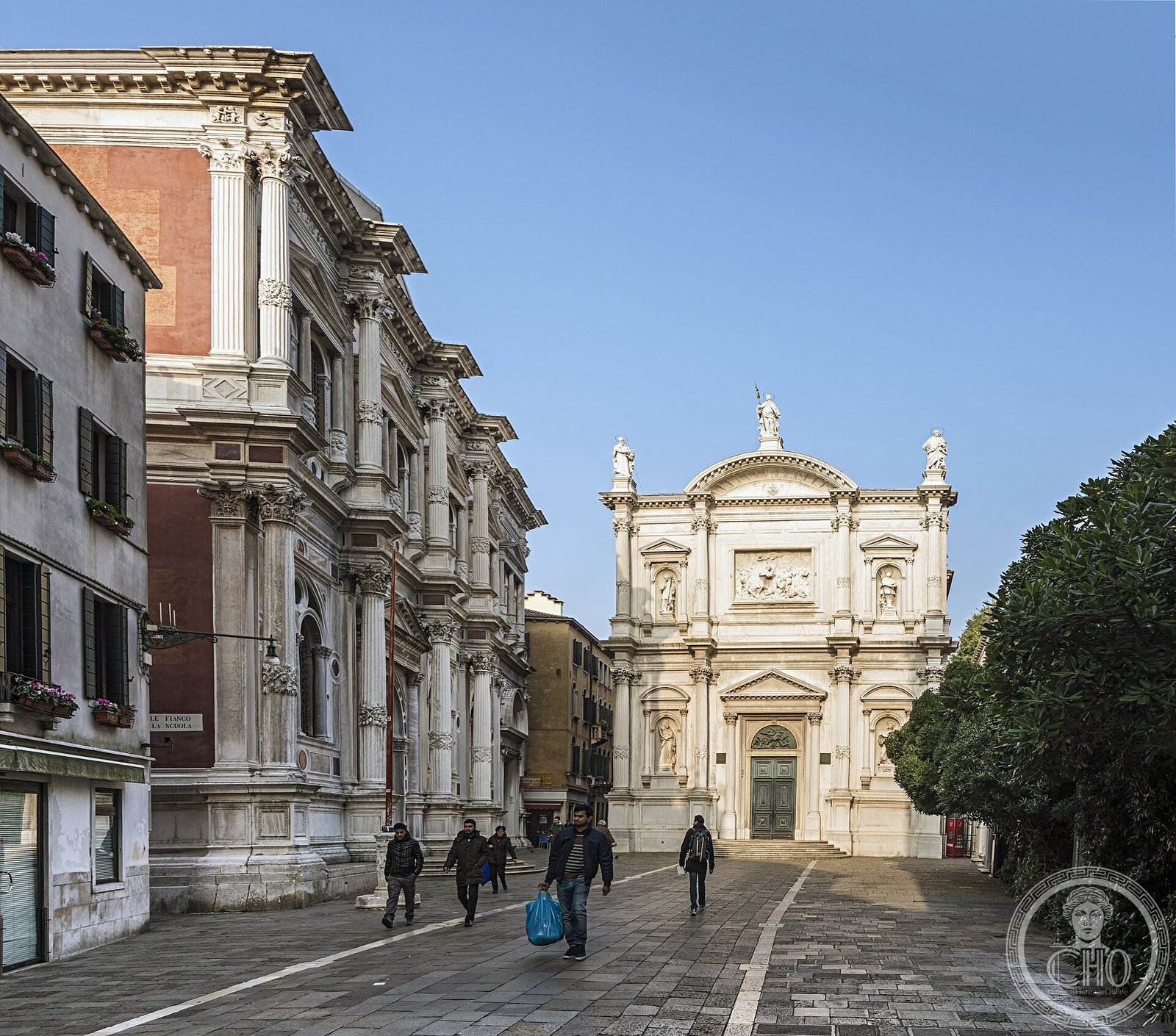
Campo San Rocco is a small square in the San Polo sestiere of Venice, situated at the heart of one of the city’s greatest concentrations of Renaissance art. The campo is flanked by the Scuola Grande di San Rocco, famous for its extraordinary cycle of paintings by Tintoretto, and the Gothic flank of the Basilica dei Frari. Together, these two buildings make Campo San Rocco one of the most artistically significant squares in Venice.
At a glance
- Type
- Public square (campo)
- Period
- Medieval origins; surrounding monuments 14th–16th century
- Style
- Venetian Gothic and Renaissance context
- Location
- San Polo sestiere, Venice
- Coordinates
- 45.4367° N, 12.3256° E
Overview
Campo San Rocco is a modest square defined almost entirely by monumental architecture. The Scuola Grande di San Rocco, with its ornate Renaissance-Mannerist facade, occupies the eastern side, while the long Gothic flank of Santa Maria Gloriosa dei Frari runs along the north. The Church of San Rocco, dedicated to the patron saint of plague victims, stands adjacent to the scuola. Few squares in Italy pack this density of world-class art into so compact a space.
History
The confraternity of San Rocco was founded in Venice in 1478 during a plague epidemic, dedicated to the French saint Roch, whose intercession was believed to protect against pestilence. The Scuola Grande di San Rocco was built between 1515 and 1560, and in 1564 the confraternity held a competition for the decoration of its interior — a competition famously won by Jacopo Tintoretto through the unconventional tactic of installing a completed ceiling painting rather than submitting a design. Tintoretto then spent twenty-three years painting the entire building, completing the cycle in 1588.
What you see
The campo is paved in the traditional Venetian manner and is relatively small, serving mainly as an approach and forecourt to the two great buildings. The Scuola Grande di San Rocco presents an ornate two-storey facade with columns, reliefs, and decorative stonework characteristic of the Venetian Renaissance. The adjacent church of San Rocco has a more restrained 18th-century facade. The interior of the Scuola contains Tintoretto’s cycle across three floors, depicting scenes from the Old and New Testaments in a dramatically lit, emotionally intense style unique in 16th-century Italy.
Cultural significance
The Scuola Grande di San Rocco is one of Venice’s UNESCO World Heritage components and holds what John Ruskin called one of the three greatest picture cycles in the world. Tintoretto’s paintings here represent the fullest expression of his art and of Venetian Mannerism, influencing generations of artists including El Greco and Rubens.
Practical information
The Scuola Grande di San Rocco is open daily to visitors; admission is charged. The Church of San Rocco has limited public visiting hours — check the parish website. The campo itself is freely accessible at all times.
Getting there
Take vaporetto line 1 to San Tomà, then walk north-west for approximately five minutes following signs to the Frari. Campo San Rocco is directly adjacent to the Basilica dei Frari. Alternatively, approach from Campo dei Frari through the archway on the north side of the basilica.
Sources & resources
See the place
Find it on the map
See this place and what’s around it →📷 Become a Cultural Heritage Online photographer
Share your photos of places: they stay published under your name as the author. The more they're seen, the more you get noticed — and soon a contest will reward the most appreciated photos.
Log in or sign up free to add a photoIs this page about you?
This page is read by travellers and heritage enthusiasts who find it on Google. Tell us how you are connected to this place and we will take it from there.