
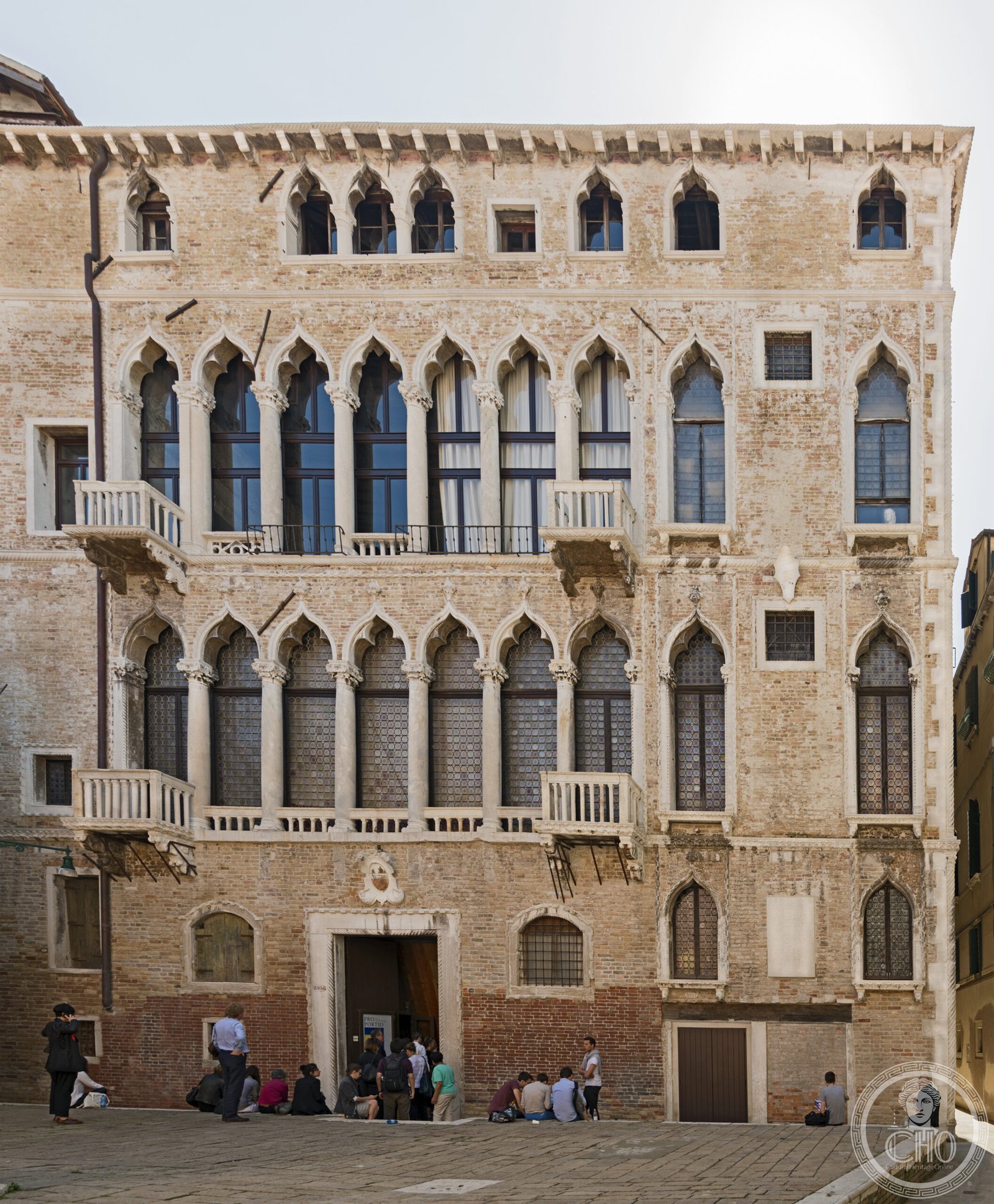
The Palazzo Pesaro degli Orfei, widely known as Palazzo Fortuny, is a late-Gothic palace in Venice built by the Pesaro family in the fifteenth century. From 1902 it became the residence and studio of Spanish-born designer Mariano Fortuny y Madrazo and his wife Henriette Negrin, who transformed it into a creative laboratory for textiles, photography, stage lighting, and painting. Today the palazzo houses the Museo Fortuny, preserving the atmosphere of a working artist’s home and showcasing the encyclopaedic genius of one of the twentieth century’s most versatile creators.
At a glance
- Type
- Historic palace and civic museum
- Period
- 15th century (construction); occupied by Fortuny from 1902
- Style
- Venetian Gothic
- Location
- Campo San Benedetto (San Beneto), San Marco sestiere, Venice
- Coordinates
- 45.4354° N, 12.3322° E
- Current use
- Museo Fortuny — civic museum managed by the Fondazione Musei Civici di Venezia
Overview
The Palazzo Pesaro degli Orfei stands on Campo San Benedetto in the San Marco sestiere of Venice. Built in Venetian Gothic style by the noble Pesaro family in the fifteenth century, it later gave its name to the confraternity of the Orfei (Orphei), a musical society that occupied the building. The palace became internationally famous after 1902, when Mariano Fortuny y Madrazo established his studio here and began the prolific experiments in fabric, dye, and light that would influence fashion and theatre across Europe.
History
The Pesaro family erected the palazzo in the mid-1400s as a private residence, employing the pointed arches and tracery characteristic of Venetian Gothic architecture. During the eighteenth and nineteenth centuries the building passed through several hands and served as the meeting place of the Orfei musical society, which gave rise to its popular name Palazzo degli Orfei. In 1902, Mariano Fortuny — painter, photographer, inventor, and couturier — and his companion Henriette Negrin moved in, eventually purchasing the property and using it as both home and workshop until Fortuny’s death in 1949. The City of Venice acquired the palace in 1956, and it opened to the public as a museum in 1975.
What you see
The interior retains the layered character of Fortuny’s lifetime of accumulation: vast textile hangings, hand-dyed Delphos pleated gowns, his patented Cesendello lighting devices, photographic equipment, and canvases crowd the original Gothic-vaulted rooms. The noble piano nobile features windows with delicate stone tracery overlooking the intimate campo below. Periodic contemporary exhibitions are staged throughout the building, often exploring themes of light, matter, and transformation — concerns central to Fortuny’s own practice. The warren of rooms above the ground floor reveals how Fortuny divided the palazzo between domestic life, textile printing workshops, and a private gallery.
Cultural significance
Palazzo Fortuny is one of the rare Venetian palaces preserved almost exactly as its last inhabitant left it, giving visitors an unusually intimate sense of a creative mind at work across multiple disciplines. Mariano Fortuny’s innovations in pleated silk, photographic scenic projection, and indirect theatrical lighting made him a pivotal figure in early-twentieth-century art and design. The building is listed among Venice’s civic museums and protected as a cultural heritage site of national importance.
Practical information
- Address
- Campo San Beneto 3958, 30124 Venice (San Marco)
- Opening hours
- Check the Fondazione Musei Civici di Venezia official website for current hours and temporary exhibitions
- Admission
- Ticketed; combined passes available with other civic museums
- Accessibility
- Limited — historic building with multiple levels and no lift; check in advance
Getting there
The palazzo is a short walk from the Sant’Angelo vaporetto stop (lines 1 and 2 on the Grand Canal). From Piazza San Marco, walk northwest through the Frezzeria district towards Campo Manin and then Campo San Benedetto — approximately 10 minutes on foot. Water taxi drop-off on the nearby Rio di Sant’Angelo is also convenient.
Sources & resources
See the place
Find it on the map
See this place and what’s around it →📷 Become a Cultural Heritage Online photographer
Share your photos of places: they stay published under your name as the author. The more they're seen, the more you get noticed — and soon a contest will reward the most appreciated photos.
Log in or sign up free to add a photoIs this page about you?
This page is read by travellers and heritage enthusiasts who find it on Google. Tell us how you are connected to this place and we will take it from there.