
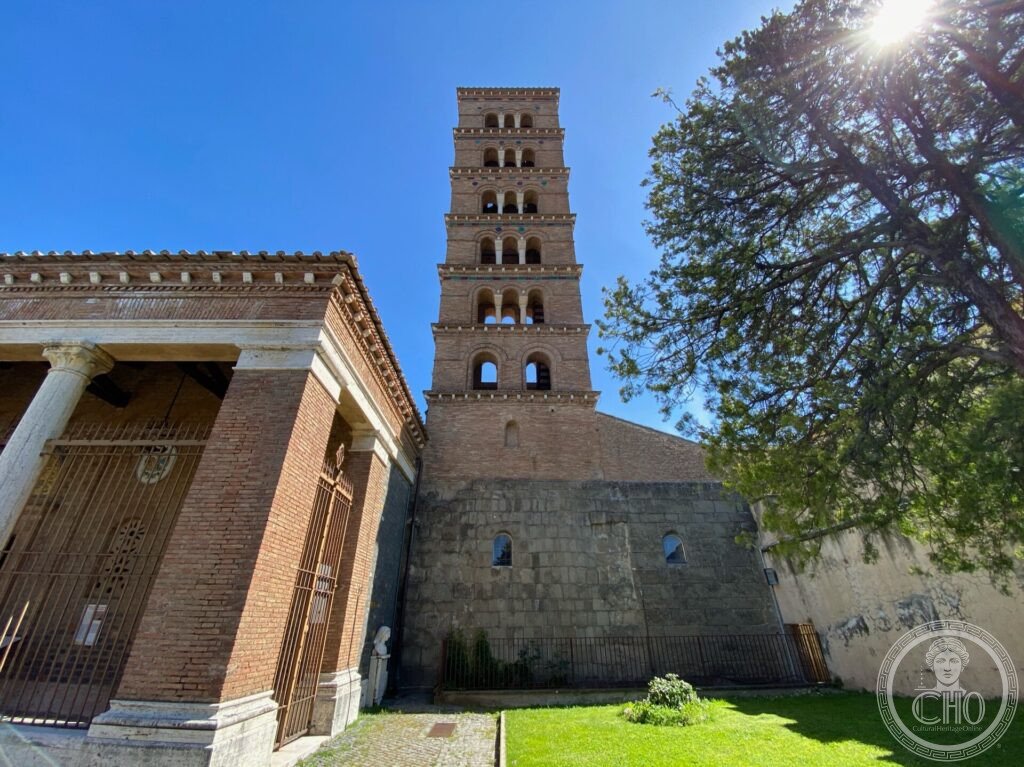
Twenty kilometres from Rome, inside a moat and bastions that make it look like a castle, there survives an abbey where the Byzantine liturgy has been sung in Greek for more than a thousand years. It was founded in 1004 by a Calabrian monk fleeing the Saracens; today it holds Domenichino’s frescoes, one of the richest libraries of Greek codices in Italy and the workshop that restored Leonardo’s Codex Atlanticus.
At a glance
The Abbey of Santa Maria di Grottaferrata — the Greek Abbey of San Nilo — sits at the edge of the Castelli Romani hills southeast of Rome. Founded in 1004 by the Calabrian Greek monk Nilus of Rossano, it is one of the oldest continuously inhabited monasteries in Italy and the last surviving house of Italo-Byzantine monasticism, following the Rule of Saint Basil and celebrating the Byzantine liturgy in Greek to this day. The fortified complex, ringed by a moat and Renaissance bastions, encloses an 11th-century church, frescoes by Domenichino, and an extraordinary library of Greek and Latin manuscripts.
Key facts
- Founded: 1004 by Saint Nilus of Rossano; completed by his disciple Saint Bartholomew, who built the first church to the Virgin
- Rite: Byzantine, in Greek; an Italo-Albanian (Greek) Catholic monastery in full communion with Rome, following the Basilian rule
- Name: from the crypta ferrata, an ancient grotto closed by an iron grille near which the monks settled
- Domenichino: the frescoes of the Farnese Chapel (Cappella di San Nilo), c. 1608–1610, narrate the lives of the founders Nilus and Bartholomew
- Fortifications: moat and bastions ordered by Cardinal Giuliano della Rovere (later Julius II), reinforced by Antonio da Sangallo the Younger
- Library: one of the richest collections of Greek and Latin manuscripts in Italy; its Book Restoration Laboratory (1931) was the first scientific lab of its kind in the country
History
Nilus of Rossano, a Calabrian monk who had fled the Arab raids of southern Italy, arrived here around 1004 on land granted by the Counts of Tusculum, seeking a permanent home for his Greek-rite community. He died soon after, and his disciple Bartholomew completed the foundation and built the church dedicated to the Assumption of the Virgin. Pope Benedict VIII confirmed the monastery’s privileges in 1024, and over the centuries the Colonna and Farnese families, cardinals and popes endowed and rebuilt it. In the 1480s Cardinal Giuliano della Rovere — the future Julius II — girded the abbey with a moat and bastions against Turkish raids, work continued by Antonio da Sangallo the Younger, giving the monastery its castle-like silhouette.
Through the Middle Ages the abbey’s scriptorium and library preserved Greek patristic and classical texts that might otherwise have been lost in the Latin West. It remains a national monument and one of the very few Eastern-rite institutions in communion with Rome — a living bridge between Byzantium and the papacy on the doorstep of the city.
What you see
You enter over a dry moat and through a fortified gatehouse into a courtyard before the 11th-century church. The facade reuses an ancient Roman sarcophagus and, above the central portal, a Byzantine mosaic lunette of the Virgin (12th century). Inside, the Farnese Chapel — the Cappella di San Nilo — holds the celebrated fresco cycle by Domenichino (c. 1608–1610), weaving the stories of the two founder-saints together with the praise of the Virgin, a high point of early-Baroque classicism. The public museum displays illuminated Greek codices, liturgical objects and archaeological finds gathered over a millennium.
The abbey’s library is among the most important repositories of ancient Greek and Latin texts in the world, with hundreds of manuscripts, several hundred incunabula and tens of thousands of printed volumes. Its Book Restoration Laboratory, founded in 1931, was the first scientific laboratory in Italy dedicated to safeguarding the written heritage; among its landmark interventions was the restoration of Leonardo da Vinci’s Codex Atlanticus.
Practical information
- Address: Corso del Popolo 128, Grottaferrata (RM)
- Visiting: the church is generally open daily; the museum is ticketed, with seasonal hours — check the abbey’s official site
- Dress code: shoulders and knees covered inside the church
- Time needed: 45–60 minutes for church and museum
Getting there
From Rome, take the regional train from Termini toward Frascati and continue to Grottaferrata, a short walk from the abbey; or the COTRAL bus from the Anagnina terminus of Metro A. By car, the Via Tuscolana (SS215) reaches Grottaferrata in about 30 minutes without traffic. GPS: 41.7854° N, 12.6669° E.
Nearby
- Frascati — town of the papal villas (Villa Aldobrandini) and the white wine of the Castelli Romani
- Tusculum — the ruined ancient city and its Roman theatre, on the hill above Grottaferrata
- Lake Albano & Castel Gandolfo — the volcanic lake and the papal summer residence
Sources
- Abbazia greca di San Nilo — official monastery and museum information
- Visit Castelli Romani — “Abbey of Saint Nilus and its Museum”
- Museum With No Frontiers (Discover Baroque Art) — the Domenichino chapel of the Holy Founders
Find it on the map
See this place and what’s around it →Historical events at this place (2)
📷 Become a Cultural Heritage Online photographer
Share your photos of places: they stay published under your name as the author. The more they're seen, the more you get noticed — and soon a contest will reward the most appreciated photos.
Log in or sign up free to add a photoIs this page about you?
This page is read by travellers and heritage enthusiasts who find it on Google. Tell us how you are connected to this place and we will take it from there.