
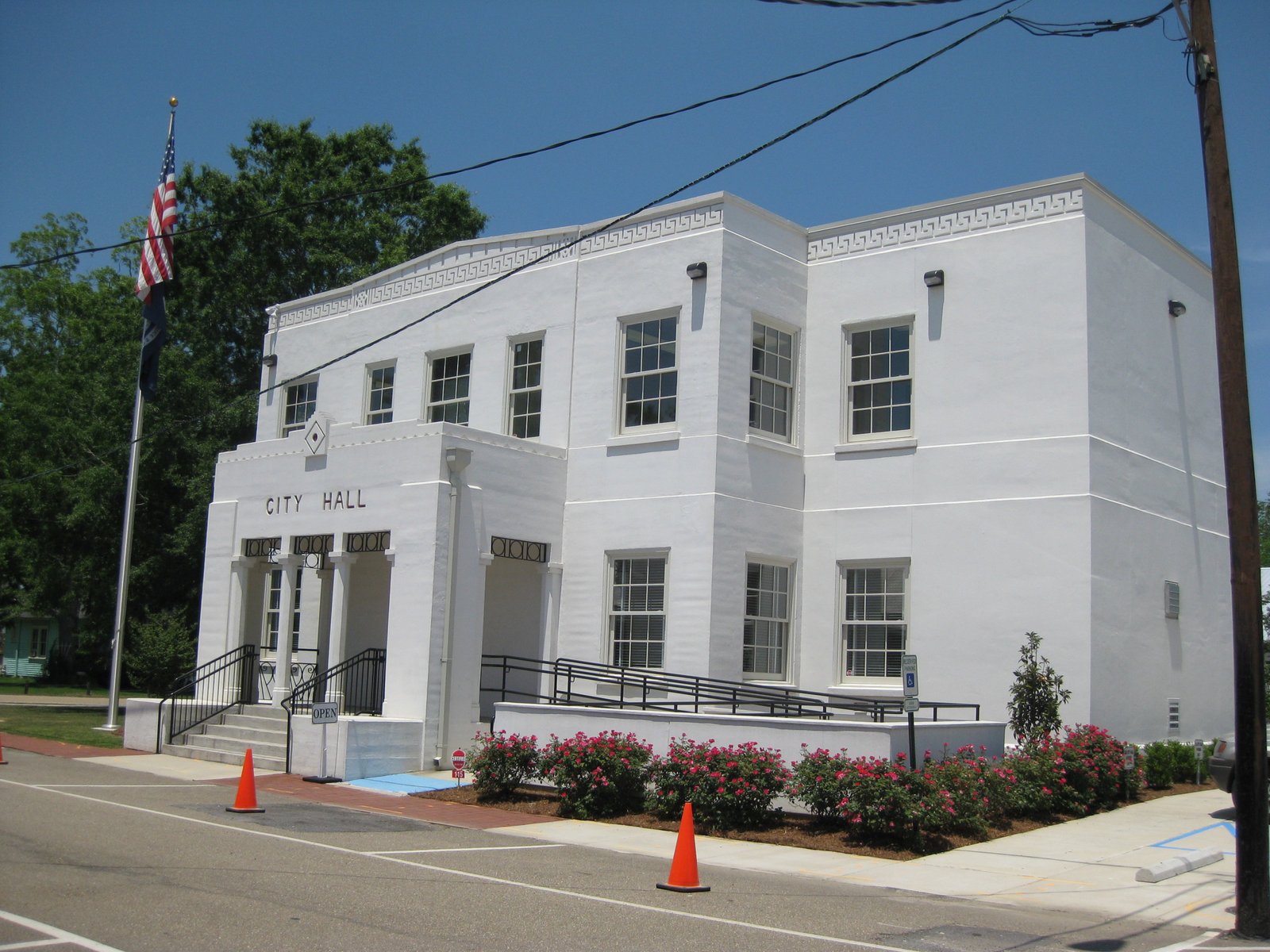
A compact two-story Art Deco building raised by the Works Progress Administration in 1940, the Old Denham Springs City Hall once housed the mayor’s offices, the parish sheriff, the public library, and the jail under one roof — a full cross-section of Depression-era civic life in a Louisiana river town now restored as a visitor and tourism center.
At a glance
The Old Denham Springs City Hall stands at 115 Mattie Street in Denham Springs, Louisiana, the seat of Livingston Parish on the Amite River east of Baton Rouge. Designed by architect E.G. Blakewood and built by the Works Progress Administration (WPA) in 1940, the two-story concrete building adopts the Art Deco aesthetic in a modest, functional key — the civic face of New Deal public works in a small Louisiana city. The building served as Denham Springs’ combined seat of local government until the 1980s, was listed on the National Register of Historic Places in 1993, and was fully restored in 2008 at a cost of $695,000. It now serves as a tourism office and gateway to the Denham Springs Antique Village district.
Key facts
- Built: 1940
- Style: Art Deco (WPA)
- Architect: E. G. Blakewood
- Builder: Works Progress Administration (WPA)
- NRHP listed: April 16, 1993 (#93000304)
- Restoration: 2008 ($695,000)
- Current use: Tourism office, Denham Springs Antique Village
- Address: 115 Mattie Street, Denham Springs, Louisiana
- GPS: 30.48545, −90.95677
History
Denham Springs developed as a railroad and agricultural town on the Amite River in the late nineteenth century, and by the 1930s it had grown into a modest city with its own civic infrastructure. The Works Progress Administration, the New Deal federal program that put unemployed Americans to work on public buildings across the country, constructed the new city hall in 1940 to a design by local architect E.G. Blakewood. The WPA’s institutional buildings of this era consistently adopted Art Deco as the idiom of progressive, forward-looking civic authority — a geometric modernism that read as both authoritative and optimistic at a moment of national hardship.
The building originally housed the full apparatus of local government in concentrated form: the mayor’s offices and the city council chambers, the offices of the parish sheriff, the public library, and, on an upper floor, the jail. This compression of civic functions into a single Art Deco block was characteristic of small-city government buildings of the WPA period. The building served as Denham Springs’ primary civic address for four decades before the city outgrew it in the 1980s. After years of disuse and a successful campaign for National Register listing in 1993, a major restoration project returned the building to active public use in 2008, rededicated on April 17 of that year. It now serves as the tourism office and welcome center for the Denham Springs Antique Village, one of Louisiana’s largest antique shopping districts.
What you see
The Denham Springs City Hall is a two-story concrete structure whose Art Deco character is expressed in the geometric simplicity of its massing and the restrained ornamental vocabulary at the entrance. WPA buildings of this scale and period generally favored a compressed, no-surplus version of the Art Deco — flat roofline, symmetrical facade, bold entrance bay with geometric detailing — without the expensive ornamental programs possible in prosperous commercial buildings of the previous decade. The Blakewood design follows this pattern, giving the building a civic solemnity that reads clearly at street level.
The 2008 restoration preserved and stabilized the historic concrete exterior and interior spaces while adapting the ground floor for public visitor use. The result is one of Louisiana’s better-preserved small-city WPA civic buildings — modest in scale but architecturally legible as a New Deal artifact, now positioned as a cultural anchor for the surrounding antique and commercial district.
Practical information
- The building serves as the tourism office for the Denham Springs Antique Village district; stop here for maps and information about the area’s antique shops and attractions.
- Exterior freely visible at all times from Mattie Street.
- Denham Springs Antique Village, one of Louisiana’s largest antique shopping areas, surrounds the building on several blocks.
Getting there
Denham Springs is located approximately 12 miles east of Baton Rouge on Interstate 12 in Livingston Parish, Louisiana. The closest major airport is Baton Rouge Metropolitan Airport (BTR), approximately 20 miles west. The city hall is in the historic downtown core, on Mattie Street near the intersection with the Florida Boulevard commercial corridor.
Nearby
- Denham Springs Antique Village — one of Louisiana’s largest antique shopping concentrations, with dozens of dealers across several downtown blocks surrounding the old city hall
- Baton Rouge — Louisiana’s state capital, 12 miles west, with the Art Deco Louisiana State Capitol (1932), the tallest state capitol in the United States
- Port Hudson State Historic Site — Civil War battlefield site on the Mississippi River, approximately 25 miles northwest, commemorating one of the longest sieges in American military history
Sources
- Wikipedia: “Denham Springs City Hall”
- National Register of Historic Places Registration Form #93000304, National Park Service, January 1993
- State of Louisiana Division of Historic Preservation, documentation for Denham Springs City Hall
- Wikimedia Commons: Denham_Springs_City_Hall.JPG, CC BY-SA 4.0, Gloverepp
Find it on the map
See this place and what’s around it →Record researched and written by Luigi De Marchi for Cultural Heritage Online, 2026.
📷 Become a Cultural Heritage Online photographer
Share your photos of places: they stay published under your name as the author. The more they're seen, the more you get noticed — and soon a contest will reward the most appreciated photos.
Log in or sign up free to add a photoIs this page about you?
This page is read by travellers and heritage enthusiasts who find it on Google. Tell us how you are connected to this place and we will take it from there.