
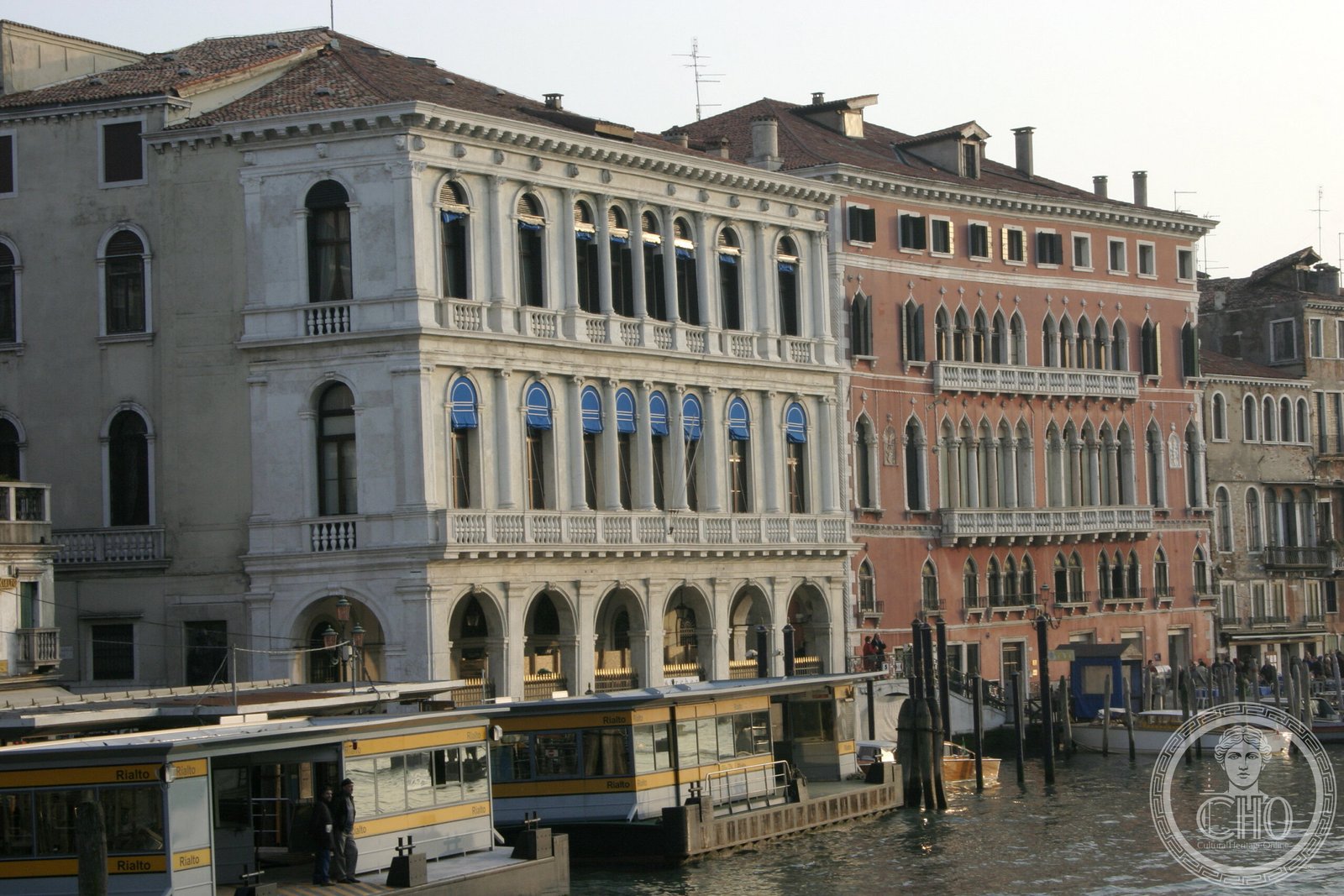
Palazzo Bembo is a fourteenth-century Venetian Gothic-Byzantine palace on the Grand Canal in Venice, situated close to the Rialto Bridge next to the Palazzo Dolfin Manin. Named after the illustrious Bembo family — one of whose members, Pietro Bembo (1470–1547), was among the most influential humanists and literary theorists of the Italian Renaissance — the palazzo is today the Venice headquarters of the European Cultural Centre (ECC), which uses its historic rooms to host exhibitions during the Venice Biennale and other international cultural events.
At a glance
- Type
- Historic palazzo; exhibition and cultural centre
- Period
- 14th century
- Style
- Venetian Gothic-Byzantine
- Location
- Grand Canal, San Marco sestiere, Venice (near Rialto Bridge)
- Coordinates
- 45.4370° N, 12.3350° E
- Current use
- European Cultural Centre Venice — exhibitions, events, residencies
Overview
Palazzo Bembo occupies a prime position on the Grand Canal at the most commercially and architecturally dense stretch of Venice’s main waterway, between the Rialto Bridge and the Ca’ d’Oro. It was built in the Gothic-Byzantine hybrid style that characterises many Venetian palaces of the trecento, combining the pointed arches of Gothic influence with the surface patterning and brick-and-stone interplay inherited from Byzantine Adriatic architecture. The building’s association with the Bembo family connects it to one of Venice’s most distinguished intellectual dynasties, and Pietro Bembo’s codification of Tuscan (Petrarchan) Italian as the literary standard had lasting effects on the Italian language.
History
The Bembo family were among Venice’s historic patriciate and had resided on the Grand Canal since at least the fourteenth century. Pietro Bembo, born in the palazzo in 1470, became secretary to Pope Leo X, a cardinal under Paul III, and the author of the influential Prose della volgar lingua (1525), which established Petrarch and Boccaccio as the supreme models for Italian literary prose and verse. After the decline of the Bembo line, the palace passed through successive private ownerships and underwent restoration in the modern period. The European Cultural Centre, an independent non-profit founded in 1989, established its Venice base in the palazzo and has since used it as an exhibition venue parallel to the Venice Biennale.
What you see
The Grand Canal façade shows the palazzo’s Gothic-Byzantine origins: a central loggia of pointed arched windows on the piano nobile flanked by solid masonry with small single-light openings, all above the water-level fondamenta. The interior rooms retain elements of their historic decoration and are used during exhibitions to show contemporary art in dialogue with the palace’s medieval and Renaissance fabric. The ECC’s exhibitions typically coincide with the Venice Biennale (Art and Architecture, alternate years) and draw international artists, curators, and architects to the Rialto quarter. The building also hosts lectures, residencies, and publications on contemporary culture and architecture.
Cultural significance
Palazzo Bembo combines two layers of cultural significance: the architectural heritage of Venetian Gothic-Byzantine palace design and the intellectual legacy of Pietro Bembo, whose linguistic and literary theories helped shape the standard Italian language as it developed from the Renaissance onward. As a contemporary exhibition space, the building demonstrates how Venice’s historic palazzo stock can be given living cultural purpose beyond tourism, contributing to the city’s identity as an active centre for international art and ideas.
Practical information
- Address
- Riva del Carbon 4793, 30125 Venice (San Marco)
- Opening hours
- Open during exhibitions only (principally during Venice Biennale periods) — check the European Cultural Centre website for programming
- Admission
- Generally free during open exhibition periods
- Accessibility
- Ground floor accessible from the fondamenta; upper floors via historic staircase
Getting there
The palazzo is on the Grand Canal a short walk from the Rialto Bridge. The nearest vaporetto stop is Rialto (lines 1 and 2), approximately three minutes on foot along the Riva del Carbon. From San Marco, walk north across the Rialto Bridge and turn left along the canal — approximately 15 minutes. Water taxis can dock directly at the palazzo’s fondamenta entrance.
Sources & resources
See the place
Find it on the map
See this place and what’s around it →Historical events at this place (2)
📷 Become a Cultural Heritage Online photographer
Share your photos of places: they stay published under your name as the author. The more they're seen, the more you get noticed — and soon a contest will reward the most appreciated photos.
Log in or sign up free to add a photoIs this page about you?
This page is read by travellers and heritage enthusiasts who find it on Google. Tell us how you are connected to this place and we will take it from there.