
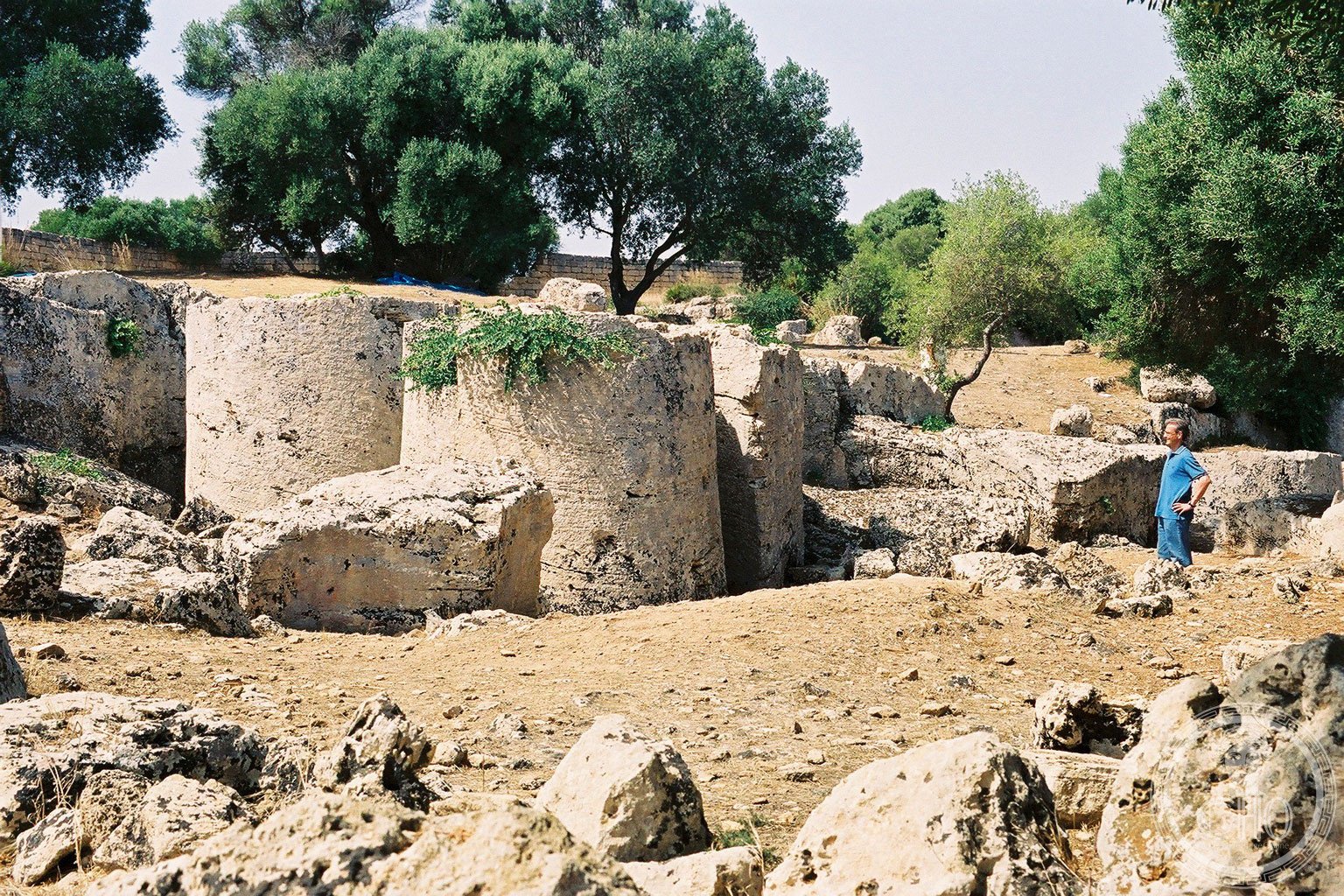
The Quarries of Cusa — known in Italian as Cave di Cusa or Rocche di Cusa — are an ancient stone quarry near Campobello di Mazara in the Province of Trapani, Sicily. Active from the first half of the sixth century BC, the quarry supplied the limestone used to construct the great temples of the nearby Greek city of Selinunte. Work stopped abruptly in 409 BC when Selinunte was sacked by Carthage, and the site was never resumed — leaving drums, capitals, and column shafts frozen in mid-extraction, making it one of the most vivid records of ancient stonecutting technique in the Mediterranean world.
At a glance
- Type
- Ancient Greek stone quarry — archaeological zone
- Period
- Active c. 550–409 BC; abandoned after Carthaginian sack of Selinunte
- Style
- Doric column production for Selinuntine temples
- Location
- 3 km south of Campobello di Mazara, Province of Trapani, Sicily
- Coordinates
- 37.6190° N, 12.7243° E
Overview
Stretching 1.8 kilometres along an east–west ridge, the Quarries of Cusa represent the primary stone source for Selinunte’s ambitious temple-building programme — one of the largest concentrations of Doric temples in the ancient world. The quarry’s sudden abandonment has preserved the working face almost exactly as it was on the day Carthaginian forces overwhelmed Selinunte, offering an unparalleled snapshot of Greek construction logistics. Today it is an official Sicilian Archaeological Zone and a regularly visited open-air museum.
History
Quarrying began here in the early sixth century BC to meet the demand generated by Selinunte’s expanding sanctuary districts, which eventually included at least seven major temples. Stonemasons cut column drums, capitals, and architrave blocks directly from the bedrock, then shaped them to near-final form before transporting them roughly 12 kilometres north-west to the city. In 409 BC, the Carthaginian general Hannibal Mago led a massive assault on Selinunte; the city fell within nine days and its population was destroyed or enslaved, ending all construction activity permanently.
What you see
Visitors walk among dozens of column drums at various stages of extraction: some still attached to the parent rock by narrow stone bridges (the final cut left for transport), others lying free where they fell. Several nearly complete column shafts — up to 2 metres in diameter — remain prone on the quarry floor, precisely as the workers abandoned them. Carved channel marks, wedge slots, and tool traces are still legible on the limestone surface, providing direct evidence of the extraction method used by ancient Greek masons. The pastoral setting amid olive groves adds to the site’s atmospheric quality.
Cultural significance
Cave di Cusa is considered one of the most important ancient quarry sites in the Mediterranean, valued by archaeologists and historians of technology alike for the unmediated view it offers into Greek building practice. Together with Selinunte, it forms a paired heritage landscape illustrating the full supply chain of monumental Doric architecture, from raw stone to finished temple.
Practical information
- Address
- Contrada Cave di Cusa, Campobello di Mazara, 91021 Trapani TP
- Hours
- Open daily; check official Parco Archeologico di Selinunte website for current schedule
- Admission
- Managed jointly with Selinunte Archaeological Park; check official website for tickets
Getting there
By car from Trapani or Marsala, take the SP53 towards Campobello di Mazara and follow signs for Cave di Cusa (approximately 3 km south of the town centre). The nearest railway station is Castelvetrano, roughly 12 km east, with bus connections to Campobello. The nearest major airport is Palermo Falcone-Borsellino (PMO), about 110 km north-east, or Trapani Birgi (TPS), approximately 60 km north-west.
Sources & resources
Find it on the map
See this place and what’s around it →📷 Become a Cultural Heritage Online photographer
Share your photos of places: they stay published under your name as the author. The more they're seen, the more you get noticed — and soon a contest will reward the most appreciated photos.
Log in or sign up free to add a photo