
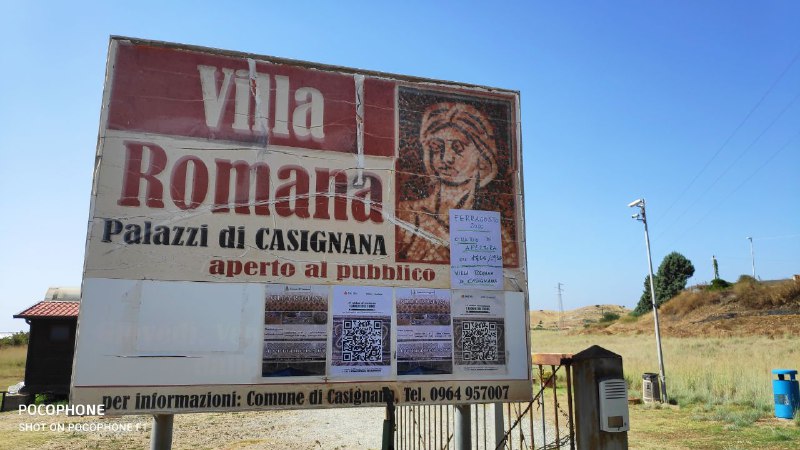
The Roman Villa of Casignana is a late-Roman residential complex in the municipality of Casignana, in the Locride area of Calabria, renowned for its exceptional polychrome mosaic floors. Dated to the third and fourth centuries AD, the villa represents one of the most significant examples of Roman aristocratic rural architecture in southern Italy, with floor mosaics comparable in quality to the famous Villa Romana del Casale in Sicily.
At a glance
- Type
- Roman villa rustica / villa urbana
- Period
- 3rd–4th century AD (late Roman Imperial)
- Style
- Late Roman Imperial residential architecture with figured polychrome mosaics
- Location
- Casignana, City of Reggio Calabria, Calabria, Italy
- Coordinates
- 38.1190° N, 16.1587° E
Overview
The Villa of Casignana occupies a commanding position in the Locride hinterland of Calabria, a territory known in antiquity as Bruttium and deeply marked by Greek colonial and Roman Imperial culture. Excavations from the 1950s onward revealed a large residential complex organised around a central peristyle court, with thermal baths and reception rooms whose floors carry elaborate polychrome mosaic compositions. The villa is now partially open to the public as an archaeological park administered by the Calabria regional cultural heritage authority.
History
The Locride region was colonised by Greek settlers in the eighth century BC, and the city of Locri Epizefiri — a short distance to the south — remained one of the most important Greek cities in Magna Graecia. After Roman conquest in the third century BC, the territory was reorganised and agricultural estates developed across the hinterland. The villa at Casignana was constructed during the prosperous late Imperial period, likely belonging to a member of the Roman aristocracy or senatorial class who combined agricultural production with luxurious residential quarters. The complex fell into disuse during the late antique period, its materials gradually reused by later populations.
What you see
The site’s most celebrated feature is its mosaic flooring: polychrome panels depicting mythological and hunting scenes, geometric borders and figured compositions covering several rooms, including the thermal bath suite. The central peristyle garden area, surrounded by a colonnaded walkway, gives a sense of the villa’s generous spatial layout. Protective shelters erected over the excavated areas allow visitors to observe the mosaics in situ, while informational panels narrate the villa’s history and the significance of its iconographic programme.
Cultural significance
The Villa of Casignana is considered one of southern Italy’s most important late-Roman archaeological sites, demonstrating that the extreme south of the Italian peninsula was home to sophisticated aristocratic culture in the third and fourth centuries AD. Its mosaics are a primary document of late Imperial artistic production outside the major urban centres, placing Calabria within the broader Mediterranean tradition of villa culture that flourished from Britain to North Africa.
Practical information
- Address
- Casignana, 89030 RC, Calabria
- Admission
- Paid entry; check current tariffs on the official site
Getting there
Casignana is best reached by car from Reggio Calabria (approximately 80 km north-east on the SS106 coastal highway, then inland via the SP). The nearest railway station is Siderno on the Reggio Calabria–Taranto line; from Siderno, a car or taxi is necessary to reach the villa. Local bus connections are limited.
Sources & resources
Find it on the map
See this place and what’s around it →📷 Become a Cultural Heritage Online photographer
Share your photos of places: they stay published under your name as the author. The more they're seen, the more you get noticed — and soon a contest will reward the most appreciated photos.
Log in or sign up free to add a photo