
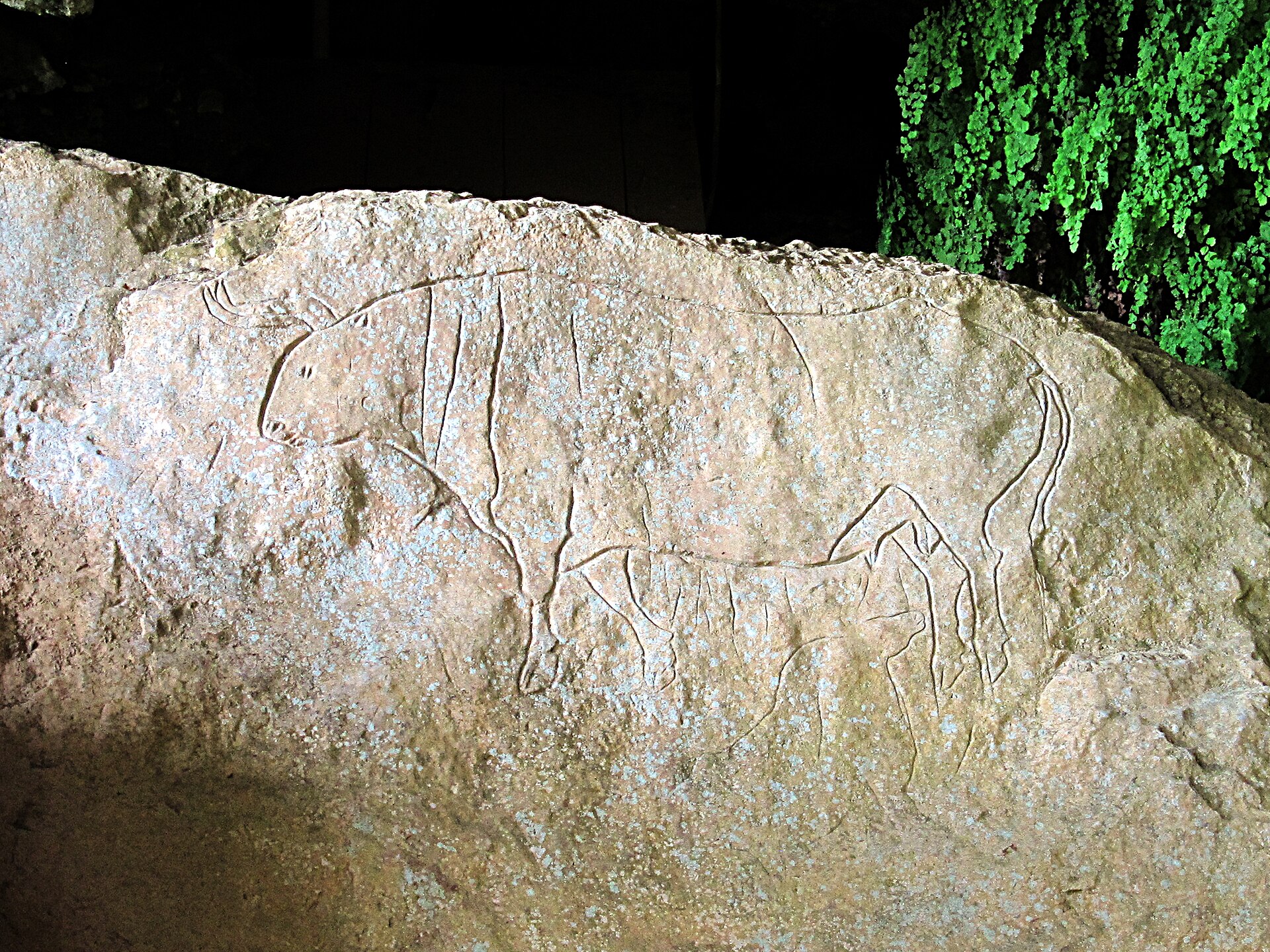
Romito Cave (Grotta del Romito) is a prehistoric cave site located near Papasidero in the province of Cosenza, Calabria, celebrated for one of the finest examples of Palaeolithic rock art in all of southern Europe. Carved into the limestone wall of the cave is a monumental bas-relief of an aurochs (wild bull) dating to approximately 12,000 BC, remarkable both for its scale — over a metre in length — and for the naturalistic confidence of its execution. The cave also contains a rare carved human figure and has yielded human skeletal remains, making it a key site in the study of Upper Palaeolithic culture in Italy.
At a glance
- Type
- Palaeolithic cave with rock engravings
- Period
- c. 12,000 BC (Upper Palaeolithic, Epigravettian culture)
- Style
- Palaeolithic bas-relief rock engraving
- Location
- Papasidero, Province of Cosenza, Calabria, Italy
- Coordinates
- 39.9107° N, 15.9303° E
Overview
Romito Cave sits within a limestone gorge carved by the Lao River near Papasidero in northern Calabria. The cave was used by Upper Palaeolithic hunter-gatherers of the Epigravettian culture, who left behind both artistic and funerary evidence of their presence. The site’s centrepiece is an engraved aurochs of exceptional quality, but the cave system also contains a second bovid engraving, a schematic human figure, and the skeletal remains of at least two individuals — one of whom shows signs of a debilitating bone condition, interpreted by some researchers as evidence of social care within Palaeolithic communities.
History
The cave was brought to scholarly attention in the early twentieth century after local awareness of the engravings, and systematic studies confirmed the reliefs’ Palaeolithic date through stylistic analysis and stratigraphic excavation. The aurochs engraving, the largest and most accomplished of the images, is attributed to the Epigravettian phase of the Italian Upper Palaeolithic, a tradition contemporary with the later stages of the Franco-Cantabrian cave art province. The human skeletal remains found in association with the site added a funerary dimension to its significance, and the individual with the bone pathology became one of the most discussed cases in the archaeology of prehistoric disability and social behaviour.
What you see
The principal engraving — the monumental aurochs — is carved directly into the limestone wall near the cave entrance, where natural light once reached it. The animal is rendered in confident, flowing lines that convey musculature and movement with a mastery comparable to the great painted caves of France and Spain. The secondary engravings, including the schematic human figure, are nearby and reward close inspection. The setting within the Lao River gorge adds natural grandeur to the visit.
Cultural significance
Romito Cave is one of the most important Palaeolithic art sites in Italy and among the finest in the Mediterranean, demonstrating that the creative and cultural impulses of Upper Palaeolithic Europe extended deep into the Italian south. The combination of monumental animal art, human representation and funerary use makes it uniquely multi-layered as an archaeological site.
Practical information
- Address
- Papasidero, 87020 CS, Calabria
- Admission
- Check current tariffs on the official site; guided visits are typically required
Getting there
Papasidero is in northern Calabria, best reached by car from Cosenza (approximately 100 km via the A2 motorway and then the SS18) or from Praia a Mare on the Tyrrhenian coast (approximately 25 km inland). The nearest railway station is Praia a Mare on the Reggio Calabria–Naples line; car hire or taxi is necessary from there.
Sources & resources
See the place
Find it on the map
See this place and what’s around it →📷 Become a Cultural Heritage Online photographer
Share your photos of places: they stay published under your name as the author. The more they're seen, the more you get noticed — and soon a contest will reward the most appreciated photos.
Log in or sign up free to add a photo