
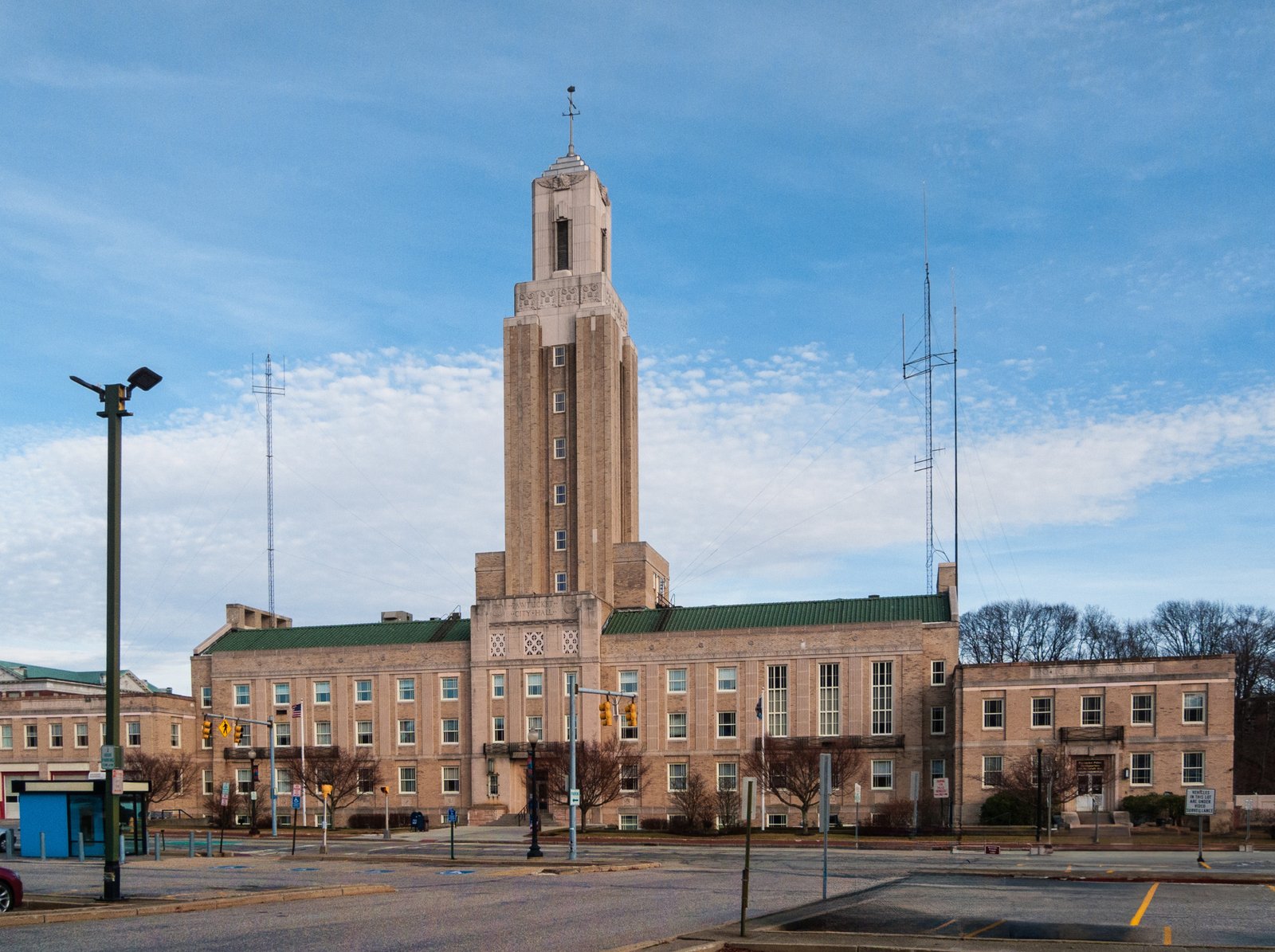
John F. O’Malley’s 1936 Art Deco civic monument anchors the center of Pawtucket—Rhode Island’s second city and the birthplace of American industrial manufacturing—with a limestone tower that still houses the city’s municipal government today.
At a glance
Pawtucket City Hall at 137 Roosevelt Avenue in downtown Pawtucket, Rhode Island is an Art Deco municipal building completed in 1936, with construction begun in 1933. Designed by Providence-based architect John F. O’Malley, the building combines a civic tower with wings that house the city’s central fire station on the north and police headquarters on the south—a mixed-function civic complex that unified several city services under a single architectural statement. Listed on the National Register of Historic Places in 1983, the building serves the city government of Pawtucket, Rhode Island’s second-largest city and the site of Slater Mill (1793), considered the cradle of the American Industrial Revolution. The pairing of an Art Deco city hall with the city’s industrial heritage makes Pawtucket one of the most complete narratives of American urban history along a single main street.
Key facts
- Completed: 1936 (construction began 1933)
- Architect: John F. O’Malley (Providence, RI)
- Style: Art Deco
- Address: 137 Roosevelt Avenue, Pawtucket, RI 02860
- Functions: Municipal government, central fire station, police headquarters
- NRHP: ref. 83003838, listed 18 November 1983
- Current use: Active Pawtucket city hall
History
Pawtucket’s claim on American industrial history begins at Slater Mill in 1793, when Samuel Slater and his partners established the first successful water-powered cotton-spinning textile mill in the United States, transplanting British manufacturing technology that transformed the American economy over the following century. The city that grew from that mill became one of the most intensely industrialized small cities in New England, and by the early twentieth century Pawtucket was the principal producer of jewelry, textiles, and wire products in Rhode Island. The city hall that O’Malley designed in 1933 and completed in 1936 was a civic statement by a confident industrial city: the Art Deco style it chose was the architectural language of the modern American metropolis, of Rockefeller Center and the Empire State Building, and Pawtucket’s adoption of it signaled the city’s identification with the dynamism and confidence of twentieth-century American industrial culture.
The New Deal years in which the building was constructed were years of stress for Pawtucket, as for every American industrial city, but the decision to proceed with a full-scale Art Deco civic monument rather than a more modest Depression-era structure reflected the city leadership’s determination to invest in institutional permanence. O’Malley’s program for the building was ambitious in its incorporation of the fire and police functions alongside the civic administration, creating a unified public safety and government campus that rationalized city operations while presenting a unified face to Roosevelt Avenue. The building’s NRHP listing in 1983 recognized both its architectural merit and its place in Pawtucket’s civic history, and it continues to function as the seat of city government nearly ninety years after its completion.
What you see
The facade of Pawtucket City Hall presents the Art Deco idiom in its civic register: a symmetrical limestone composition organized around a central tower that gives the building vertical authority on Roosevelt Avenue, with wings extending to either side in the horizontal composition that the Moderne idiom favored for civic buildings of this type. O’Malley deployed the decorative vocabulary of the period—the incised geometric ornament, the simplified pilasters, the stepped crown—in a register calibrated for a city hall rather than a commercial skyscraper, producing a building that reads as substantial and permanent without the theatrical scale of the great urban landmarks of the period.
The building materials are the high-quality limestone that New England civic architecture demanded in the Art Deco era, and the surface weathering of nine decades gives the facade a warmth and texture that the original polished stone would not have possessed. The integration of the fire station and police headquarters wings into a single symmetrical composition is visible in the facade organization, where the three functions are articulated as distinct but unified volumes under a single architectural rule.
Practical information
- Current use: Active city hall; open during normal municipal office hours
- Exterior: Freely viewable from Roosevelt Avenue at any time
- Interior: Lobby accessible during business hours; council chambers may be open to the public during meetings
- Photography: Exterior from public sidewalk freely permitted
- Time needed: 15–20 minutes for exterior; 30–45 minutes combined with nearby Slater Mill
Getting there
Pawtucket City Hall is at 137 Roosevelt Avenue in downtown Pawtucket, about a 15-minute drive north of downtown Providence via I-95 North. T.F. Green Providence Airport is 8 miles south; Providence Station (Amtrak/MBTA) is 3 miles south. The MBTA commuter rail Pawtucket/Central Falls Station is within walking distance. Pawtucket is immediately north of Providence across the Seekonk River; driving from Boston takes approximately 45 minutes via I-95 South.
Nearby
- Slater Mill (1793) — America’s first successful water-powered textile mill, now a museum and NRHP landmark, 0.4 miles south at Roosevelt Avenue and Slater Street
- Pawtucket Armory (1895) — Romanesque Revival state armory, one block from City Hall on Exchange Street
- McCoy Stadium (1942) — Minor league baseball park, 0.7 miles north
- Providence, Rhode Island — State capital and Brown University campus, 15 minutes south; extensive concentration of Federal Hill, College Hill, and Benefit Street historic architecture
Sources
- Wikipedia, “Pawtucket City Hall” — primary narrative source
- National Register of Historic Places, ref. 83003838 (18 November 1983)
- Wikimedia Commons, Pawtucket_City_Hall,_Rhode_Island.jpg (Kenneth C. Zirkel, CC BY-SA 4.0, 2018)
Find it on the map
See this place and what’s around it →Record researched and written by Luigi De Marchi for Cultural Heritage Online, 2026.
📷 Become a Cultural Heritage Online photographer
Share your photos of places: they stay published under your name as the author. The more they're seen, the more you get noticed — and soon a contest will reward the most appreciated photos.
Log in or sign up free to add a photoIs this page about you?
This page is read by travellers and heritage enthusiasts who find it on Google. Tell us how you are connected to this place and we will take it from there.