
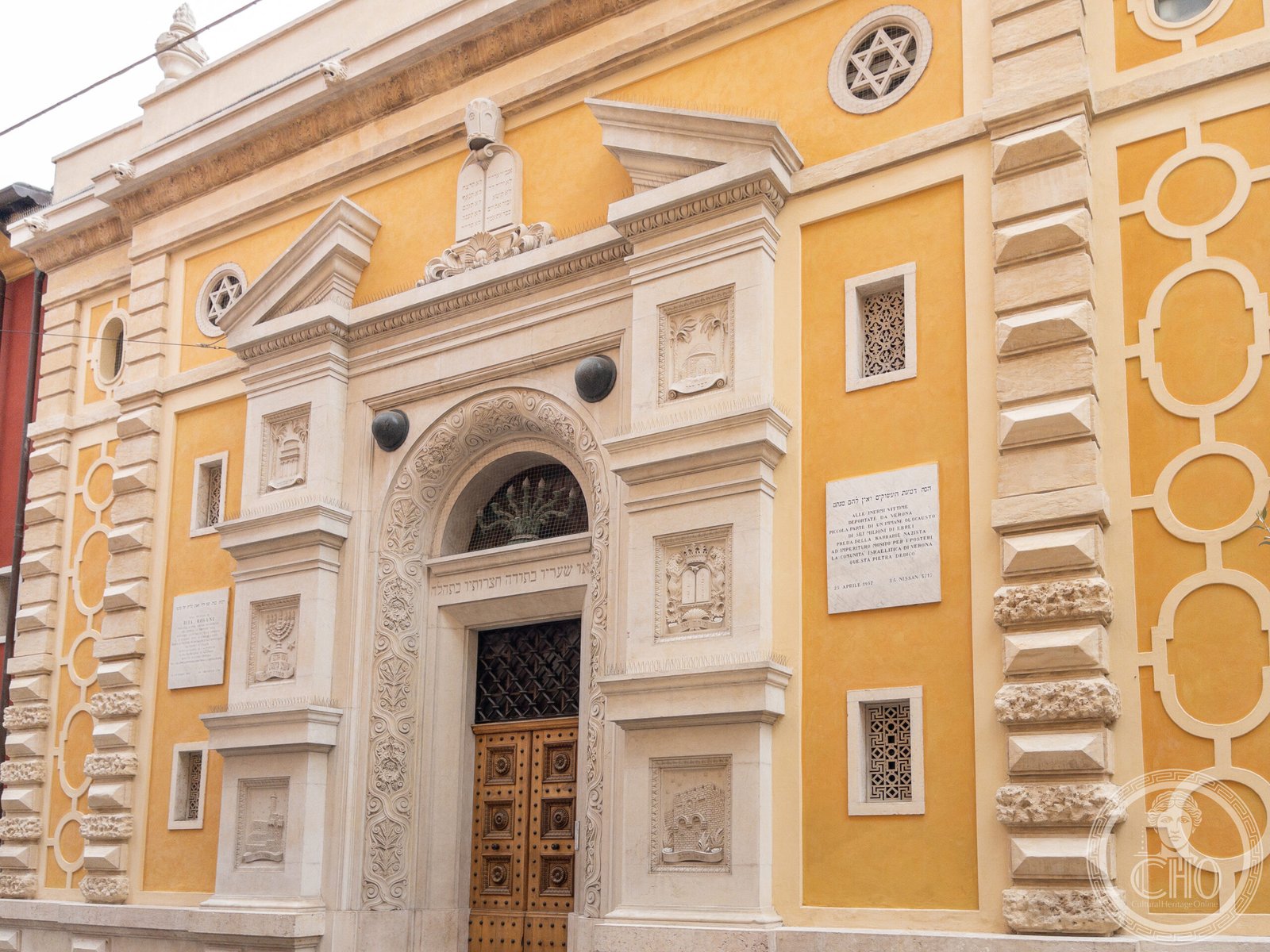
Jewish Synagogue of Verona
The Jewish Synagogue of Verona is the principal place of worship of Verona’s Jewish community, located within the historic Ghetto quarter established in the 16th century. The current building dates from the 18th century and is notable for its refined interior decorative programme combining Baroque and Neoclassical elements. It stands as a testimony to centuries of Jewish presence in Verona and to the community’s cultural vitality during the period of the Serenissima Republic of Venice.
At a glance
- Type
- Synagogue / Jewish heritage monument
- Period
- Jewish community in Verona documented from the 10th century; current synagogue building 18th century
- Style
- Baroque-Neoclassical interior; discrete street facade
- Location
- Via Portici 3, 37121 Verona VR, Italy (former Ghetto quarter)
- Coordinates
- 45.4421° N, 10.9968° E
Overview
The Verona Synagogue sits at the heart of the city’s former Jewish Ghetto, established in 1600 under Venetian rule and concentrated around Via Portici and the adjacent streets near the Piazza delle Erbe. The building presents a deliberately unassuming street facade, a common feature of ghetto-era synagogues across northern Italy, concealing an ornate and carefully crafted interior. It remains an active place of worship for Verona’s small but historic Jewish community.
History
Jews have lived in Verona since at least the 10th century, with documented moneylending and commercial activity through the medieval period under various condotte agreements. During Venetian rule, Verona’s Jewish community was formally confined to the Ghetto from 1600, a network of streets that could be locked at night. The current synagogue was built in the 18th century to replace earlier prayer spaces within the Ghetto buildings. Following emancipation after 1866, when Verona joined unified Italy, the community expanded but the historic synagogue remained the community’s focal point. The community suffered devastating losses during the Nazi occupation of 1943–1945.
What you see
The synagogue interior follows the Italian rite layout with a central bimah (raised reading platform) and the Aron HaKodesh (ark) on the eastern wall. The decorative programme features gilded woodwork, carved marble, and painted vaults in a restrained Baroque-Neoclassical idiom characteristic of Veneto Jewish interiors of the 18th century. A small museum within the building preserves Torah scrolls, silver ritual objects, and textile furnishings documenting centuries of community life. The former Ghetto streets outside retain their historic urban morphology, recognisable by the narrowness and the traces of former gate positions.
Cultural significance
The Verona Synagogue is one of a network of historic synagogues in the Veneto region — alongside Venice, Padua, and Mantua — that collectively represent the cultural and artistic heritage of Italian Jewry under the Republic of Venice. Its preservation testifies to a plurisecular tradition of Jewish intellectual and commercial life in one of Italy’s greatest Renaissance cities. The site is listed among the monuments of Jewish Italy protected under the historic heritage framework of the Union of Italian Jewish Communities.
Practical information
- Address
- Via Portici 3, 37121 Verona VR, Italy
- Visits
- Guided visits available; contact the Jewish Community of Verona in advance. Check official website for current schedule.
- Admission
- Donation suggested
Getting there
The synagogue is located in the historic city centre, approximately 5 minutes on foot from Piazza delle Erbe. From Verona Porta Nuova railway station, take bus lines 11, 12, or 13 to the city centre (approx. 15 minutes), or walk in 20 minutes. From the Arena di Verona, walk north through Via Mazzini for approximately 7 minutes. On-street parking is limited; use Piazza Arsenale or Piazza della Cittadella parking areas.
Sources & resources
Find it on the map
See this place and what’s around it →📷 Diventa un fotografo di Cultural Heritage Online
Condividi le tue foto dei luoghi: restano pubblicate con la tua firma come autore. Più vengono viste, più ti fai conoscere — e presto un concorso premierà le foto più apprezzate.
Accedi o registrati gratis per aggiungere una fotoDo you manage this place?
This page is read by travellers and heritage enthusiasts who find it on Google. Keep it accurate — and make it work for you. Free for non-profit heritage institutions.