
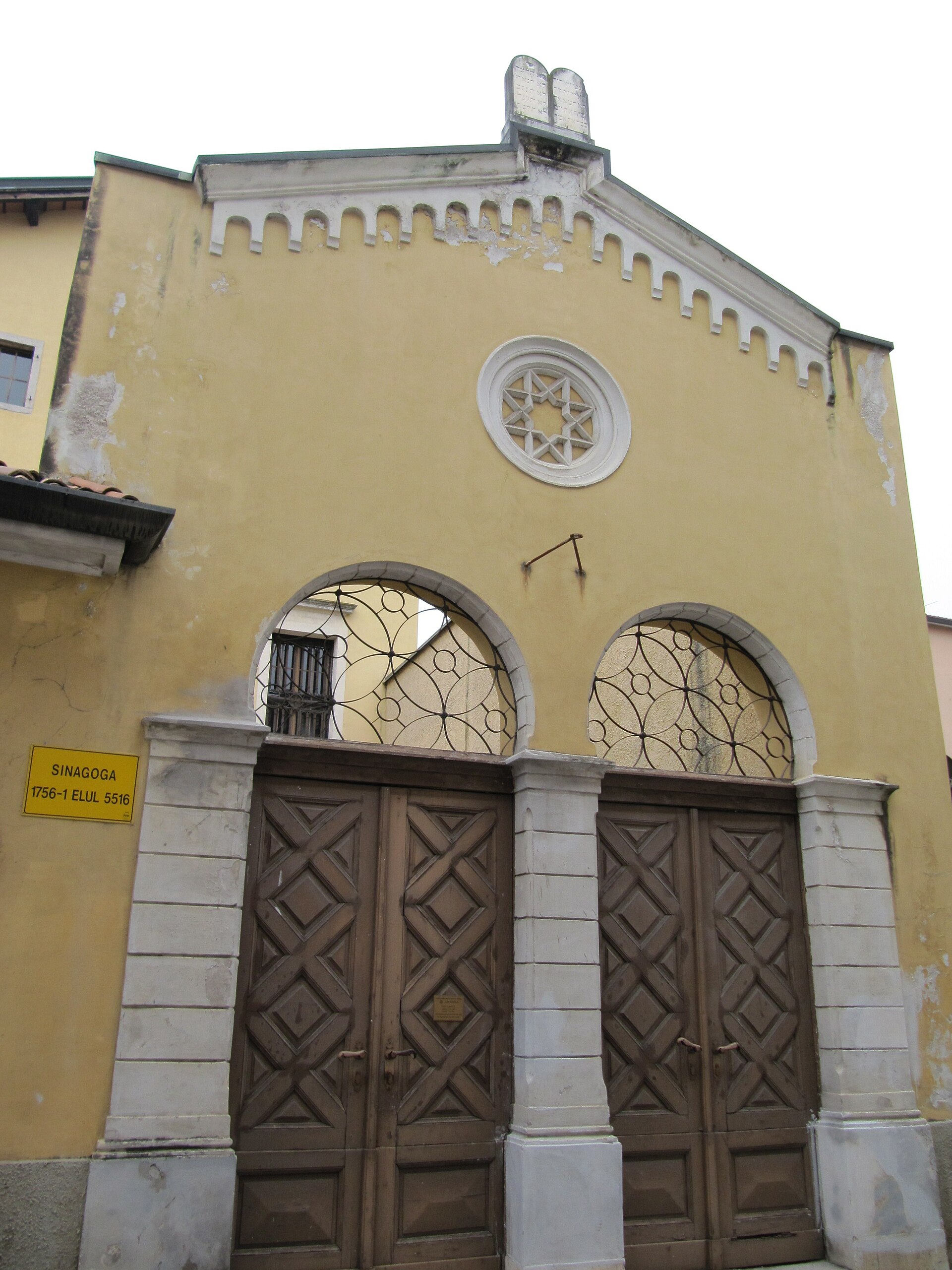
The Synagogue of Gorizia is an 18th-century Jewish place of worship in Gorizia, a border city in Friuli-Venezia Giulia that historically passed between Habsburg Austria and Italy, and whose Jewish community reflected the cosmopolitan character of the Habsburg frontier. One of the relatively well-preserved synagogues of the Friulian-Venetian Jewish tradition, it stands as a monument to the deep roots of Jewish settlement in the northeastern Italian borderlands and to the distinctive Ashkenazic-Sephardic hybrid culture that developed there under centuries of Austrian rule.
At a glance
- Type
- Jewish synagogue (place of worship and community monument)
- Period
- 18th century; community present in Gorizia from the 16th century
- Style
- Central European synagogue architecture with interior decorative elements
- Location
- Gorizia, Friuli-Venezia Giulia, Italy
Overview
Gorizia’s synagogue serves as the principal monument of a Jewish community that flourished under Habsburg administration from the 16th century onwards, benefiting from the relative tolerance extended to Jewish merchants and financiers in the Empire’s commercial hubs. The building reflects the Central European synagogue typology characteristic of communities under Habsburg rule, blending sobriety of exterior with interior decorative richness. Gorizia today, divided between Italy and Slovenia since 1947 and reunited as a European cross-border cultural capital, lends the synagogue an additional layer of historical resonance as a site of borderland identity.
History
Jews settled in Gorizia from at least the 16th century, when the city was a thriving commercial centre under Habsburg governance connecting the Adriatic to Central Europe. The community established a formal organisation and constructed a synagogue in the 18th century as its numbers and prosperity grew, occupying a position typical of frontier Jewish communities: economically active, culturally distinct, and dependent on the protection of rulers whose interests aligned with trade. The 20th century brought the community’s devastating diminution through emigration, the Fascist racial laws of 1938, and the Holocaust; the synagogue remains as a monument to a community that can no longer fill it.
What you see
The synagogue’s exterior follows the discreet urban typology common to European Jewish places of worship built in periods of toleration but not full emancipation, with a street-facing facade that does not immediately announce its function. The interior preserves the characteristic elements of the Ashkenazic rite: the raised bimah (reading platform), the Aron Kodesh (Torah ark) facing Jerusalem, and the women’s gallery above. Decorative elements, inscriptions in Hebrew, and historic furnishings document the aesthetic and liturgical culture of the community across the 18th and 19th centuries. The building is managed with attention to both its religious significance and its role as a heritage site.
Cultural significance
The Synagogue of Gorizia is an important monument in the network of northeastern Italian Jewish heritage sites, a network that includes Trieste’s Great Synagogue, the synagogues of the Veneto, and the sites of the former Friulian communities. Its location in a city that embodied the Habsburg ideal of multiethnic coexistence — and that was violently divided in 1947 — gives the building a historical weight that transcends its architectural scale. In 2025 Gorizia and Nova Gorica were designated the European Capital of Culture, bringing renewed attention to the borderland’s layered heritage.
Practical information
- Address
- Gorizia, 34170 GO, Friuli-Venezia Giulia
- Coordinates
- 45.9491° N, 13.6260° E
- Hours
- Check the official website or local tourist office for current visiting conditions; access may be by appointment
Getting there
Gorizia is served by rail from Trieste (approximately 40 minutes) and from Udine. Trieste Airport (Friuli Venezia Giulia) is the nearest international airport, approximately 45 km away. The city centre, where the synagogue is located, is compact and walkable from the railway station. Cross-border connections to Nova Gorica (Slovenia) make the city easily accessible from the Ljubljana direction as well.
Sources & resources
See the place
Find it on the map
See this place and what’s around it →📷 Become a Cultural Heritage Online photographer
Share your photos of places: they stay published under your name as the author. The more they're seen, the more you get noticed — and soon a contest will reward the most appreciated photos.
Log in or sign up free to add a photoIs this page about you?
This page is read by travellers and heritage enthusiasts who find it on Google. Tell us how you are connected to this place and we will take it from there.