
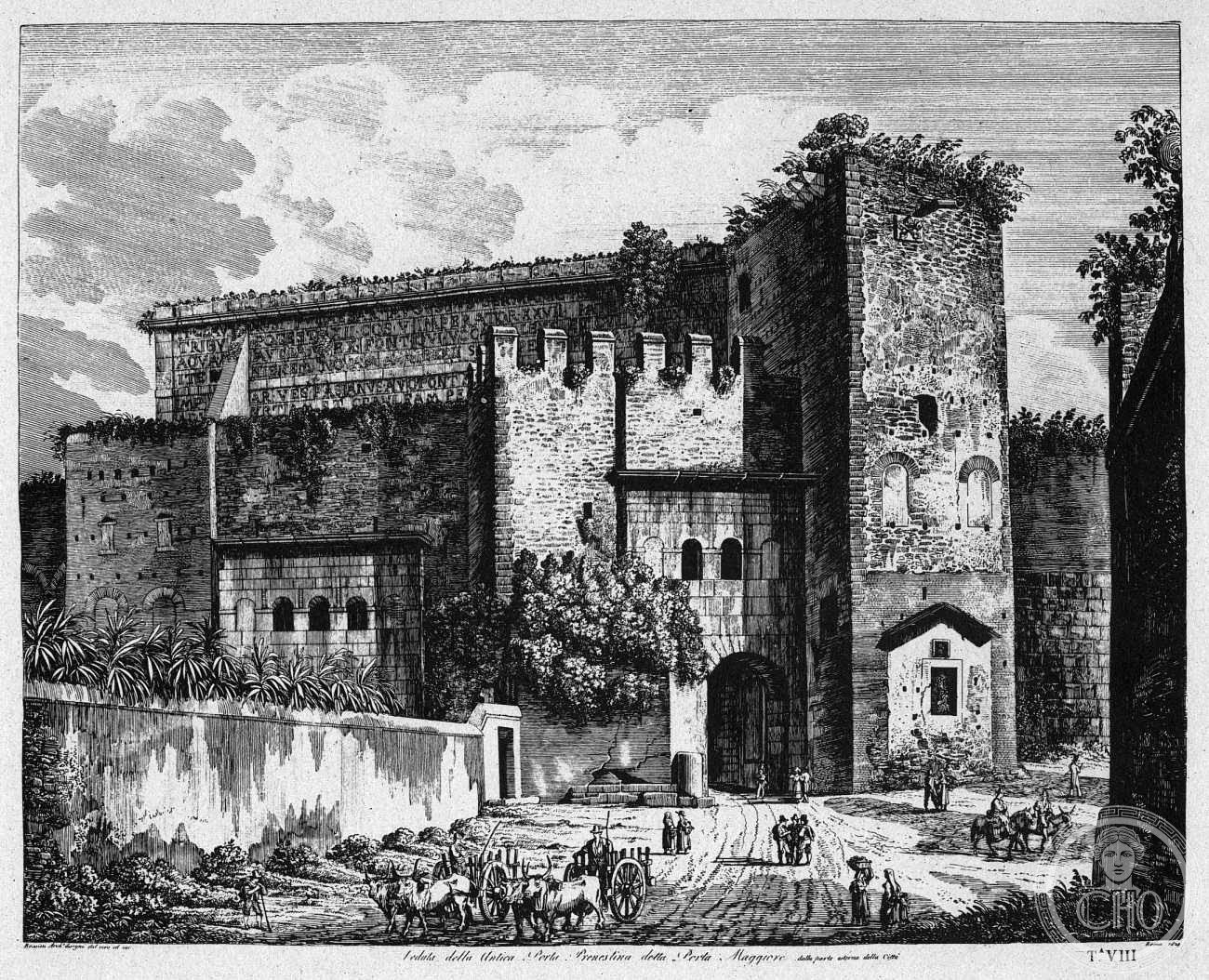
Porta Maggiore is one of the most imposing ancient monuments surviving in Rome, originally built in AD 52 by Emperor Claudius not as a city gate but as a monumental archway carrying two branches of the Aqua Claudia and Anio Novus aqueducts over the Via Praenestina and Via Labicana. Only later incorporated into the Aurelian Walls in the 3rd century AD, the double-arched travertine structure stands at the eastern edge of historic Rome and remains among the best-preserved examples of Roman hydraulic engineering in the world.
At a glance
- Type
- Ancient Roman aqueduct arch, later incorporated as city gate
- Period
- Built AD 52 under Emperor Claudius; integrated into Aurelian Walls c. AD 271
- Style
- Roman imperial — rusticated travertine with engaged columns and entablature
- Location
- Piazzale di Porta Maggiore, Rome, Lazio, Italy
- Coordinates
- 41.8914° N, 12.5152° E
Overview
Porta Maggiore stands at the junction of the ancient Via Praenestina and Via Labicana, marking a key eastern approach to Rome. The structure was conceived as a functional aqueduct carrier rather than a ceremonial arch, though its scale and the quality of its rusticated travertine masonry lend it a grandeur equal to any triumphal monument. It carries the dedicatory inscriptions of three emperors — Claudius, Vespasian, and Titus — recording successive restorations of the Aqua Claudia aqueduct system it supports.
History
Emperor Claudius completed the monument in AD 52 as part of his major expansion of Rome’s water supply, bringing the Aqua Claudia and Anio Novus aqueducts into the city after decades of construction. The inscription in the attic records Claudius’s dedication, with later inscriptions added by Vespasian and Titus recording repairs to the Aqua Claudia after earthquake damage. When Emperor Aurelian built his defensive circuit around Rome in the 270s AD, he incorporated the massive travertine structure into the new city wall, transforming the utilitarian aqueduct arch into an actual city gate. The gateway remained in active defensive use through the medieval period, bearing witness to centuries of Rome’s turbulent history.
What you see
The monument presents two large barrel-vaulted arches of rusticated travertine, each spanning one of the ancient roads, surmounted by two aqueduct channels visible in the attic zone. The rough-hewn surface treatment of the travertine blocks — left deliberately unfinished in the Roman rustic style — contrasts powerfully with the refined Latin inscriptions carved across the full width of the entablature. Flanking the arches are the remains of engaged Corinthian pilasters and decorative mouldings that soften the massive engineering presence of the structure.
Cultural significance
Porta Maggiore exemplifies the Roman capacity to elevate purely functional infrastructure into monumental civic art. As an aqueduct terminal carrying two of Rome’s most important water supplies, it represents the technological sophistication underpinning Roman urban civilisation; as one of the best-preserved monuments of early imperial Rome, it remains an essential reference point for the study of Roman engineering, epigraphy, and architectural history.
Practical information
- Address
- Piazzale di Porta Maggiore, 00185 Rome, Lazio, Italy
- Hours
- Exterior always visible (open-air); check official website for any interior access
- Admission
- Free to view externally
Getting there
Take Metro Line A to Termini station, then bus 105 or tram 5/14 to Porta Maggiore. By Metro Line B, alight at Termini and connect via tram. By car, follow Via Prenestina eastward from the city centre; parking is limited. The site is visible from the tram stop at Piazzale di Porta Maggiore.
Sources & resources
See the place
Find it on the map
See this place and what’s around it →Historical events at this place (1)
📷 Become a Cultural Heritage Online photographer
Share your photos of places: they stay published under your name as the author. The more they're seen, the more you get noticed — and soon a contest will reward the most appreciated photos.
Log in or sign up free to add a photoIs this page about you?
This page is read by travellers and heritage enthusiasts who find it on Google. Tell us how you are connected to this place and we will take it from there.