
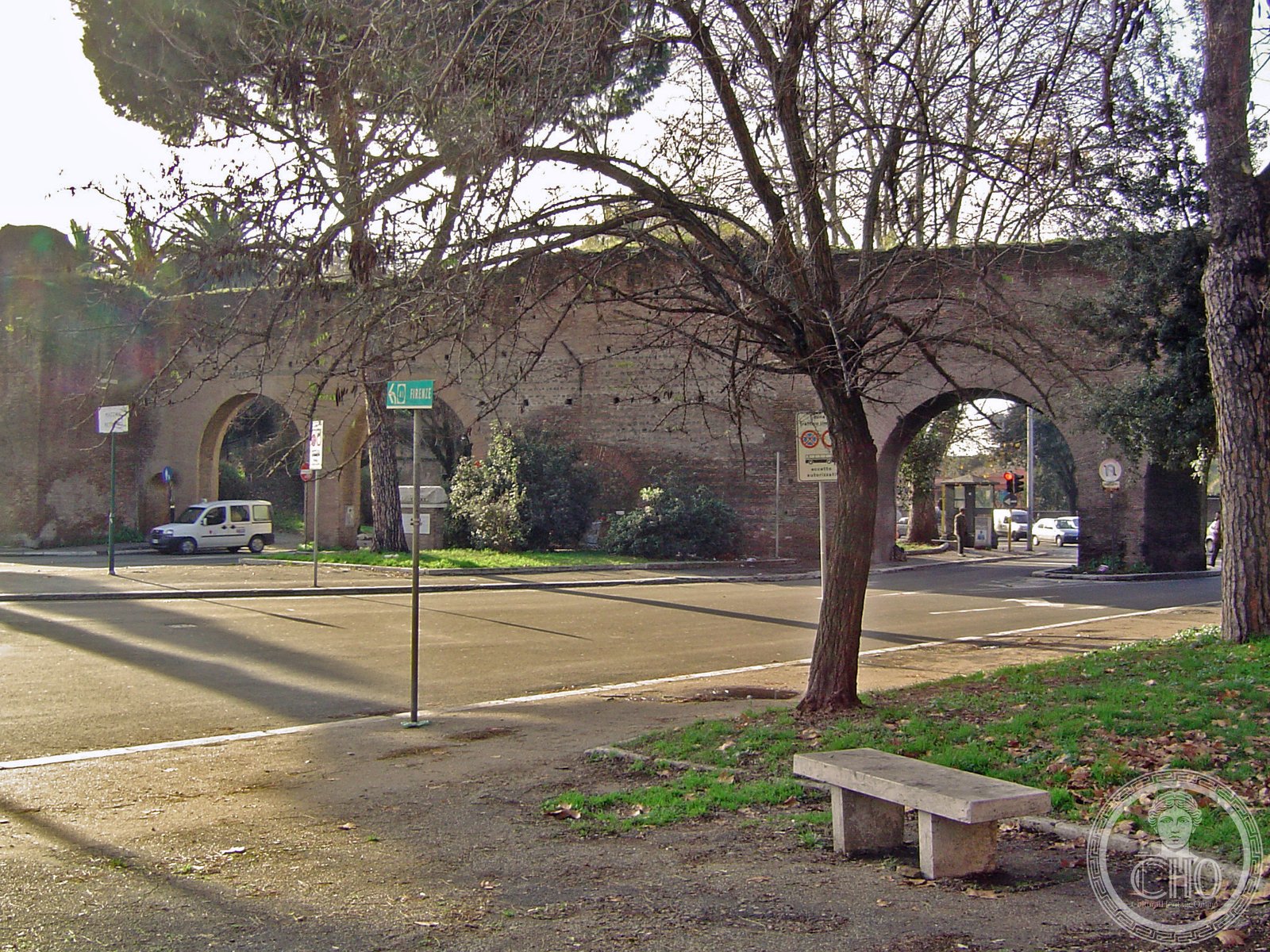
Porta Metronia is one of the lesser-known but historically significant gateways in Rome’s Aurelian Walls, the massive circuit of defensive fortifications built between AD 271 and 275 under Emperor Aurelian to protect the expanding city from barbarian incursions. Located on the Caelian Hill side of the circuit, the gate once controlled access along a route toward the ancient Via Latina, and though reduced in importance after antiquity, its surviving masonry remains an authentic witness to the defensive engineering of the late Roman Empire.
At a glance
- Type
- Ancient Roman city gate in the Aurelian Walls
- Period
- Built c. AD 271–275 under Emperor Aurelian
- Style
- Late Roman military architecture — brick masonry with barrel-vaulted passage
- Location
- Piazzale Numa Pompilio area, Caelian Hill, Rome, Lazio, Italy
- Coordinates
- 41.8823° N, 12.4988° E
Overview
Porta Metronia forms part of the Aurelian Walls, the 19-kilometre circuit of brick fortifications that Emperor Aurelian ordered constructed around Rome beginning in AD 271, completing the city’s first continuous defensive perimeter since the ancient Servian Walls. The gate served the southeastern sector of the city wall near the Caelian Hill, controlling movement along routes that connected to the Via Latina and the Appian Way network. Though overshadowed in fame by more celebrated gates such as Porta San Sebastiano or Porta Maggiore, Porta Metronia preserves important evidence of Roman military architecture and the late antique transformation of the city.
History
The construction of the Aurelian Walls between AD 271 and 275 represented one of the most ambitious building projects of the late Roman Empire, enclosing an area of approximately 1,400 hectares with a circuit of brick walls some 3.5 metres thick and originally 6 metres high. Porta Metronia was among the original gateways in this circuit, positioned to serve routes toward the southeastern area of the ancient city. During the 5th and 6th centuries the walls were repeatedly raised and strengthened by emperors and later by Gothic and Byzantine military commanders, and the gates underwent successive modifications. The gate’s name may derive from a family name or local toponym connected to the Caelian Hill neighbourhood.
What you see
The surviving structure shows the characteristic Roman brick construction of the Aurelian period, with courses of fired brick bonded with thick mortar layers typical of late imperial military engineering. The gateway passage retains evidence of its original form, including the haunches of the barrel vault that once covered the roadway through the wall. The surrounding wall fabric integrates earlier structures, including fragments of an ancient aqueduct branch incorporated into the wall circuit, visible in the masonry texture. The area around the gate preserves the Aurelian Wall corridor in relatively good condition, offering a sense of the scale of Rome’s ancient defences.
Cultural significance
Porta Metronia and the Aurelian Walls represent a decisive moment in Rome’s urban history — the acknowledgment that the city required physical defences for the first time in centuries, reflecting the political and military pressures of the Crisis of the Third Century. As a surviving element of this circuit, the gate connects visitors directly to the late antique city and to the transformations that would eventually lead to the end of the Western Roman Empire.
Practical information
- Address
- Piazzale Numa Pompilio, Rome, Lazio, Italy
- Hours
- Exterior visible at all times (open-air monument)
- Admission
- Free to view externally
Getting there
Take bus lines 118, 160, or 628 toward Viale delle Terme di Caracalla; the gate is a short walk from the Baths of Caracalla, themselves accessible from the Circo Massimo stop on Metro Line B. By foot from the Colosseum, allow approximately 20 minutes walking south through the Caelian Hill. The area is also easily combined with a visit to the Baths of Caracalla.
Sources & resources
See the place
Find it on the map
See this place and what’s around it →Historical events at this place (1)
📷 Become a Cultural Heritage Online photographer
Share your photos of places: they stay published under your name as the author. The more they're seen, the more you get noticed — and soon a contest will reward the most appreciated photos.
Log in or sign up free to add a photo