
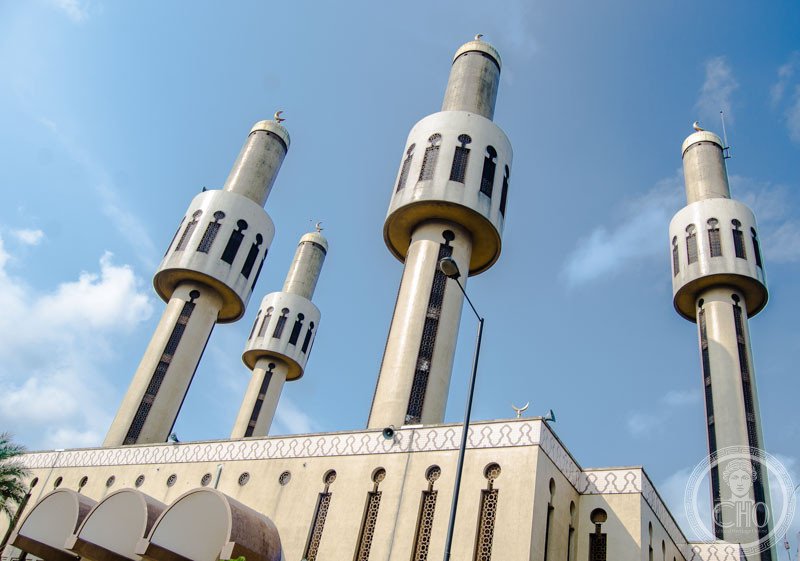
The Lagos Central Mosque is the principal jum’at (Friday) mosque of Lagos Island and the official seat of the Chief Imam of Lagos, serving as the spiritual and institutional centre of Islam in Nigeria’s largest city. Located along Nnamdi Azikiwe Street on Lagos Island, the mosque is one of the oldest and most prominent Islamic institutions in Lagos, playing a central role in the religious life of the city’s Muslim community since the 19th century. Its white minaret and domed prayer hall are recognisable landmarks within the dense urban fabric of Lagos Island.
At a glance
- Type
- Jum’at (Friday) mosque; seat of the Chief Imam of Lagos
- Period
- 19th century (founded); rebuilt and expanded in the 20th century
- Style
- Islamic religious architecture with West African influences
- Location
- Nnamdi Azikiwe Street, Lagos Island, Lagos, Nigeria
- Coordinates
- 6.4641° N, 3.4448° E
Overview
The Lagos Central Mosque serves as the primary house of worship for Lagos Island’s Muslim community and functions as the institutional home of the Chief Imam of Lagos, the highest Islamic religious authority in the state. Situated on the busy Nnamdi Azikiwe Street, it occupies a prominent position at the heart of Lagos Island’s commercial and cultural district. On Fridays and during major Islamic festivals such as Eid al-Fitr and Eid al-Adha, the mosque draws tens of thousands of worshippers from across the city.
History
Islam arrived in Lagos in the early 19th century, brought primarily by Yoruba Muslims returning from the hinterland and by traders connected to the wider West African Muslim network. The Lagos Central Mosque was established as the community grew, serving initially as a simple prayer ground before being progressively formalised and rebuilt over the following decades. The institution of the Chief Imam of Lagos — whose seat is here — became an important intermediary between the Muslim community and colonial and post-independence authorities. The mosque has been expanded and renovated multiple times to accommodate the city’s growing population.
What you see
The mosque complex features a main prayer hall capable of accommodating thousands of worshippers, a prominent minaret visible above the surrounding streetscape, and ablution facilities. The façade combines Islamic architectural motifs with West African building traditions. The interior is characterised by an open, column-supported prayer space oriented towards Mecca, with the mihrab (prayer niche) and minbar (pulpit) marking the qibla wall. The surrounding street and compound are lively with activity, particularly on Fridays.
Cultural significance
As the seat of the Chief Imam of Lagos, the Central Mosque is a focal point not only for religious observance but also for community governance, social services and interfaith dialogue in Nigeria’s most populous city. It stands as a monument to the deep historical roots of Islam in Yoruba culture and to the complex, pluralist religious landscape of Lagos. The mosque’s visible presence in the commercial heart of Lagos Island embodies the integration of religious and civic life in West African urban culture.
Practical information
Address: Nnamdi Azikiwe Street, Lagos Island, Lagos, Nigeria. The mosque is open for the five daily prayers and for Friday jum’at services. Non-Muslim visitors are advised to visit outside peak prayer times, dress modestly and seek permission before photographing inside. There is no formal admission fee.
Getting there
The Lagos Central Mosque is on Lagos Island, accessible from the mainland by the Carter Bridge, Eko Bridge or Third Mainland Bridge. From Lagos Island bus terminals, Nnamdi Azikiwe Street is walkable. Ride-hailing services (Bolt, Uber) operate on Lagos Island. The mosque is close to Tinubu Square, a central Lagos Island landmark.
Sources & resources
See the place
Find it on the map
See this place and what’s around it →📷 Become a Cultural Heritage Online photographer
Share your photos of places: they stay published under your name as the author. The more they're seen, the more you get noticed — and soon a contest will reward the most appreciated photos.
Log in or sign up free to add a photo