
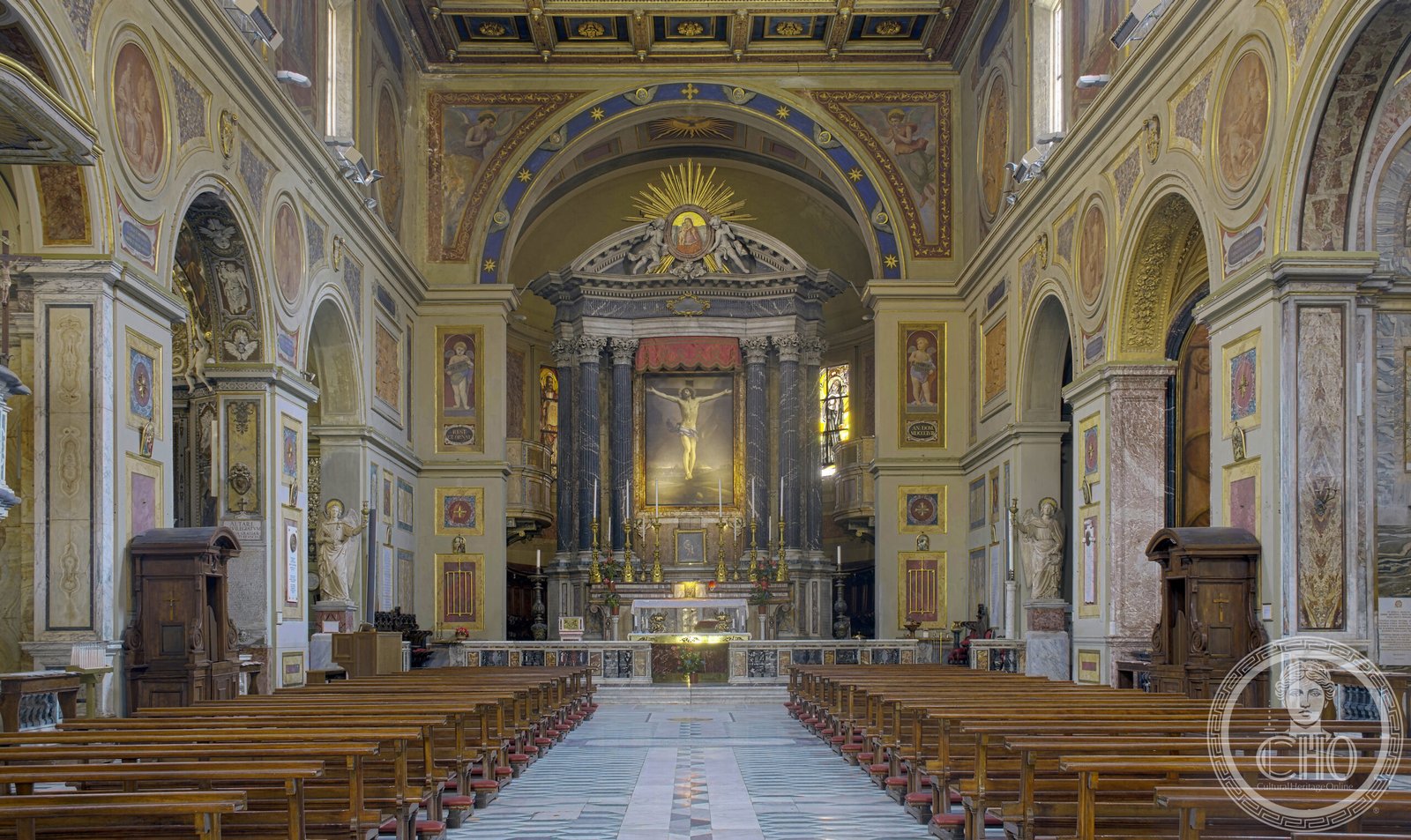
San Lorenzo in Lucina is a Roman Catholic minor basilica, titular church, and active parish in central Rome, standing in Piazza di San Lorenzo in Lucina in the Rione Colonna, two blocks from the Palazzo Montecitorio and the Via del Corso. One of Rome’s oldest churches, it preserves a 4th-century titular foundation on a site connected with the early Christian community of Lucina, and today houses important Baroque furnishings including Guido Reni’s celebrated painting of the Crucifixion and Bernini’s funerary monument to Nicolas Poussin’s patron.
At a glance
- Type
- Minor basilica, titular church, and parish church
- Period
- Origins 4th century; current fabric largely 12th century with major 17th-century interventions
- Style
- Romanesque (exterior campanile); Baroque interior
- Location
- Piazza di San Lorenzo in Lucina, Rione Colonna, Rome, Italy
- Coordinates
- 41.9033° N, 12.4765° E
Overview
San Lorenzo in Lucina is among the oldest titular churches of Rome, a designation that identifies it as one of the city’s ancient presbyteral churches historically assigned to a cardinal-priest. The church takes its name from Saint Lawrence, the 3rd-century Roman deacon and martyr, and from Lucina, a wealthy Roman matron who is said to have offered her house as an early Christian meeting place on this site. Its interior, remodelled in the 17th century, preserves significant Baroque paintings and sculpture that make it an important stop on the map of Rome’s artistic heritage.
History
A Christian community was established on this site no later than the early 4th century, when a titulus was recorded here, associated with the figure of Lucina. The 5th century saw formal church construction, and the building was substantially rebuilt in the 12th century — the campanile of this phase still stands. Pope Paschal II consecrated the rebuilt church in 1112. The interior was thoroughly remodelled in the 17th century under Cardinal Francesco Maria Brancaccio and subsequent patrons, giving the nave its current Baroque appearance. The church’s close proximity to the Palazzo Montecitorio has kept it embedded in the civic life of central Rome across centuries.
What you see
The church’s exterior presents a sober 12th-century Romanesque portico and a Romanesque campanile with multiple loggias, contrasting with the Baroque refinement of the interior. Inside, the nave is lined with chapels containing significant 17th-century altarpieces; the highlight is Guido Reni’s painting of the Crucifixion (c. 1637–1638), widely regarded as one of his finest devotional works. A chapel contains a monument by Gian Lorenzo Bernini, and the church houses a reliquary said to contain the gridiron on which Saint Lawrence was martyred. The piazza outside, lined with café tables, is one of central Rome’s most pleasant squares.
Cultural significance
San Lorenzo in Lucina is a rare example of a church that layers nearly seventeen centuries of Christian history — from the household titulus of the early community to a fully articulated Baroque interior — within a single building of modest external dimensions. Its status as a titular church means it has been home to some of the Catholic Church’s most eminent cardinals across its history. The presence of works by Guido Reni and Gian Lorenzo Bernini places it firmly in the canon of Roman Baroque sacred art.
Practical information
- Address
- Piazza di San Lorenzo in Lucina 16/A, 00186 Roma RM, Italy
- Opening hours
- Typically open daily for visits; check the parish website for current hours and Mass schedule
- Admission
- Free (donations welcome)
Getting there
The church is in the historic centre of Rome, a short walk from the Spagna metro station (Line A) and from the Palazzo Montecitorio. Bus lines serving Via del Corso stop nearby. The piazza is approximately 500 metres north of the Pantheon and 400 metres from the Trevi Fountain.
Sources & resources
See the place
Find it on the map
See this place and what’s around it →Historical events at this place (2)
📷 Become a Cultural Heritage Online photographer
Share your photos of places: they stay published under your name as the author. The more they're seen, the more you get noticed — and soon a contest will reward the most appreciated photos.
Log in or sign up free to add a photo