
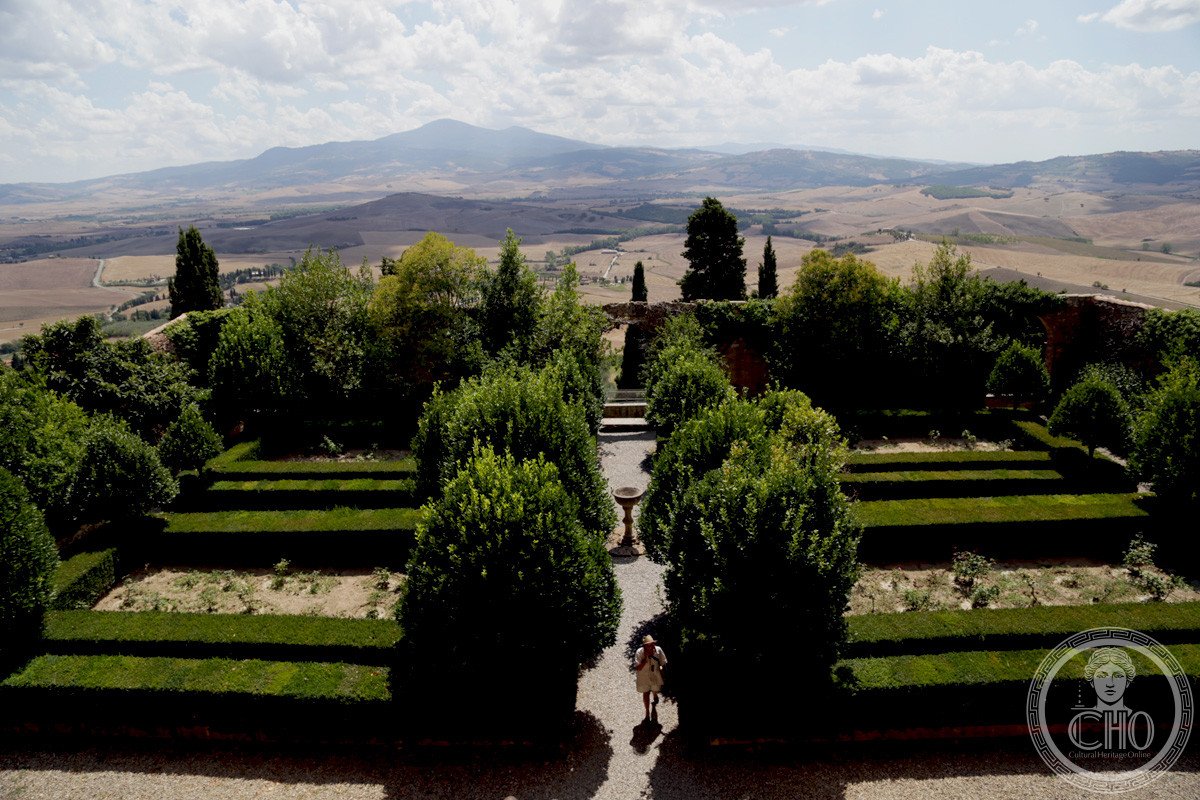
Palazzo Piccolomini is a Renaissance palace in the centre of Pienza, Tuscany, commissioned by Pope Pius II (Enea Silvio Piccolomini) and designed by the Florentine architect Bernardo Rossellino between 1459 and 1462. The palace is the finest secular building of the model Renaissance town that Pius II had constructed around the cathedral of his native village, and it remains substantially intact as one of the best-preserved examples of fifteenth-century papal residential architecture in Italy. Pienza, including the palace, was inscribed on the UNESCO World Heritage List in 1996.
At a glance
- Type
- Renaissance papal palace (now museum)
- Period
- 1459–1462
- Style
- Florentine Renaissance
- Architect
- Bernardo Rossellino (after designs by Leon Battista Alberti)
- Patron
- Pope Pius II (Enea Silvio Piccolomini, 1405–1464)
- Location
- Piazza Pio II, Pienza, Province of Siena, Tuscany
- Coordinates
- 43.0765° N, 11.6787° E
- UNESCO
- Part of the Pienza Historic Centre World Heritage Site (1996)
Overview
The Piccolomini Palace occupies the southern side of Piazza Pio II, directly opposite the Cathedral of the Assumption and beside the Bishop’s Palace. Rossellino’s design follows the principles established by Leon Battista Alberti’s Palazzo Rucellai in Florence, with three rusticated storeys and a loggia on the ground floor facing the Val d’Orcia. The palace served as the pope’s summer residence and now operates as a museum preserving Piccolomini family furnishings, tapestries, weapons, and personal objects accumulated over several centuries of aristocratic ownership.
History
Enea Silvio Piccolomini, elected Pope Pius II in 1458, immediately set about transforming his birthplace of Corsignano into a model Renaissance city renamed in his own honour. He hired Bernardo Rossellino to redesign the entire town centre in a single unified campaign completed between 1459 and 1462 — an exceptional instance of comprehensive Renaissance urban planning. The palace, cathedral, and town hall were constructed simultaneously around the new central piazza. After Pius II’s death in 1464 the palace passed to the Piccolomini family, who retained it until 1962, when it was donated to the state.
What you see
The palace’s most celebrated feature is its rear garden loggia, a three-storey open arcade overlooking the Val d’Orcia with views extending to Monte Amiata — designed specifically to frame the Sienese landscape that Pius II loved. Inside, the museum displays the papal coat of arms, original fifteenth-century furniture, an armoury with sixteenth-century weapons, Brussels tapestries, and a library. The internal courtyard follows Florentine Renaissance conventions with arched colonnades on three sides.
Cultural significance
Pienza represents the most completely realised example of Renaissance ideal urban planning to have survived intact, and the Piccolomini Palace is its centrepiece. UNESCO described the town as an “outstanding example of the Renaissance concept of urban space and design.” The palace’s loggia view over the Val d’Orcia, itself a separate UNESCO landscape, is one of the iconic vistas of Tuscan heritage.
Practical information
- Address
- Piazza Pio II 2, 53026 Pienza (SI)
- Hours
- March–October 10:00–18:30; November–February 10:00–16:30; closed Tuesdays — verify on official website before visiting
- Admission
- Paid entry; check current prices on the official museum website
Getting there
Pienza is located in the Val d’Orcia approximately 52 km south of Siena. The town has no railway station; the closest are Chiusi-Chianciano Terme and Buonconvento. LFI bus services connect Pienza to Siena and Montepulciano. By car, take the SP146 from San Quirico d’Orcia or the SS2 Via Cassia from the A1 motorway.
Sources & resources
- Wikipedia — Palazzo Piccolomini, Pienza
- UNESCO World Heritage — Pienza Historic Centre
- Cultural Heritage Online — More Italian heritage destinations
See the place
Find it on the map
See this place and what’s around it →📷 Become a Cultural Heritage Online photographer
Share your photos of places: they stay published under your name as the author. The more they're seen, the more you get noticed — and soon a contest will reward the most appreciated photos.
Log in or sign up free to add a photoIs this page about you?
This page is read by travellers and heritage enthusiasts who find it on Google. Tell us how you are connected to this place and we will take it from there.