
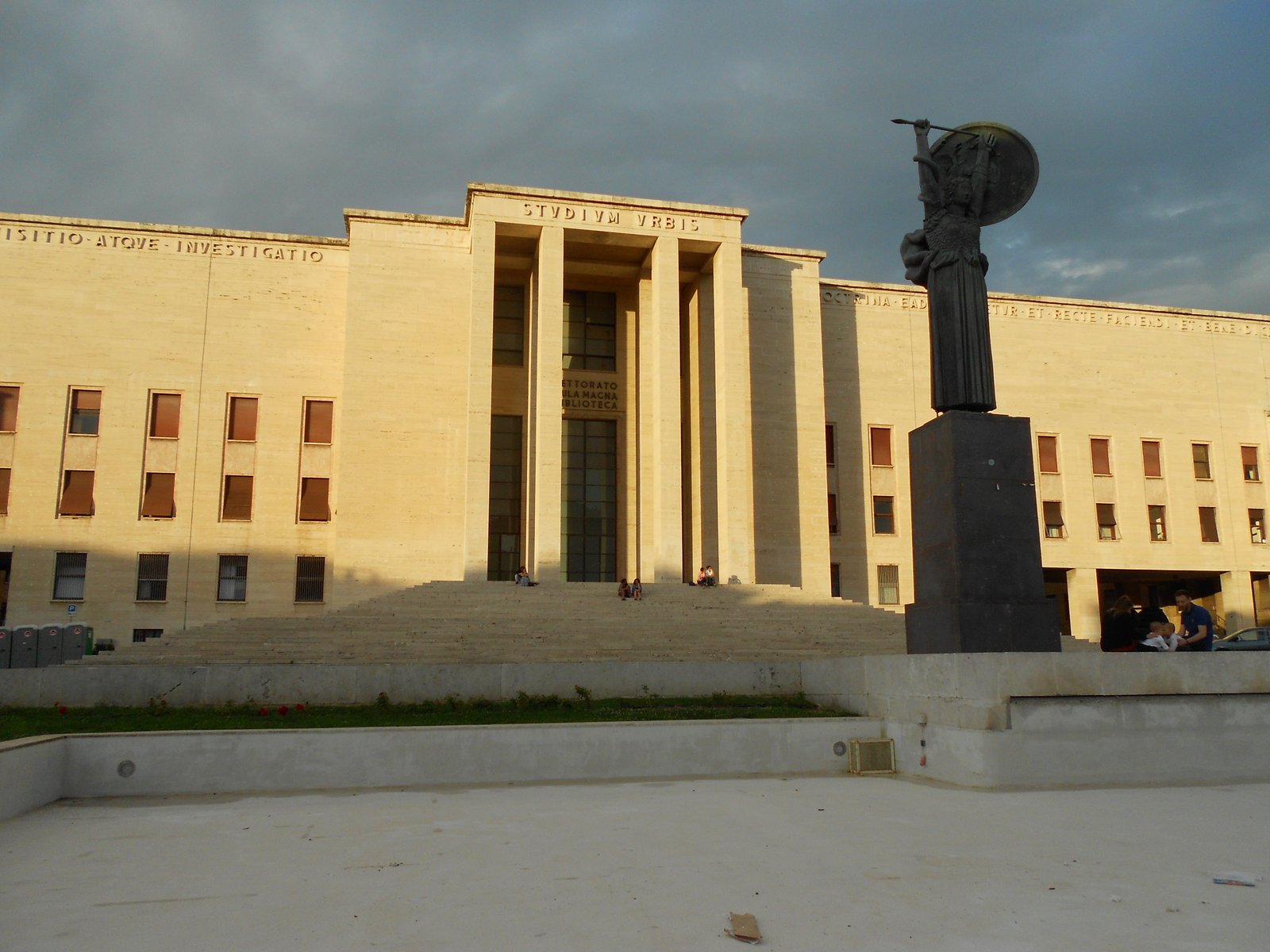
The Sapienza campus, planned by Marcello Piacentini between 1932 and 1935, is the largest single act of Italian inter-war architecture: a walled city of teaching buildings entered through a propylaeum of travertine, with a monumental Rectorate at its head and a bronze Minerva by Arturo Martini as its civic emblem.
At a glance
Commissioned by Benito Mussolini in 1932 and inaugurated three years later, the Citta Universitaria gave Rome its first purpose-built university campus, replacing the dispersed faculties of the old Palazzo della Sapienza on Corso del Rinascimento. Piacentini served as architectural coordinator and designed the Palazzo del Rettorato himself; the individual institutes were entrusted to a team that combined moderate classicists with the leading rationalists of the day, including Giuseppe Pagano, Giovanni Michelucci, Gio Ponti, Pietro Aschieri, Arnaldo Foschini, Giuseppe Capponi and Gaetano Minnucci. Today the complex remains the seat of Sapienza Universita di Roma, the largest university in Europe by enrolment.
Key facts
- Master planner: Marcello Piacentini, appointed by Mussolini in 1932; opened in 1935.
- Design team: Giuseppe Pagano (Physics, 1934), Giovanni Michelucci (Mineralogy and Geology, 1933), Gio Ponti (Mathematics, 1934), Pietro Aschieri (Chemistry, 1934), Giuseppe Capponi (Pharmaceutical Botany, 1932-1935), Arnaldo Foschini (monumental entrance and Hygiene), Gaetano Minnucci (university recreation building).
- Centerpiece: Palazzo del Rettorato by Piacentini (completed 1936), housing the rectorate, the Aula Magna and the Biblioteca Alessandrina.
- Civic emblem: the bronze Minerva by sculptor Arturo Martini, set on a plinth at the centre of a reflecting pool facing the Rettorato.
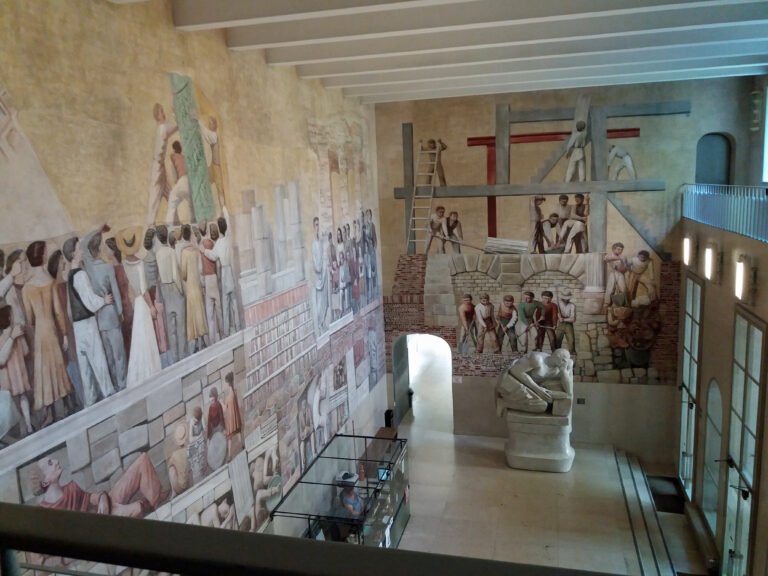
- Aula Magna fresco: L’Italia tra le Arti e le Scienze by Mario Sironi, 1935.
- Patron / owner: Universita degli Studi di Roma “La Sapienza”.
- Address: Piazzale Aldo Moro 1, 00185 Roma; quartiere Tiburtino.
History
By the early 1930s the original Sapienza, founded in 1303 and housed since the seventeenth century in Borromini’s Palazzo della Sapienza, was no longer able to absorb the growth of an Italian state university system that the Fascist regime had set out to reorganise. In 1932 Mussolini personally entrusted Marcello Piacentini, by then the most powerful architect in Rome and director of the journal L’Architettura, with the design of a new campus on the eastern edge of the centro storico, in the rapidly developing Tiburtino district.
Piacentini’s brief was twofold: produce a single coherent plan and assemble a design team that would reconcile the regime’s appetite for monumental classicism with the modernism then advancing through Gruppo 7 and the Movimento Italiano per l’Architettura Razionale. He acted as supervisor and arbiter, with the right to amend the others’ projects, and reserved the Palazzo del Rettorato and the master plan for himself. Construction proceeded in parallel on a dozen institutes between 1932 and 1935; the campus was inaugurated on 31 October 1935 in the presence of King Vittorio Emanuele III.
The Aula Magna received Mario Sironi’s monumental fresco L’Italia tra le Arti e le Scienze the same year, and Arturo Martini’s bronze Minerva was placed in the pool of Piazzale della Minerva facing the Rectorate. The complex passed intact through the post-war years and remains the working heart of Sapienza Universita di Roma, with later additions including Piacentini’s own Cappella della Divina Sapienza (1947-1952).
What you see
The visitor enters from Piazzale Aldo Moro through Arnaldo Foschini’s monumental propylaeum: two travertine wings framing a deep, axial perspective that resolves on the Rettorato at the far end. The plan is Beaux-Arts in its symmetry but stripped of historicist ornament; the buildings stand free in green courts rather than along streets, and the surfaces are dressed in pale travertine, brick and intonaco. This is Piacentini’s moderate-monumental register – measured, axial, civic – in deliberate counterpoint to the harder rationalism of Pagano’s Physics Institute on the right, with its long ribbon windows, or Gio Ponti’s Mathematics Institute on the left of Piazzale della Minerva.
The Rettorato closes the axis with a six-storey block faced in travertine, flanked by lower wings; behind its colonnaded loggia rise the Aula Magna and the Biblioteca Alessandrina. In front of it, in a shallow rectangular basin, stands Arturo Martini’s Minerva – helmeted, frontal, the patron-goddess of the university and the single most reproduced image of the campus. Around the central axis the individual institutes form a catalogue of Italian architecture of the early 1930s: Michelucci’s stark Mineralogy block, Capponi’s curved Pharmaceutical Botany pavilion, Aschieri’s Chemistry, and Minnucci’s recreation building, today the Nuovo Teatro Ateneo.
Practical information
- Open access to the campus grounds from dawn until late evening; individual buildings follow academic-year opening hours.
- The Aula Magna and the Biblioteca Alessandrina can be visited during institutional events; check the Sapienza website for the academic calendar.
- Allow at least 90 minutes for a slow walk through the central axis, the Piazzale della Minerva and the side institutes.
- Comfortable walking shoes are recommended: distances inside the 1935 perimeter are generous and surfaces are travertine and stone.
- Photography is permitted in the external spaces.
Getting there
The campus stands at Piazzale Aldo Moro, twenty minutes on foot east of Termini station along Via Cesare De Lollis, or one stop by metro Line B to Policlinico followed by a five-minute walk south. From Fiumicino airport take the Leonardo Express to Termini and then bus 492 or the metro. From Ciampino, the COTRAL bus reaches Anagnina, then metro Line A to Termini and connect.
Nearby
- Basilica di San Lorenzo fuori le Mura – Constantinian foundation, ten minutes east on foot.
- Quartiere Coppede – fantastical 1920s ensemble by Gino Coppede, two metro stops north.
- MAXXI – Zaha Hadid’s national museum of 21st-century art, in Flaminio.
- Cimitero Acattolico al Testaccio – resting place of Keats and Shelley, south of the centre.
See the place
Sources
- Sapienza Universita di Roma – official site, history of the campus.
- Wikipedia – Sapienza University of Rome (history and 1935 inauguration).
- Wikipedia – Citta universitaria di Roma (team attributions for the individual institutes, infobox coordinates).
- Wikipedia – Marcello Piacentini (1932 commission, role as coordinator).
- M. Piacentini (ed.), La citta universitaria di Roma, Rome, 1935 (original presentation volume).
Find it on the map
See this place and what’s around it →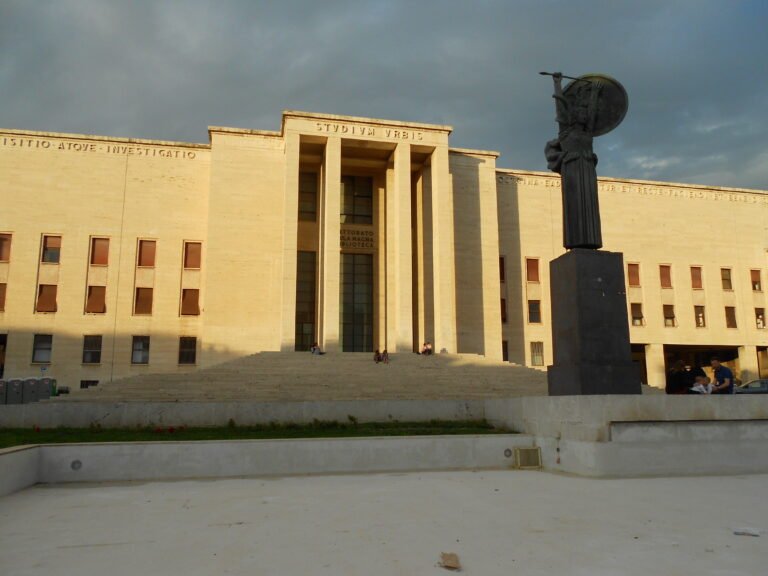
Historical events at this place (6)
- 2021 La città UNIVERSITARIA
- 2021 la Città Universitaria di Roma
- Birth Anniversary: Marcello Piacentini — December 8, 1881
- 18 maggio 1960 muore Marcello Piacentini
- 2025 MAGGIO MUSEALE Partecipazione del Polo Museale Sapienza alla Notte Europea dei Musei 2025
- 2025 Il Polo Museale Sapienza presenta il programma di Maggio Museale nell’ambito della Notte Europea dei Musei 2025
📷 Become a Cultural Heritage Online photographer
Share your photos of places: they stay published under your name as the author. The more they're seen, the more you get noticed — and soon a contest will reward the most appreciated photos.
Log in or sign up free to add a photo