
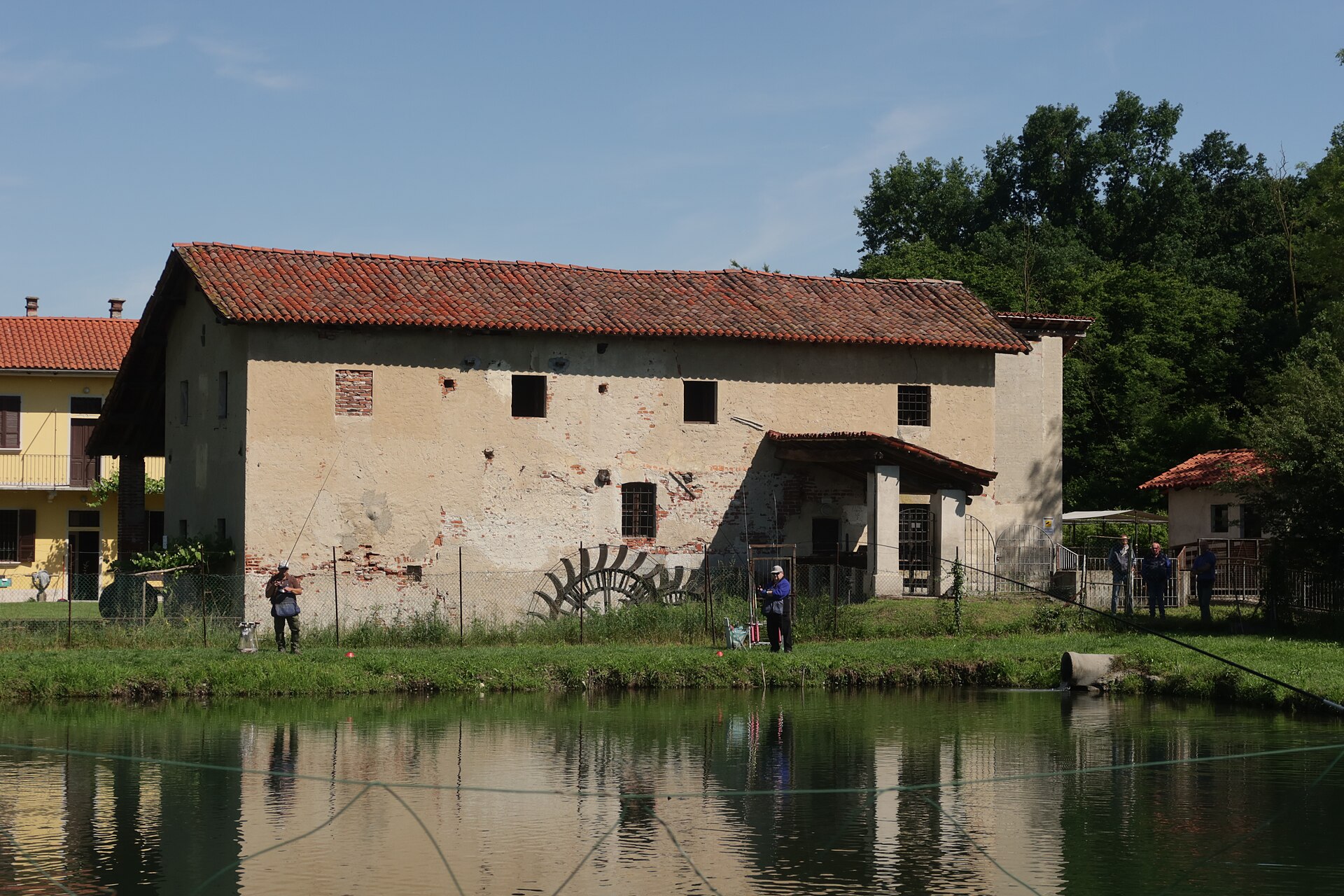
The Old Mill of Bellinzago is a historic watermill in Bellinzago Novarese, Province of Novara, Piedmont, one of the surviving examples of the milling infrastructure that once lined the irrigation and drainage channels crossing the Novara lowlands. Operating on the hydraulic network fed by the rivers Ticino and Agogna, the mill ground grain for local communities across several centuries before mechanisation rendered it obsolete. Today the structure stands as a landmark of the rural industrial archaeology of the western Po plain, documenting the hydraulic engineering and milling technology of pre-industrial northern Italy.
At a glance
- Type
- Historic watermill / rural industrial heritage
- Period
- Medieval origins; current fabric largely 17th–19th century
- Style
- Rural vernacular construction; hydraulic mill architecture
- Location
- Bellinzago Novarese, Province of Novara, Piedmont
- Coordinates
- 45.5720° N, 8.6894° E
Overview
Bellinzago Novarese is a small comune in the Province of Novara, situated about 15 kilometres north of Novara on the gravel plain between the rivers Ticino and Agogna. The area’s flat topography and abundant water supply from Alpine snowmelt made it particularly suited to watermill construction, and numerous mills operated on the network of channels (rogge) that irrigated the rice and cereal fields. The Old Mill of Bellinzago is among the best-preserved of these structures in the province.
History
Water-powered milling has a long history in the Novara lowlands, with documentary evidence of mills on the area’s channels stretching back to the medieval period. The current fabric of the Bellinzago mill reflects successive rebuilding and enlargement from the seventeenth through the nineteenth century, when demand for milled grain grew alongside the population and the expansion of the area under cultivation. The mill likely ceased commercial operation in the early to mid-twentieth century as electric roller mills displaced traditional millstones throughout rural northern Italy.
What you see
The mill building is a two- or three-storey structure of brick and rubble construction typical of Lombard–Piedmontese rural vernacular architecture, set beside the channel that once fed its wheel. The millrace, sluice structures, and the channel itself remain legible in the landscape, giving the site its hydraulic-engineering character. Internal features — millstone housings, wooden gearing, and the wheel pit — document the mechanical system that transformed water flow into rotary grinding motion.
Cultural significance
Mills were the economic hinge of pre-industrial rural communities, and their survival in the landscape of the Novara plain connects the contemporary visitor to the hydraulic civilisation of the Po Valley that shaped settlement patterns, property law, and seasonal labour rhythms for centuries. The Old Mill of Bellinzago represents a category of heritage — vernacular industrial infrastructure — that is at risk of disappearing as rural depopulation accelerates and maintenance becomes uneconomical.
Practical information
The mill is located in or near the village of Bellinzago Novarese. Access and opening: the structure may be viewable from outside at any time; internal visits, if available, are likely by arrangement with the local municipality or cultural association. Check with the Bellinzago Novarese comune for current access conditions.
Getting there
Bellinzago Novarese is approximately 15 kilometres north of Novara. The nearest railway station is Novara (Milan–Turin line, 30 minutes from Milan). Local buses connect Novara with Bellinzago. By car, drive north from Novara on the SS32 toward Arona and follow signs for Bellinzago Novarese.
Sources & resources
- Bellinzago Novarese — Wikipedia
- Province of Novara — Wikipedia
- Cultural Heritage Online — Italy heritage guide
See the place
Find it on the map
See this place and what’s around it →📷 Become a Cultural Heritage Online photographer
Share your photos of places: they stay published under your name as the author. The more they're seen, the more you get noticed — and soon a contest will reward the most appreciated photos.
Log in or sign up free to add a photoIs this page about you?
This page is read by travellers and heritage enthusiasts who find it on Google. Tell us how you are connected to this place and we will take it from there.