
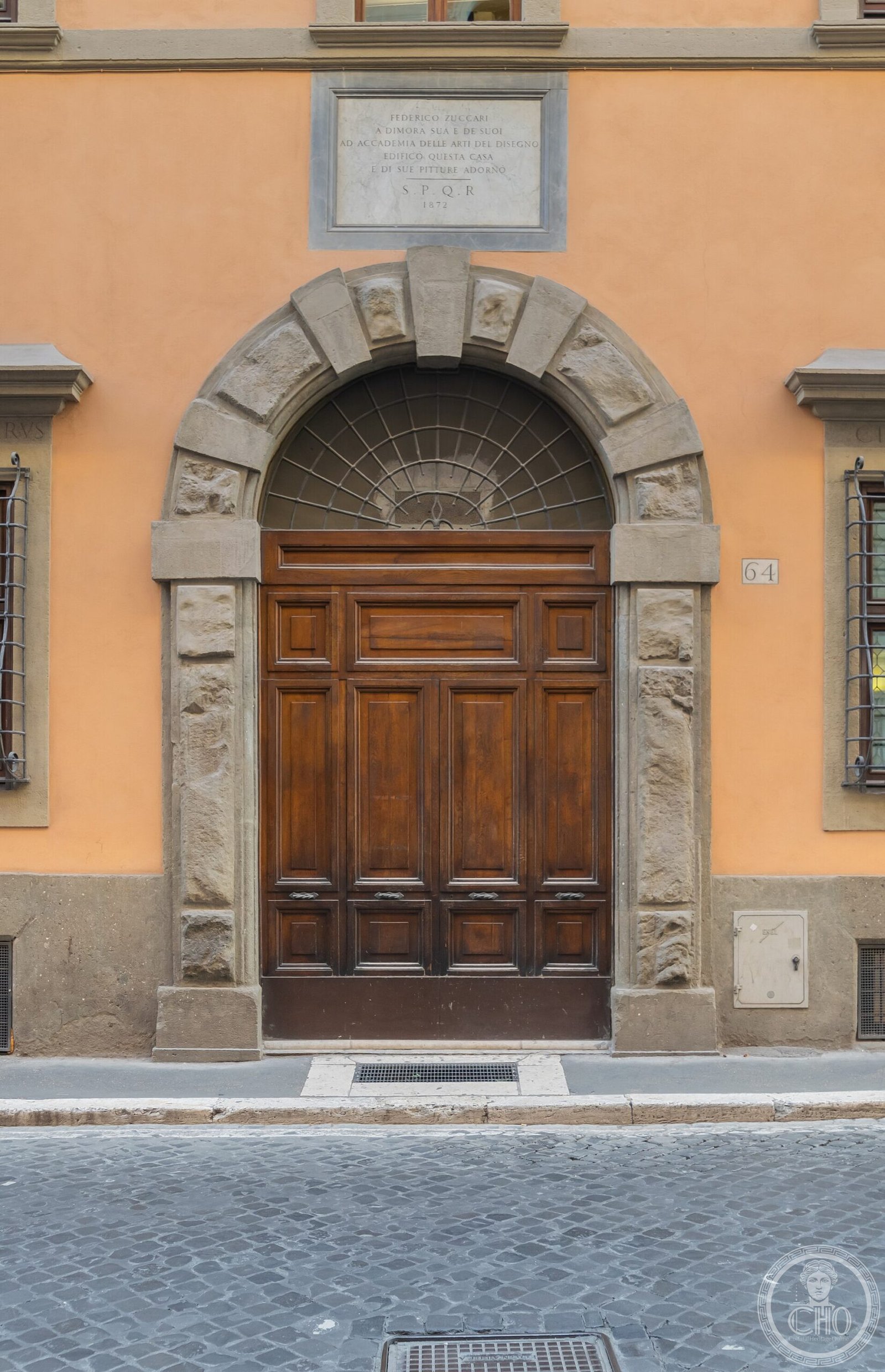
The Bibliotheca Hertziana – Max Planck Institute for Art History is a German research institute in the historic centre of Rome, housed in a cluster of four buildings along the Via Gregoriana near Trinità dei Monti. Founded in 1912 through a bequest by Henriette Hertz as a Kaiser Wilhelm Institute, it specialises in the history of Italian and European art and is one of the very few Max Planck institutes located outside Germany. Its core seat is the 16th-century Palazzo Zuccari, famous for its grotesque window and door frames shaped as open mouths — a singular example of Mannerist architectural fantasy in the Roman townscape.
At a glance
- Type
- Specialist research library and art history institute
- Period
- Founded 1912; Palazzo Zuccari built c. 1590–1600
- Style
- Late Mannerist (Palazzo Zuccari); modern addition by Juan Navarro Baldeweg
- Location
- Via Gregoriana 28, near Trinità dei Monti, Rome
- Coordinates
- 41.9056° N, 12.4842° E
Overview
The Bibliotheca Hertziana holds one of the finest specialist libraries for Italian art history in the world, with more than 300,000 volumes, extensive photographic archives, and digital resources covering Italian art and architecture from the medieval period to the 20th century. Researchers from across the globe apply for residencies to use its collections in situ, making it a hub of international art-historical scholarship within walking distance of the monuments it documents.
The institute’s four buildings create an unusual campus within the dense fabric of central Rome: the historic Palazzo Zuccari, the adjacent Palazzo Stroganoff, the Villino Stroganoff across Via Gregoriana, and a purpose-built new library wing designed by Spanish architect Juan Navarro Baldeweg, completed in 2013. The new wing was engineered to fit behind the historic palazzi without altering their street frontage, a model of heritage-sensitive contemporary architecture.
As a Max Planck institute, the Bibliotheca Hertziana does not confer degrees but publishes research, hosts symposia, and funds long-term scholarly projects, particularly in digital art history and the study of Rome’s urban and artistic development across the centuries.
History
Henriette Hertz (1846–1913) was a German philanthropist and amateur art historian who settled in Rome and amassed a distinguished art collection alongside a working scholarly library. Her 1912 bequest to the Kaiser Wilhelm Society — forerunner of the Max Planck Society — endowed the institute with her villa, library, and a substantial financial legacy, with the condition that it remain in Rome and serve international art-historical research. The institute was named in her honour.
The Palazzo Zuccari, its principal historic building, was constructed around 1590 for the painter Federico Zuccari, who designed it as a residence and studio. The building is celebrated for its fantastical entrance portal: a wide-open mouth of a monster, the door framed by lips and teeth in rusticated stone, and matching window frames on the piano nobile — a bold example of the Mannerist taste for the grottesco that Zuccari deployed with theatrical self-promotion. After Zuccari’s death the palace passed through several hands, including Queen Christina of Sweden, before Henriette Hertz acquired and restored it.
Under the Max Planck Society the institute expanded steadily through the 20th century, acquiring the adjacent Stroganoff properties and eventually commissioning the Navarro Baldeweg library to house the growing collections in climate-controlled, modern stacks while preserving the historic rooms for reading and seminars.
What you see
The Palazzo Zuccari’s façade on Via Gregoriana is the primary visual experience for visitors who pass without entering: the monstrous mouth portal and the gaping oval window frames on the upper floor are immediately recognisable from art history textbooks and remain startling in person. The rusticated stonework is darkened with Roman patina but the sculptural modelling of the lips, tongue, and teeth retains remarkable detail. A small courtyard garden is visible through the entrance when the gate is open.
The interior historic rooms — reading room, seminar spaces, Henriette Hertz’s former apartments — retain their early-20th-century fittings and atmospheric libraries-within-a-library. Researchers describe the experience of working in the historic reading room, with frescoed ceilings and tall library shelves, as one of the more singular scholarly environments in Europe. The Navarro Baldeweg wing, accessible from the courtyard, contrasts cleanly: white concrete, indirect light, temperature-controlled compactus shelving.
The rooftop terrace of the new wing commands a view across the Roman roofscape toward the Quirinale and the Pincian Hill — a vantage point accessible to institute researchers and occasionally to the public during heritage open days.
Cultural significance
The Bibliotheca Hertziana represents the tradition of the learned foreign academy in Rome — institutions that have sustained international scholarly engagement with Italian cultural heritage since the 17th century, alongside the French, British, American, and other national academies clustered on and around the Janiculum and the Pincio. Its specialist focus on art history makes it a primary reference institution for researchers working on any period of Italian visual culture.
The Palazzo Zuccari itself is listed among Rome’s most significant Mannerist buildings and is regularly cited in studies of 16th-century architectural fantasy and the culture of the Roman artist-patrician residence. The building’s survival intact as a scholarly institution — rather than subdivision into apartments or conversion to a hotel — is itself a significant heritage outcome.
Practical information
- Address
- Via Gregoriana 28, 00187 Roma RM
- Access
- Library open to accredited researchers by application; the façade of Palazzo Zuccari is freely visible from the street; check the institute website for public events and open days
- Website
- biblhertz.it
Getting there
The Via Gregoriana runs from the top of the Spanish Steps (Trinità dei Monti) toward the Quirinale hill. The nearest metro station is Spagna (Line A), approximately 5 minutes’ walk via the Scalinata di Trinità dei Monti. Buses stop on Via Sistina and Via del Tritone. The location is central and walkable from the Trevi Fountain (10 minutes) and Villa Borghese (15 minutes on foot through the Pincio).
Sources & resources
- Bibliotheca Hertziana — Wikipedia
- Official website — Max Planck Institute for Art History
- Cultural Heritage Online — Rome guides
Find it on the map
See this place and what’s around it →📷 Become a Cultural Heritage Online photographer
Share your photos of places: they stay published under your name as the author. The more they're seen, the more you get noticed — and soon a contest will reward the most appreciated photos.
Log in or sign up free to add a photo