
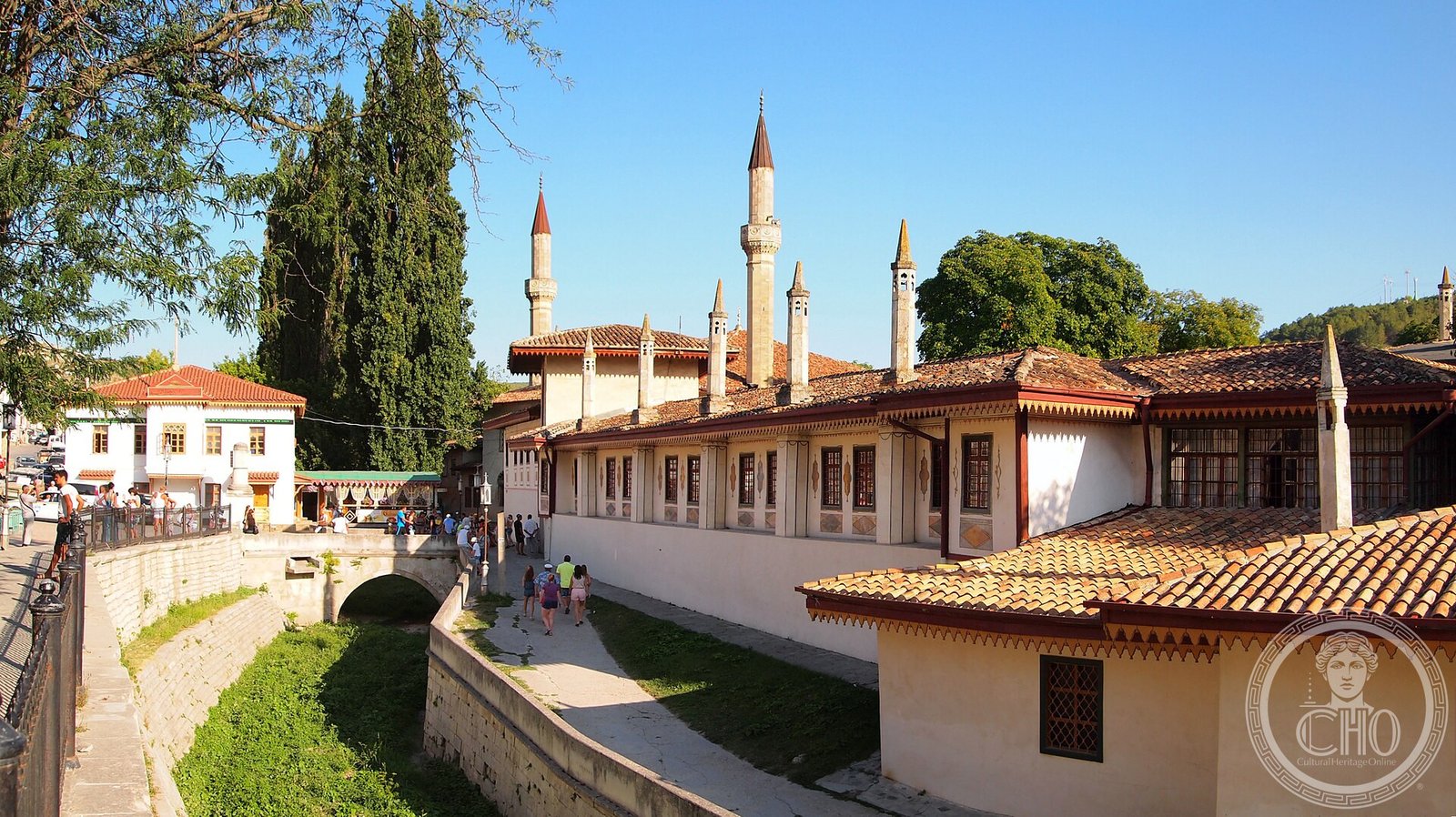
The Khan’s Palace — known in Crimean Tatar as Hansaray, meaning “Khan’s House” — is a 16th-century walled royal complex in Bakhchysarai, Crimea, and the only surviving example of Crimean Tatar palatial architecture. Built as the seat of the Crimean Khanate, its ensemble of a mosque, harem, mausolea, gardens, and living quarters makes it one of the most significant Muslim palatial monuments in Eastern Europe.
At a glance
- Type
- Royal palace complex (Khan’s residence)
- Period
- 16th century; expanded through 18th century
- Style
- Crimean Tatar; Ottoman-influenced Islamic architecture
- Location
- Bakhchysarai, Crimea
- Coordinates
- 44.7487° N, 33.8816° E
Overview
The Khan’s Palace is located in the town of Bakhchysarai, Crimea, and was built in the 16th century as the home of a succession of Crimean Khans. The walled enclosure contains a mosque, a harem, a cemetery, living quarters, and gardens. It is one of the best-known Muslim palaces found in Europe, alongside the Sultan palaces of Istanbul and the Alhambra in Spain.
History
The Crimean Khanate, a successor state to the Golden Horde, established Bakhchysarai as its capital in the early 16th century, and construction of the palace complex began under Khan Sahib I Giray around 1532. The palace served as the administrative and cultural centre of the Khanate for over two centuries, witnessing diplomatic receptions, religious ceremonies, and the daily life of successive Khans and their courts. Following Russian annexation of Crimea in 1783, the palace was preserved — albeit with alterations — and became a site of cultural and historical pilgrimage. Alexander Pushkin’s visit in 1820 inspired his famous poem The Fountain of Bakhchisaray, which brought the palace international literary fame.
What you see
The palace interior has been decorated to appear lived in, reflecting the traditional 16th-century Crimean Tatar style, with intricately painted ceilings, glazed tile work, and latticed wooden screens. The Great Khan Mosque (Büyük Han Camii), dating to the 16th century, anchors the complex’s religious life. The Fountain of Tears (Selsebil), commemorated in Pushkin’s poem, stands in the palace courtyard — a marble fountain whose slow drip of water was said to express the Khan’s grief. The harem quarters, cemetery with domed mausolea, and formal gardens complete an ensemble that evokes the sophisticated culture of the Crimean Khanate.
Cultural significance
Hansaray is the sole surviving monument of the Crimean Tatar khanate’s palatial architecture and a primary touchstone of Crimean Tatar cultural identity. It has been proposed for UNESCO World Heritage List inclusion as part of the historic centre of Bakhchysarai. Its ongoing significance is inseparable from the complex history of Crimea and the Crimean Tatar people, making it a site of profound political, cultural, and emotional resonance.
Practical information
- Address
- Bakhchysarai, Crimea
- Museum
- The palace houses a museum of Crimean Tatar history and culture
Getting there
Bakhchysarai is situated approximately 30 km south of Simferopol, the main transport hub of Crimea. Historically, visitors reached the town by train or road from Simferopol. Given the current geopolitical situation, travellers should consult up-to-date official travel advisories before planning a visit to Crimea.
Sources & resources
Find it on the map
See this place and what’s around it →📷 Become a Cultural Heritage Online photographer
Share your photos of places: they stay published under your name as the author. The more they're seen, the more you get noticed — and soon a contest will reward the most appreciated photos.
Log in or sign up free to add a photoIs this page about you?
This page is read by travellers and heritage enthusiasts who find it on Google. Tell us how you are connected to this place and we will take it from there.