
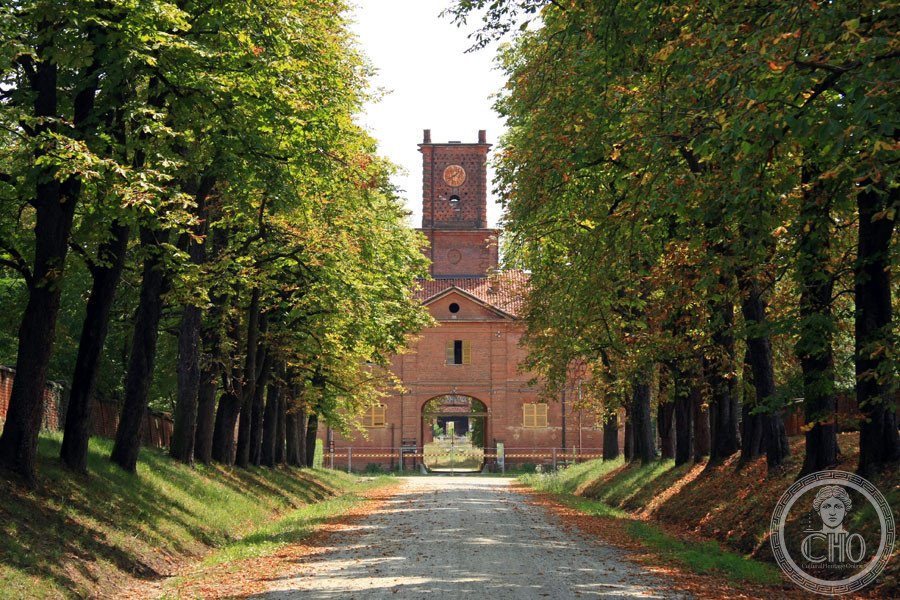
The Castello della Mandria is a Savoy royal hunting lodge and residential complex at the heart of La Mandria Regional Park, on the north-western outskirts of Turin in Piedmont. Originally established in the 17th century as a depot for the royal horse herds (mandria in Italian), the complex was substantially rebuilt and enlarged under Victor Emmanuel II in the 1860s as a private retreat away from the official court. The surrounding park — covering roughly 6,500 hectares — is one of the largest fenced natural reserves in Western Europe and part of the collective Residences of the Royal House of Savoy UNESCO World Heritage Site.
At a glance
- Type
- Royal hunting lodge and residential complex
- Period
- 17th century (origins); major expansion 1860s under Victor Emmanuel II
- Style
- Savoy eclectic; formal and landscape park
- Location
- Borgo Castello, Venaria Reale, Città Metropolitana di Torino, Piedmont, Italy
- Coordinates
- 45.1471° N, 7.6000° E
Overview
The Mandria estate was conceived as a working royal stud farm supplying horses for the Savoy hunts and cavalry, set within a vast walled enclosure that preserved a large tract of mixed woodland and wetland. Victor Emmanuel II transformed the central complex into a private residence where he could live informally with his morganatic wife Rosa Vercellana (“la Bela Rosin”), away from the ceremonial constraints of the royal palace in Turin. Today the castle and park together form one of the most visited natural and cultural sites in Piedmont.
History
Charles Emmanuel II of Savoy created the enclosed estate in the mid-17th century, building the original lodge and service structures to manage the royal herds. The site was fortified and expanded during the 18th century. After Italian Unification, Victor Emmanuel II — who had ceded the formal Savoy palaces to the new Italian state — retained the Mandria as a personal property and invested substantially in renovating the apartments, stables and formal gardens between 1861 and 1878. Following the end of the monarchy in 1946, the property passed to the Italian state; the park was formally established as a regional nature reserve by the Piedmont Regional Council in 1978.
What you see
The Borgo Castello complex includes the main royal apartments, decorated in the mid-19th-century eclectic style with original furnishings, the private apartments of Rosa Vercellana, and an extensive stable block. The surrounding park preserves ancient woodland, the Ceronda and Casternone streams, and remnants of the original walled hunting grounds. Guided tours of the royal apartments offer insight into the informal domestic life of the Risorgimento era. The park itself is open year-round for walking, cycling and wildlife watching.
Cultural significance
The Castello della Mandria is included in the UNESCO World Heritage designation “Residences of the Royal House of Savoy” (1997), which encompasses 14 palaces and gardens built by the Savoy dynasty in the Turin area between the 16th and 18th centuries. The complex is culturally significant both as a monument to the Risorgimento period and as testimony to the Savoy dynasty’s role in shaping the Italian state. Its unusual dual nature — a working stud farm and a discreet private residence — makes it distinct from the formal ceremonial palaces of the broader Savoy complex.
Practical information
- Address
- Borgo Castello, 10078 Venaria Reale TO, Italy
- Park hours
- Open daily; seasonal hours — check the La Mandria Regional Park website
- Castle tours
- Guided tours of the royal apartments available; booking recommended — check official website for current schedule and admission prices
- Website
- Check official website for current information
Getting there
The Mandria estate is approximately 15 km north-west of central Turin. By public transport, take the metro to Fermi station (line 1) and then a bus toward Venaria Reale; the Borgo Castello entrance is accessible from the Venaria side. By car, take the A55 Tangenziale Nord toward Venaria Reale, then follow signs for La Mandria / Borgo Castello. Bicycle entry is available from multiple gates around the park perimeter.
Sources & resources
See the place
Find it on the map
See this place and what’s around it →📷 Become a Cultural Heritage Online photographer
Share your photos of places: they stay published under your name as the author. The more they're seen, the more you get noticed — and soon a contest will reward the most appreciated photos.
Log in or sign up free to add a photoIs this page about you?
This page is read by travellers and heritage enthusiasts who find it on Google. Tell us how you are connected to this place and we will take it from there.