
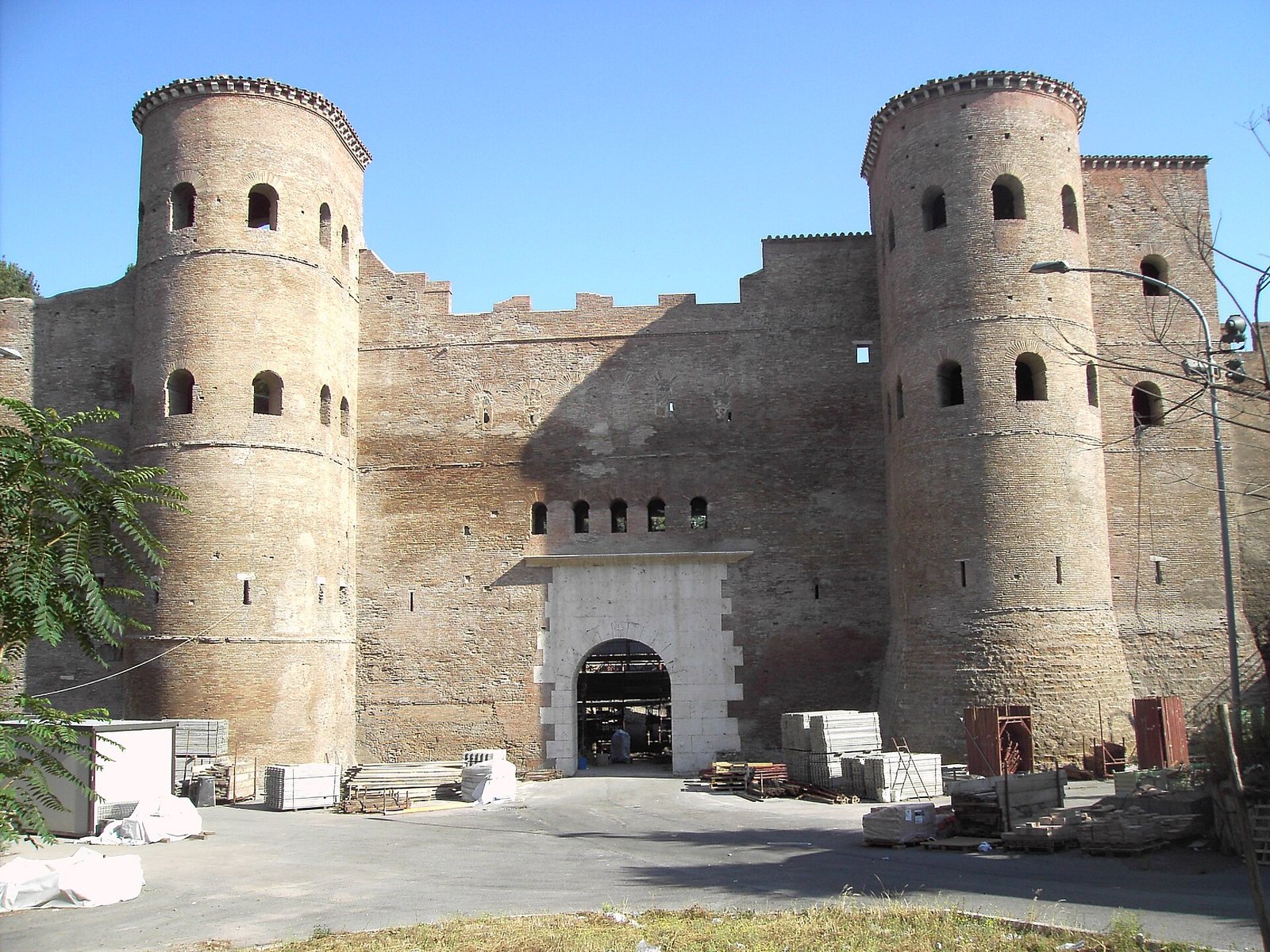
The Asinaria Gate (Porta Asinaria) is a late-Roman city gate in the Aurelian Walls of Rome, situated in the Lateran quarter near the Basilica of San Giovanni in Laterano. Built in the late third century as part of Emperor Aurelian’s great defensive circuit, the gate gained historical prominence in 536 when the Byzantine general Belisarius entered Rome through it to recapture the city from the Ostrogoths. The structure retains its twin semicircular towers and the original vaulted passageway, making it one of the best-preserved minor gates in the Aurelian perimeter.
At a glance
- Type
- Roman city gate (porta) with flanking towers
- Period
- Late 3rd century AD (Aurelian Walls construction, c. 271–275); modified in the 4th–6th centuries
- Style
- Late Roman military architecture
- Location
- Piazzale Appio, Lateran quarter, Rome
- Coordinates
- 41.8857° N, 12.5087° E
Overview
Porta Asinaria forms part of the Aurelian Walls, the 19-kilometre defensive circuit that Emperor Aurelian ordered built between 271 and 275 AD to protect Rome against the mounting military pressures of the late imperial period. The gate stood on the ancient road leading south-east toward the Alban Hills, a route used primarily for agricultural traffic — hence its association with the Latin word for donkeys (asini), though the etymology remains debated. Today the gate can be admired from the outside and forms a visible, intact element of the UNESCO-listed Aurelian Walls.
History
Construction of the Aurelian Walls began around 271 AD under Emperor Aurelian and was largely completed under his successor Probus by 275 AD; the Asinaria Gate was one of the original openings in this circuit. Emperor Honorius oversaw significant strengthening of the entire wall system between 401 and 403 AD, adding height to the walls and enlarging the flanking towers, and the gate was modified as part of this programme. The gate’s most celebrated historical moment came in December 536, when the Byzantine general Belisarius, commanding forces of Emperor Justinian I, entered Rome through the Asinaria Gate as the Ostrogothic garrison simultaneously departed through the Porta Flaminia on the opposite side of the city. In the medieval period the gate fell out of primary use as traffic patterns shifted, and it was eventually walled up, surviving as a masonry-filled arch until modern archaeological attention restored its visibility.
What you see
The gate presents two flanking semicircular towers in brick, characteristic of late-Roman military construction, framing a central arched passageway that once carried wheeled traffic through the walls. The brickwork displays the distinctive alternating bonding courses of Aurelian-period construction, with later Honorian additions visible in the upper register of the towers. The internal passageway retains its barrel vault, and the portcullis grooves can still be traced in the masonry. The surrounding stretch of Aurelian Wall remains largely intact in this section, offering an unbroken view of the ancient defensive perimeter extending toward San Sebastiano Gate to the south.
Cultural significance
The Aurelian Walls, of which the Asinaria Gate is an integral element, are inscribed within Rome’s UNESCO World Heritage designation and represent the most complete surviving ancient Roman defensive circuit in existence. The gate’s role in the Byzantine reconquest of Rome in 536 makes it a primary site in the history of the Gothic Wars, one of the defining conflicts of late antiquity that shaped the transition from the ancient to the medieval world. For students of Roman military engineering, the gate offers a legible cross-section of construction techniques spanning more than a century of late imperial building.
Practical information
The Asinaria Gate is visible from Piazzale Appio at all hours as an external monument. Interior access and organised visits depend on the programming of the Sovrintendenza Capitolina ai Beni Culturali. Check the official Roma Capitale heritage website for current tour schedules. The adjacent stretch of Aurelian Wall along Viale Carlo Felice is freely accessible on foot at all times.
Getting there
The gate is located at Piazzale Appio, adjacent to the Basilica of San Giovanni in Laterano. The nearest metro station is San Giovanni (Line A), approximately 300 metres away. Numerous bus lines serve Piazzale Appio directly. From the Colosseo metro station the walk takes approximately 15 minutes along Via Capo d’Africa and Via Tasso.
Sources & resources
See the place
Find it on the map
See this place and what’s around it →Historical events at this place (2)
📷 Become a Cultural Heritage Online photographer
Share your photos of places: they stay published under your name as the author. The more they're seen, the more you get noticed — and soon a contest will reward the most appreciated photos.
Log in or sign up free to add a photo