
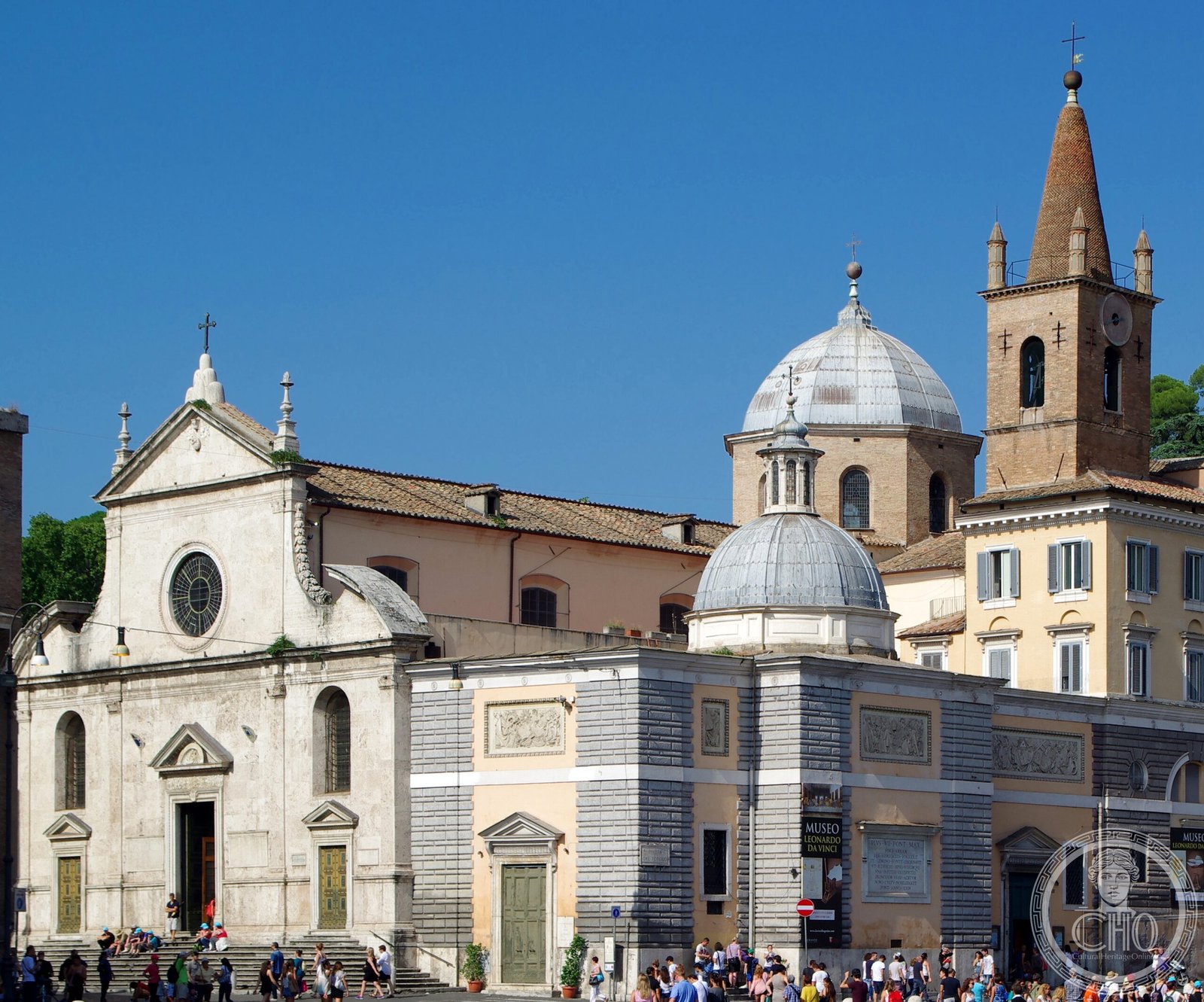
Santa Maria del Popolo is a late-15th-century Augustinian basilica at the northern gate of Rome, on the Piazza del Popolo, containing one of the most concentrated collections of Renaissance and Baroque masterpieces of any church in the world. Its chapels were decorated by Pinturicchio, Raphael, Annibale Carracci, and Caravaggio — whose two large canvases in the Cerasi Chapel, the Conversion of Saint Paul and the Crucifixion of Saint Peter (1600–1601), are among the defining works of Western art.
At a glance
- Type
- Titular basilica and parish church of the Augustinian Order
- Period
- Founded 1099; rebuilt 1472–1477 under Pope Sixtus IV; extensively decorated 15th–17th century
- Style
- Renaissance and Baroque
- Location
- Piazza del Popolo 12, 00187 Rome
- Coordinates
- 41.9115° N, 12.4765° E
Overview
Santa Maria del Popolo stands at the Porta del Popolo, the ancient northern gateway of Rome where the Via Flaminia entered the city. For centuries it was the first church seen by travellers arriving from northern Europe, making it the symbolic threshold of Catholic Rome. The church’s interior is structured around a series of richly decorated side chapels commissioned by Rome’s most powerful families, creating an extraordinary sequence of Renaissance and Baroque art accumulated over more than two centuries.
History
A small chapel was founded on this site in 1099, according to tradition to exorcise a walnut tree haunted by the ghost of Nero. Pope Sixtus IV had the building completely rebuilt between 1472 and 1477 in a style influenced by early Florentine Renaissance architecture — one of the first Renaissance churches in Rome. In the early 16th century Pope Julius II commissioned Bramante and then Raphael to design the Chigi Chapel (completed by Bernini in the 1650s). The Cerasi Chapel received Caravaggio’s two masterpieces in 1600–1601, alongside an Annunciation by Annibale Carracci on the altarpiece.
What you see
The single nave is lined with chapels of exceptional quality: the Della Rovere Chapel decorated by Pinturicchio (c. 1485–1490) with frescoed Life of Saint Jerome; the Chigi Chapel designed by Raphael with its pyramidal tombs and Bernini’s Habakkuk and the Angel; and the Cerasi Chapel with Caravaggio’s two paintings flanking Carracci’s altarpiece. The apse contains stained glass by Guillaume de Marcillat (1509) and two further Pinturicchio frescoes. Fifteen papal tombs from the late 15th century line the nave walls.
Cultural significance
Santa Maria del Popolo is considered one of the world’s great art-church combinations, rivalled in Rome only by San Luigi dei Francesi for the density of canonical masterpieces per square metre. Caravaggio’s Cerasi Chapel paintings mark a rupture point in European painting — their radical naturalism and dramatic chiaroscuro announced the Baroque age. Raphael’s Chigi Chapel, completed by Bernini after a century’s interruption, is itself one of the supreme examples of how the Renaissance and Baroque dialogue played out in Rome’s sacred spaces.
Practical information
Santa Maria del Popolo is open Monday to Saturday (morning and afternoon with a midday break) and Sunday mornings; hours may vary on feast days. Entry to the church is free; a fee applies to enter specific chapels during some periods. Lighting for artworks may require coins or cards. The Piazza del Popolo is a major public square with surrounding cafés and the twin Baroque churches of Santa Maria in Montesanto and Santa Maria dei Miracoli directly opposite.
Getting there
The church is at the Piazza del Popolo, served directly by Metro Flaminio (Line A, second stop from Termini on the northbound branch). Tram line 2 also runs along the Viale Flaminia to the piazza. From the Spanish Steps (Piazza di Spagna metro) it is a 15-minute walk north through the Villa Borghese gardens. Parking is available under the piazza in the Parcheggio del Popolo.
Sources & resources
See the place
Find it on the map
See this place and what’s around it →📷 Become a Cultural Heritage Online photographer
Share your photos of places: they stay published under your name as the author. The more they're seen, the more you get noticed — and soon a contest will reward the most appreciated photos.
Log in or sign up free to add a photoIs this page about you?
This page is read by travellers and heritage enthusiasts who find it on Google. Tell us how you are connected to this place and we will take it from there.