
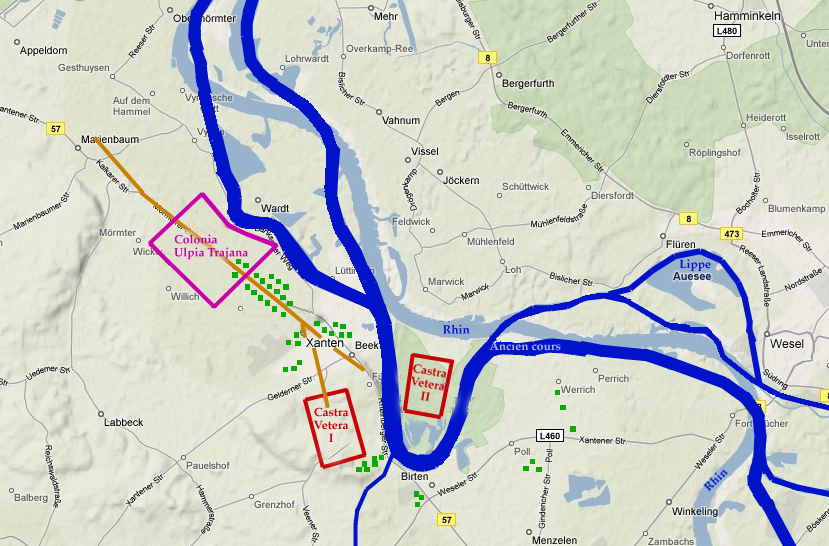
A major Roman city in Germania Inferior, founded by Emperor Trajan and preserved today as an archaeological park near the Rhine.
At a glance
Colonia Ulpia Traiana was one of the largest Roman settlements in the provinces north of the Alps. Its status as a colonia granted inhabitants full Roman citizenship and civic privileges that made it a provincial center of considerable importance.
History
Emperor Trajan founded the city around 100 CE, naming it after himself. It flourished as a hub for the surrounding region until its decline around 275 CE. The site occupied a strategic position in Germania Inferior, serving as an administrative and commercial nexus along major trade routes. Colonia Ulpia Traiana ranked third among Roman cities in present-day Germany, behind only Cologne and Trier in size and influence.
What you see
Public buildings at the site reflected the city’s prominence within the empire. Though much remains underground, ongoing excavations continue to reveal the urban layout and material culture of this provincial capital. The remains span residential quarters, administrative structures, and religious monuments typical of a fully developed Roman settlement.
Cultural significance
As one of only approximately 150 coloniae in the entire Roman Empire, Ulpia Traiana held elite legal status that set it apart from ordinary provincial cities. Such settlements functioned as miniature Romes, spreading Roman law, language, and culture into frontier territories. Its establishment marked Trajan’s ambition to consolidate Roman power in the Rhine region.
Key facts
- Country: Germany
- City: Xanten, North Rhine-Westphalia
- Coordinates: 51.66°N, 6.45°E
- Founded: c. 100 CE by Emperor Trajan
- Status: Roman colonia (legal status granting citizenship)
- Abandoned: c. 275 CE
- Third-largest Roman city in present-day Germany
Practical information & getting there
The site is now home to the Archaeological Park Xanten and the LVR-RömerMuseum, where you can explore Roman artifacts and reconstructions. Ongoing excavations continue to unearth new finds. Visit culturalheritageonline.com for current exhibition details and opening hours.
Sources & resources
- Colonia Ulpia Traiana – Wikipedia
- Cultural Heritage Online
Find it on the map
See this place and what’s around it →
📷 Become a Cultural Heritage Online photographer
Share your photos of places: they stay published under your name as the author. The more they're seen, the more you get noticed — and soon a contest will reward the most appreciated photos.
Log in or sign up free to add a photo