
Curated Itinerary
Silk Roads: Chang’an to the Tianshan — Six Stages Across Three Countries
The Chang’an-Tianshan Corridor is the best-documented single stretch of the historic Silk Road — a chain of 33 UNESCO-recognised sites strung across roughly…
The Chang’an-Tianshan Corridor is the best-documented single stretch of the historic Silk Road — a chain of 33 UNESCO-recognised sites strung across roughly 5,000 km from the ancient Chinese capital of Chang’an (modern Xi’an) to the Chuy Valley of Kyrgyzstan. No traveller covers all 33 in one trip. This itinerary picks six of the corridor’s most accessible and best-preserved stops, moving west from China’s historic heartland to the edge of Central Asia.
This is not a route you complete in a week. It crosses one of the world’s largest countries end to end before continuing into Central Asia, and requires internal flights or long-distance rail at several junctures. What holds it together is the corridor itself — the physical trace of over a thousand years of trade, pilgrimage and empire.
Stage 1 — Xi’an, Ancient Chang’an (China)
Begin at the corridor’s eastern anchor. Xi’an was Chang’an, capital of the Han and Tang dynasties and the formal starting point of the Silk Road when the Han court opened relations with Central Asia in the 2nd century BCE. While the imperial palace ruins themselves (Weiyang Palace, Daming Palace) are the formal UNESCO component sites here, most travellers begin instead at the Terracotta Army, the funerary army of China’s first emperor and the region’s essential first stop.
Allow two full days for Xi’an before heading west.
Stage 2 — Maijishan Grottoes (Tianshui, Gansu)
Take the high-speed train roughly two hours west to Tianshui. The Maijishan Grottoes rise from a freestanding sandstone cliff carved with roughly 7,200 Buddhist sculptures and 1,000 square metres of murals, accumulated across twelve dynasties from 384 CE onward. Covered walkways bolted to the cliff face let visitors climb between galleries 30 to 80 metres above the ground.
Stage 3 — Jiaohe Ruins (Turpan, Xinjiang)
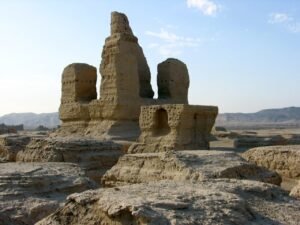
Continue west into Xinjiang, via Lanzhou and onward transport to the Turpan Depression. Jiaohe is one of the world’s best-preserved ancient earthen cities — not built but carved downward from a natural loess plateau, its streets cut as trenches and its rooms excavated as chambers. It has stood largely intact since the Han dynasty.
Stage 4 — Gaochang Ruins (Turpan, Xinjiang)
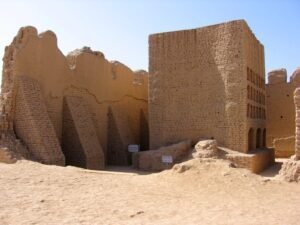
A short distance further east of Turpan, Gaochang (Khara-Khoja) covers 4.5 km² — the largest mudbrick city ruins in the world by area, with walls still standing 8 to 11 metres high thanks to the extreme aridity of the Turpan Depression. A cosmopolitan Silk Road capital for over a thousand years, it passed through Han Chinese, Qu-dynasty, Tang and Uyghur Gaochang rule before its final abandonment.
Stage 5 — Kizil Caves (near Kucha, Xinjiang)
The route continues west to Kucha, once one of the great oasis kingdoms of the Tarim Basin. The Kizil Caves, cut into a river cliff 65 km further west, hold 236 Buddhist grottoes dating from the 3rd to 8th centuries CE — among the earliest Buddhist cave art in China, painted in a style that still shows visible Gandharan and Persian influence.
Stage 6 — Burana Tower, Balasagun (Kyrgyzstan)
Crossing from Xinjiang into Kyrgyzstan via Central Asian border routes, the corridor’s westernmost UNESCO component awaits near Tokmok, 80 km east of Bishkek. Burana Tower is the last standing monument of Balasagun, an 9th-century Karakhanid capital — an 11th-century minaret reduced from 45 to roughly 25 metres by a 15th-century earthquake, surrounded by carved stone balbals and the earthwork traces of the vanished city.
Practical Notes
- Duration: 12–18 days for the full six-stage route, including transit days
- Best season: April–June or September–October (avoid Xinjiang’s summer heat and Central Asian winter cold)
- Logistics: High-speed rail connects Xi’an–Tianshui–Lanzhou; onward travel into Xinjiang is by rail or air; overland border crossings connect Xinjiang to Kyrgyzstan, or fly via Almaty/Bishkek
- Visas: China visa required for most nationalities; Kyrgyzstan offers visa-free or e-visa entry for many countries — verify current requirements before travel
- GPS files: Download the GPX or KML to load into OsmAnd, Garmin, or Google Earth
Step by step



Download for tour navigation
GPX for Garmin / Komoot / OsmAnd. KML for Google Earth and Maps.