
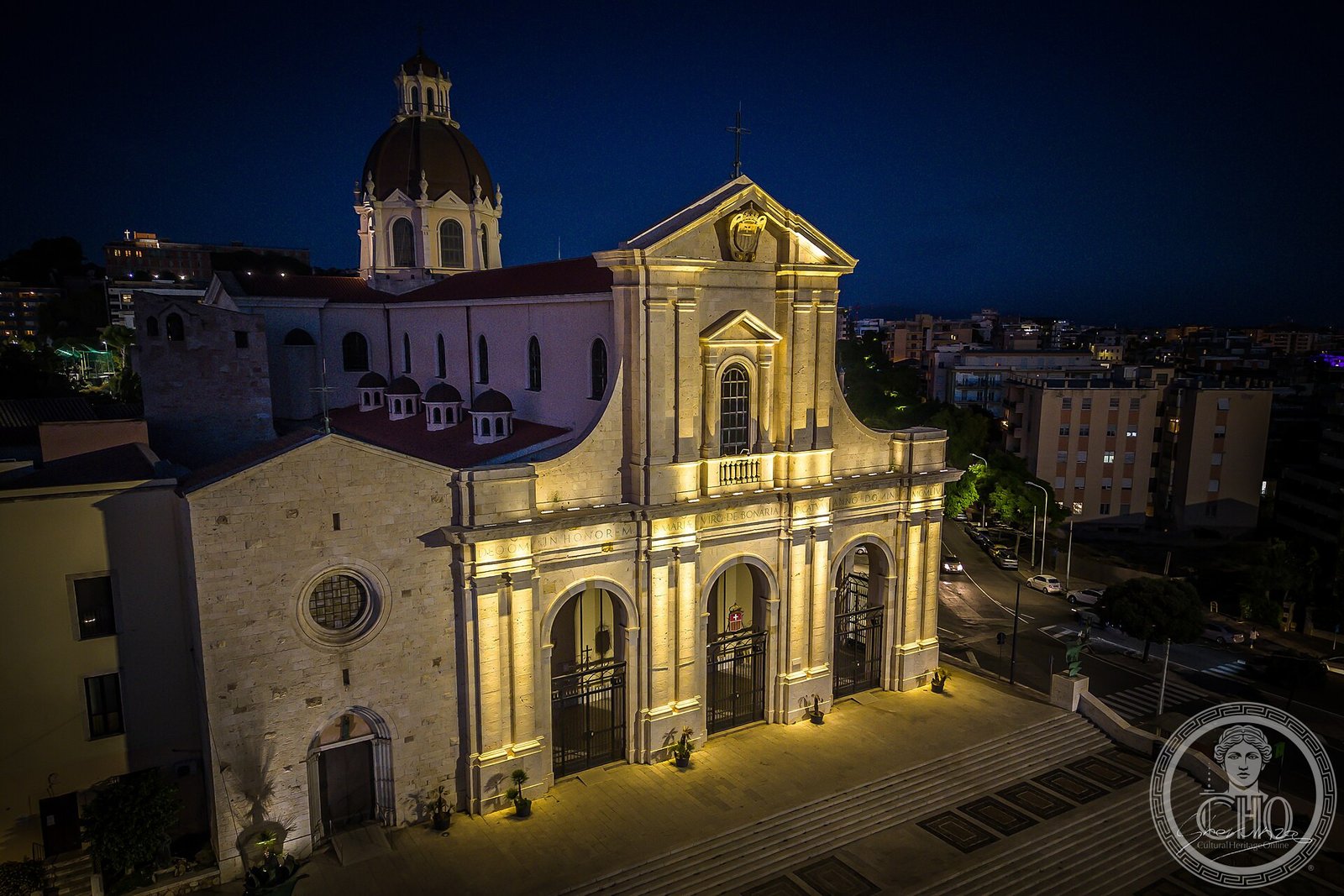
The Sanctuary of Our Lady of Bonaria crowns the Bonaria hill in Cagliari, Sardinia, and is one of the most venerated Marian shrines in the Mediterranean world. Founded by the Mercedarian order in 1326, the sanctuary houses a carved wooden statue of the Virgin — the “Madonna di Bonaria” — whose miraculous arrival by sea in 1370 is enshrined in local tradition. Christopher Columbus, a devoted pilgrim, is said to have named the Argentine city of Buenos Aires after this sanctuary, making it a site of transatlantic cultural significance.
At a glance
- Type
- Marian sanctuary and pilgrimage church
- Period
- Founded 1326 by the Mercedarian order; expanded 15th–18th centuries
- Style
- Gothic-Catalan; later Baroque additions
- Location
- Piazza Bonaria, Cagliari, Sardinia, Italy
- Coordinates
- 39.2084° N, 9.1244° E
Overview
The Sanctuary of Our Lady of Bonaria is the mother church of the Mercedarian order in Sardinia and the primary Marian pilgrimage site on the island, drawing hundreds of thousands of visitors each year. The complex includes the original Gothic chapel where the statue of the Madonna is enshrined, a larger adjacent basilica added in the 18th century, and the Monumental Cemetery of Bonaria that extends down the hill. The sanctuary holds the title of minor basilica and is the ecclesiastical seat of the patron saint of Sardinia.
History
The Mercedarian friars arrived in Sardinia with the Aragonese forces that took Cagliari in 1326 and established their first chapel on the Bonaria hill. The legendary centrepiece of the sanctuary’s history is the arrival in 1370 of a crate washed ashore during a storm, found to contain a wooden statue of the Virgin holding the Christ Child and a lit candle that had not been extinguished by the sea. The statue was enshrined in the chapel and quickly attracted pilgrimage from across Sardinia and beyond. The larger basilica was begun in the 18th century to accommodate the growing influx of pilgrims, and the complex was further enhanced in the 19th and 20th centuries.
What you see
The original Gothic-Catalan chapel (14th century) is the spiritual heart of the complex, with the venerated statue of the Madonna di Bonaria displayed in a gilded niche above the altar. The 18th-century basilica alongside it is a spacious neoclassical structure decorated with votive offerings — ship models, paintings, and ex-votos — donated by sailors and travellers over six centuries. A museum within the sanctuary houses the most significant votive objects and archival materials documenting the pilgrimage tradition, while the adjacent hilltop terrace offers panoramic views across the Gulf of Cagliari.
Cultural significance
The claimed connection to Buenos Aires — derived from Christopher Columbus’s devotion to the Madonna di Bonaria and documented in Argentine historiography — gives this Sardinian sanctuary a unique transatlantic dimension shared by few sites of its size. As patron sanctuary of Sardinia, it occupies a central place in the island’s collective religious identity, and its pilgrimage on the first Sunday of May remains one of the largest religious gatherings in the region.
Practical information
- Address
- Piazza Bonaria, 09125 Cagliari CA, Sardinia, Italy
- Hours
- The basilica is generally open daily; check official website for museum hours and liturgical schedule
- Admission
- Free entry to the basilica; check official website for museum admission
Getting there
The sanctuary is 2 km south-east of Cagliari city centre, reachable on foot along the seafront boulevard Viale Diaz. CTM city buses serving the Bonaria district stop within 200 m of the entrance. By car, park in the public areas along Viale Diaz or in the Piazza Bonaria surroundings. Cagliari Elmas Airport is 7 km to the north-west; a taxi or bus ride takes approximately 20 minutes.
Sources & resources
See the place
Find it on the map
See this place and what’s around it →📷 Become a Cultural Heritage Online photographer
Share your photos of places: they stay published under your name as the author. The more they're seen, the more you get noticed — and soon a contest will reward the most appreciated photos.
Log in or sign up free to add a photoIs this page about you?
This page is read by travellers and heritage enthusiasts who find it on Google. Tell us how you are connected to this place and we will take it from there.