
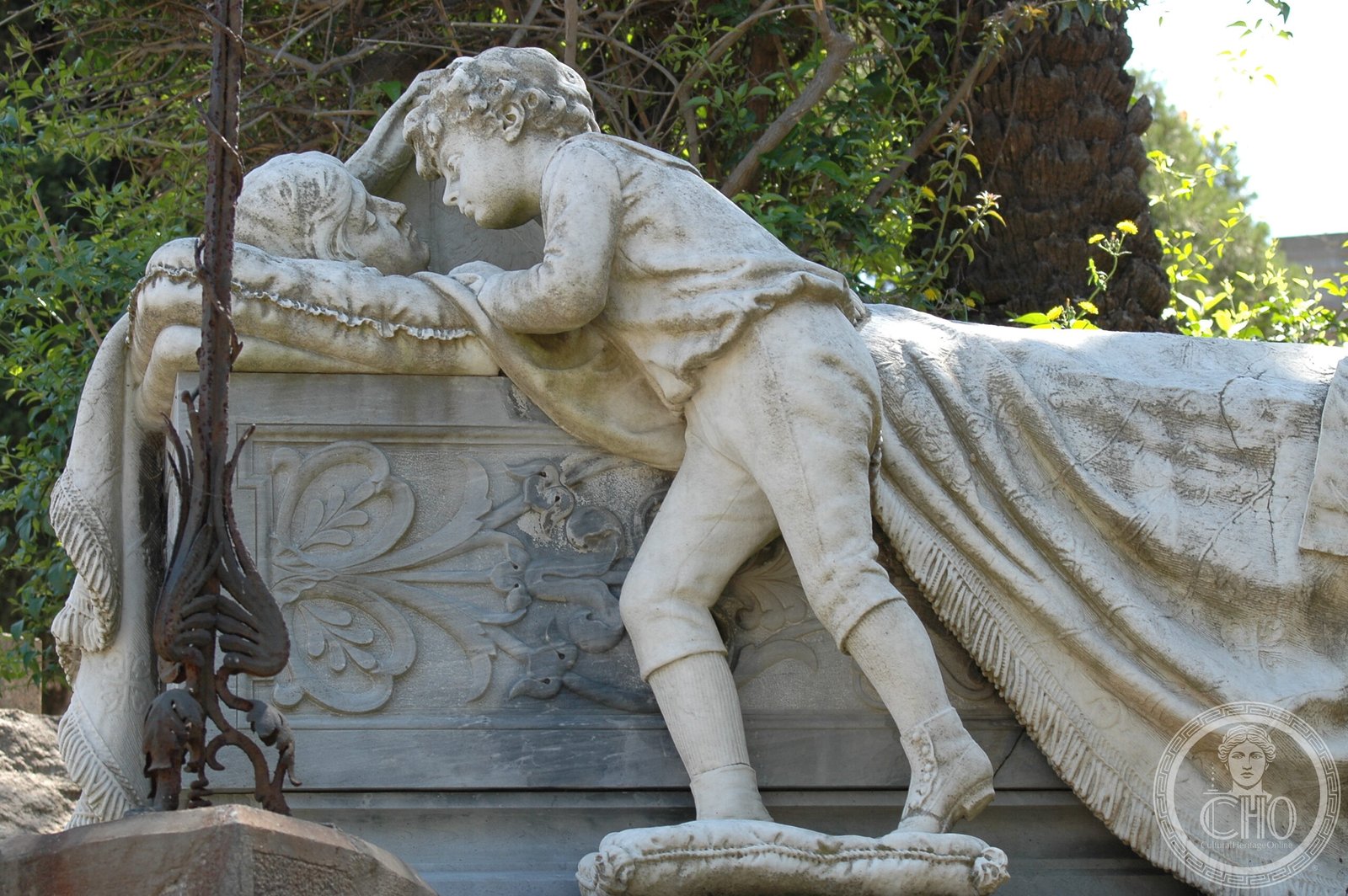
The Monumental Cemetery of Bonaria in Cagliari, Sardinia, was the city’s principal burial ground from 1829 until 1968, occupying a terraced hillside beside the Sanctuary of Our Lady of Bonaria. Developed over nearly 140 years of active use, the cemetery grew from a modest enclosure at the base of the Bonaria hill upward through successive terraces of increasingly elaborate funerary architecture, creating one of the most significant 19th-century monumental cemeteries in the Italian islands. Among those interred here are the archaeologist Giovanni Spano, the tenor Piero Schiavazzi, and General Carlo Sanna.
At a glance
- Type
- Monumental cemetery
- Period
- In use 1829–1968; funerary monuments span 19th–20th centuries
- Style
- Neoclassical, Eclectic, and Liberty funerary architecture
- Location
- Piazza Cimitero / Via Ravenna, Cagliari, Sardinia, Italy
- Coordinates
- 39.2112° N, 9.1240° E
Overview
The Monumental Cemetery of Bonaria is located in Cagliari, Sardinia, in use between 1829 and 1968. The cemetery originally occupied an area at the base of the hill of Bonaria, and over time expanded upwards in a series of landscaped terraces. The main entrance is located in Piazza Cimitero, with a second entrance from Via Ravenna, near the Basilica of Bonaria. Several notable figures were buried here, including the canonical archaeologist Giovanni Spano, the tenor Piero Schiavazzi, and General Carlo Sanna.
History
The cemetery was founded in 1829 as Cagliari’s first regulated burial ground outside the city churches, in line with Napoleonic-era sanitary legislation that prohibited intra-mural interment across the Italian states. Its location beside the Mercedarian sanctuary on the Bonaria hill gave it immediate religious prestige, and Cagliari’s leading families quickly commissioned elaborate chapels and tombs. Active burials continued for nearly 140 years, ceasing in 1968 when a new municipal cemetery opened; since then the site has been maintained as a heritage monument open to visitors.
What you see
The terraced hillside is lined with rows of neoclassical funerary chapels, obelisks, and figurative sculpture ranging from early 19th-century severity to exuberant Liberty-style monuments from the early 20th century. Carved angels, portrait busts, and draped urns in Carrara marble are interspersed with cast-iron railings and ceramic tile inserts that reflect the eclectic tastes of Cagliari’s bourgeoisie across successive generations. The upper terraces command views over the Gulf of Cagliari and the adjacent basilica complex, situating the cemetery within its topographic and spiritual context.
Cultural significance
Monumental cemeteries of the 19th century functioned as open-air museums of funerary sculpture and civic memory, and Bonaria is among the finest surviving examples in Sardinia. The concentration of tombs of scholars, artists, and military figures makes it a biographical landscape of Cagliari’s intellectual and civic life over more than a century. Its proximity to the Marian sanctuary reinforces a sacred topography of the Bonaria hill that continues to attract both pilgrims and heritage visitors.
Practical information
- Address
- Piazza Cimitero, 09125 Cagliari CA, Sardinia, Italy
- Admission
- Generally free; check locally for any guided-tour arrangements
Getting there
The cemetery is adjacent to the Sanctuary of Bonaria, approximately 2 km south-east of Cagliari city centre. CTM city buses serving the Bonaria district stop near Piazza Cimitero. On foot, follow Viale Diaz from the city centre along the seafront and ascend the Bonaria hill steps. By car, limited parking is available in Piazza Cimitero; the Cagliari Elmas Airport is approximately 7 km away.
Sources & resources
See the place
Find it on the map
See this place and what’s around it →📷 Become a Cultural Heritage Online photographer
Share your photos of places: they stay published under your name as the author. The more they're seen, the more you get noticed — and soon a contest will reward the most appreciated photos.
Log in or sign up free to add a photoIs this page about you?
This page is read by travellers and heritage enthusiasts who find it on Google. Tell us how you are connected to this place and we will take it from there.