
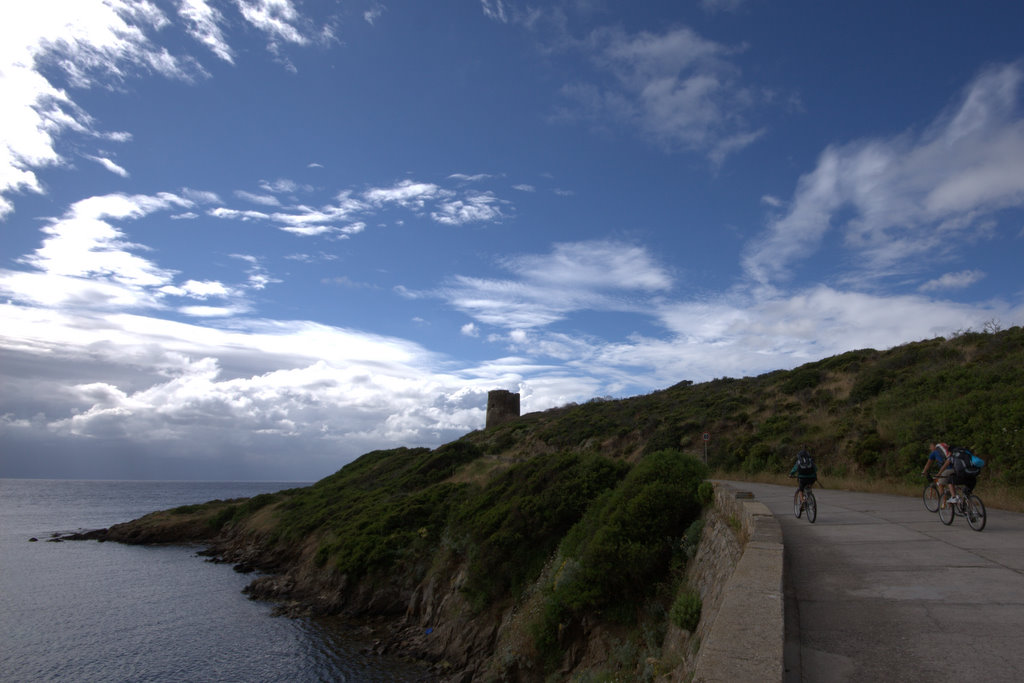
The Cala d’Oliva Tower is a historic coastal watchtower standing at the sheltered inlet of Cala d’Oliva on the northwestern tip of Sardinia’s Asinara island. Built during the Spanish-Aragonese period of Sardinian rule, the tower formed part of a chain of coastal defences designed to warn against pirate raids and Saracen incursions along this remote stretch of the Mediterranean. Today the tower overlooks the only inhabited settlement on an island that is now a national park and marine reserve, a landscape of wild scrub, albino donkeys, and crystalline waters.
At a glance
- Type
- Coastal watchtower (torre costiera)
- Period
- 16th–17th century, Aragonese-Spanish rule of Sardinia
- Style
- Military vernacular; rubble-stone construction typical of Sardinian coastal towers
- Location
- Cala d’Oliva, Asinara island, Sassari, Sardinia, Italy
- Coordinates
- 41.0788° N, 8.3352° E
Overview
Asinara is a 52 km² island off the north-western tip of Sardinia, virtually uninhabited and renowned for its albino donkey population and rugged, mountainous coastline. The Cala d’Oliva Tower stands at the island’s only permanent settlement, a small hamlet that once served as the administrative hub of both the quarantine station and the high-security prison that defined Asinara’s modern history. The tower predates all of these functions by several centuries, rooted in the Aragonese defensive network that shaped the Sardinian coast from the 15th century onward.
History
The Aragonese crown, which controlled Sardinia from 1326, ordered the construction of a system of coastal towers to defend the island’s perimeter from the frequent raids of Berber and Ottoman pirates. The Cala d’Oliva Tower was part of this network, positioned to command views over the inlet and signal danger to neighbouring towers along the coast. The island’s isolation made it a site of successive institutional uses: a quarantine station in the 19th century, a World War I prisoner-of-war camp, and later one of Italy’s most secure prisons until 1998, when Asinara was transformed into a national park.
What you see
The tower is a compact cylindrical or rectangular stone structure, characteristic of the Aragonese-era coastal defences found throughout Sardinia. Its masonry, hewn from local granite, blends into the rocky landscape of the inlet. The surrounding hamlet of Cala d’Oliva retains traces of its later institutional life — low white buildings from the prison era — while the inlet itself offers a tranquil anchorage of clear turquoise water backed by maquis-covered hills. The albino donkeys that roam the island freely are a common sight in the area around the tower.
Cultural significance
The tower is a visible reminder of the long-contested sovereignty over Sardinia’s strategic coastline and the persistent threat of maritime raiding that shaped settlement patterns across the western Mediterranean. As a surviving element of the Aragonese tower network, it contributes to the extraordinary density of military heritage preserved on an island that has been, in succession, a place of exile, detention, and now ecological sanctuary.
Practical information
- Access
- Asinara is accessible only by authorised boat; private vehicles are prohibited. Guided tours and boat services depart from Porto Torres and Stintino.
- Opening hours
- Check the official Parco Nazionale dell’Asinara website for current permits and guided excursion timetables.
- Admission
- Entry to the island requires a park permit; fees vary by season.
Getting there
The nearest mainland access points are Porto Torres and Stintino on the north-western coast of Sardinia. Ferry and boat services to Asinara operate seasonally from both towns; journey time is approximately 30–45 minutes. Porto Torres is connected to Sassari by rail and to the A22 motorway. Olbia Costa Smeralda Airport (OLB) is the closest major airport, roughly 90 km to the east.
Sources & resources
- Wikipedia: Asinara
- Wikipedia: Asinara National Park
- Official park site: parcoasinara.org
- Cultural Heritage Online
See the place
Find it on the map
See this place and what’s around it →📷 Become a Cultural Heritage Online photographer
Share your photos of places: they stay published under your name as the author. The more they're seen, the more you get noticed — and soon a contest will reward the most appreciated photos.
Log in or sign up free to add a photoIs this page about you?
This page is read by travellers and heritage enthusiasts who find it on Google. Tell us how you are connected to this place and we will take it from there.