
The Rocca Maggiore is a large medieval fortress that crowns the hill above Assisi in Umbria, dominating the skyline and the surrounding Spoleto valley from an elevation of 505 metres. Originally a Lombard stronghold and later a papal fortress, it was reconstructed in its present form by Cardinal Albornoz in 1367 and later enlarged by Pope Innocent VIII. Together with the Rocca Minore to the east, it formed Assisi’s principal defensive system and remains one of the best-preserved examples of 14th-century military architecture in central Italy.
At a glance
- Type
- Medieval military fortress and civic monument
- Period
- Origins in the early medieval period; reconstructed 1367 by Cardinal Albornoz; enlarged late 15th century
- Style
- Italian Gothic military architecture; travertine stone construction
- Location
- Via della Rocca, 06081 Assisi PG, Umbria
- Coordinates
- 43.0730° N, 12.6157° E
- Current use
- Public monument; museum; panoramic viewpoint
Overview
The Rocca Maggiore rises above Assisi’s terracotta rooftops, its crenellated towers and cylindrical keep visible from across the valley as far as Perugia on clear days. While Assisi is best known internationally for the Basilica of Saint Francis — a UNESCO World Heritage Site — the Rocca offers an equally important layer of the city’s history: the turbulent relationship between papal authority and the communes of central Italy during the 14th century. Inside the fortress, visitors can explore the keep, the passages along the walls, and a polygonal tower added by Pius II, while the panorama from the battlements is one of the finest in Umbria.
History
A fortification has stood on this rocky spur above Assisi since at least the early medieval period, when Lombard lords controlled the hilltop. The young Frederick II of Hohenstaufen was housed here in 1198 as ward of the local consul, and his eventual departure triggered a popular uprising that destroyed the earlier fortress. Cardinal Gil Álvarez Carrillo de Albornoz — the formidable soldier-bishop sent by Pope Innocent VI to restore papal control over Italy — rebuilt the fortress in 1367 as part of a network of fortifications across Umbria and the Marche. Pope Pius II added the distinctive polygonal tower in the 1450s, and Innocent VIII later reinforced the complex further. After the unification of Italy the fortress passed to the municipality of Assisi.
What you see
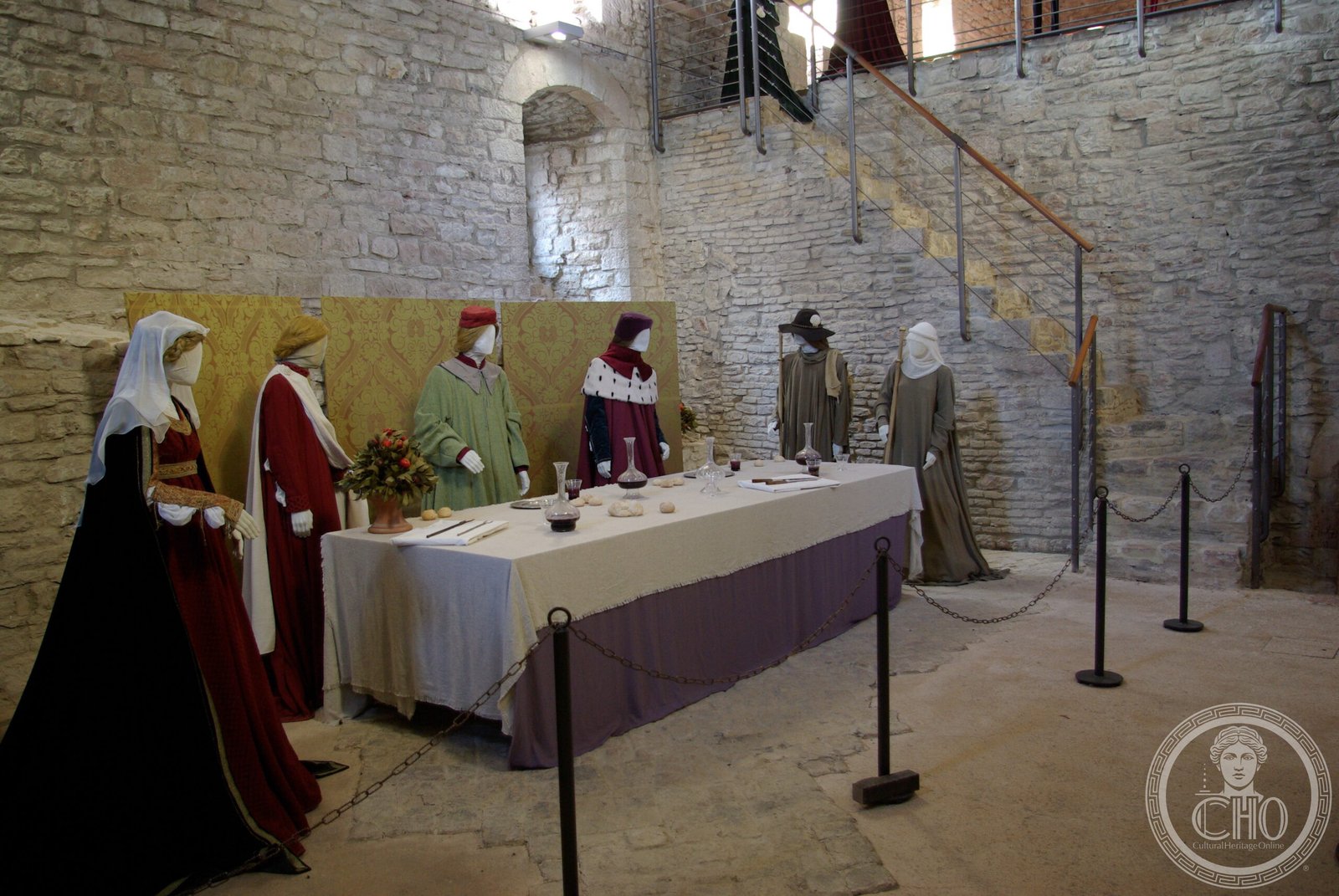
The fortress is entered from the south-eastern side through a drawbridge gate leading into the courtyard. The principal keep — a tall square tower with a corbelled parapet — anchors the complex and can be climbed for vertiginous views over Assisi’s pink-stone rooftops, the Basilica of Saint Francis, and the broad Spoleto valley beyond. The curtain walls connect several towers of different periods, and the internal passages are largely intact. The polygonal tower added by Pius II is distinguished by its angled bastion design, an early response to the challenge of artillery warfare.
Cultural significance
The Rocca Maggiore is integral to understanding Assisi not only as a pilgrimage city but as a civic and political entity that fought for its autonomy against both imperial and papal power throughout the Middle Ages. Its presence on the same UNESCO World Heritage List inscription as the Basilica of Saint Francis (2000) reflects the recognition that Assisi’s cultural importance encompasses both its Franciscan spiritual heritage and its medieval civic architecture.
Practical information
- Address
- Via della Rocca, 06081 Assisi PG
- Opening hours
- Check official Assisi municipality website for current seasonal hours; generally open daily except major holidays
- Admission
- Paid entry; combined ticket with Pinacoteca Comunale often available
- Accessibility
- The fortress interior involves steep stairs and uneven surfaces; not fully wheelchair-accessible
Getting there
From Assisi’s historic centre (Piazza del Comune), the Rocca Maggiore is reached on foot via a steep path (approximately 15–20 minutes uphill). Assisi is served by trains from Perugia (20 minutes) and Foligno, with the station located in Santa Maria degli Angeli below the hill; a bus connects the station to the historic centre. By car, Assisi is accessible from the E45 motorway and the Perugia–Assisi road. The nearest major airport is Perugia San Francesco d’Assisi (PEG).
Sources & resources
See the place
Find it on the map
See this place and what’s around it →📷 Become a Cultural Heritage Online photographer
Share your photos of places: they stay published under your name as the author. The more they're seen, the more you get noticed — and soon a contest will reward the most appreciated photos.
Log in or sign up free to add a photoIs this page about you?
This page is read by travellers and heritage enthusiasts who find it on Google. Tell us how you are connected to this place and we will take it from there.