
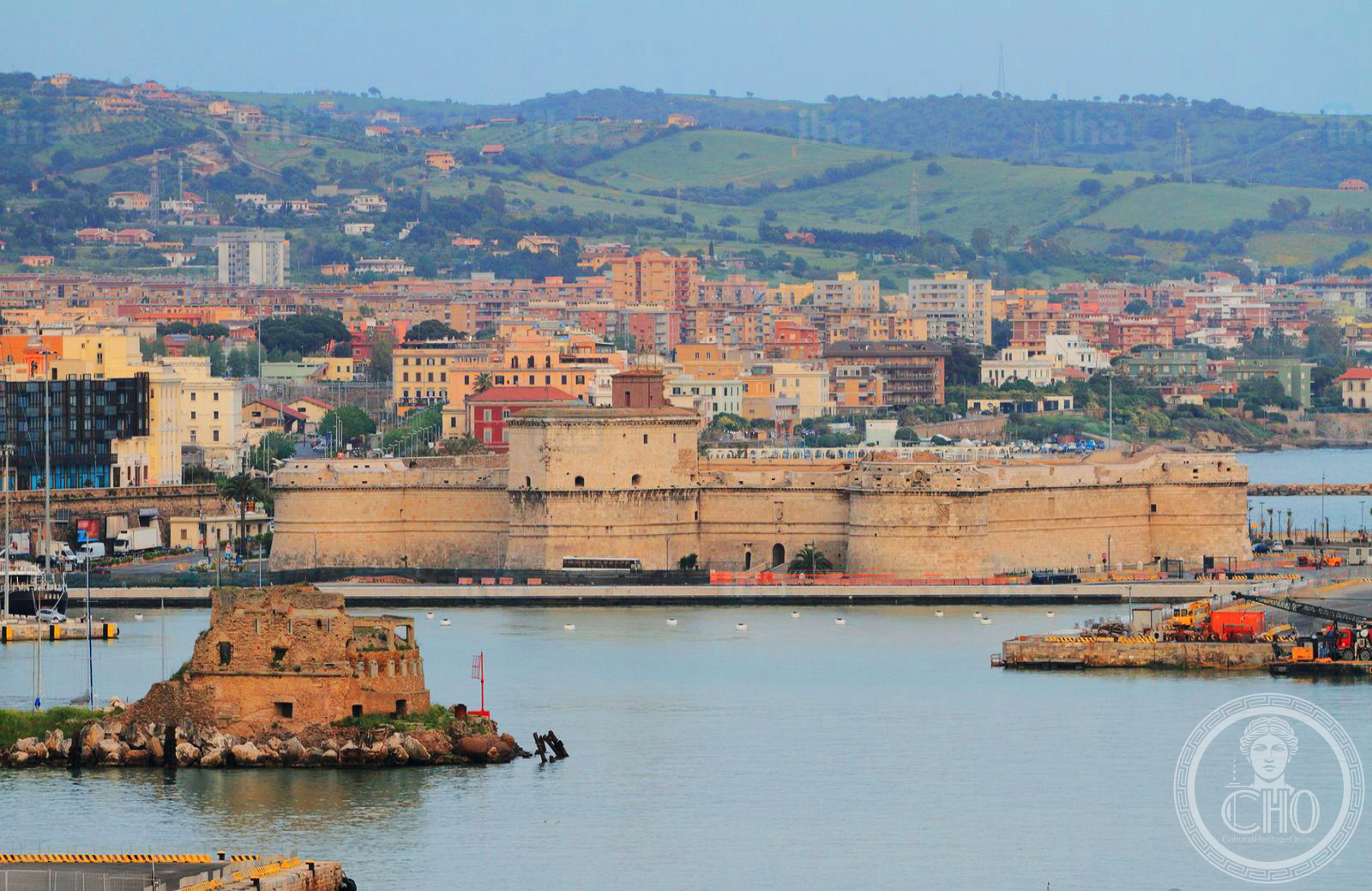
Civitavecchia is a city and major sea port on the Tyrrhenian Sea, 60 kilometres west-north-west of Rome, Lazio, Italy, at coordinates 42.096° N, 11.783° E. It is the principal cruise and ferry port of central Italy, connecting Rome with Sardinia, Sicily, and international maritime routes. The city’s layered heritage ranges from the ancient Roman port of Centumcellae, commissioned by Emperor Trajan in the 2nd century, to the monumental Forte Michelangelo designed by Donato Bramante and continued by Michelangelo himself in the early 16th century.
At a glance
- Type
- Coastal city and working seaport
- Period
- Founded as Roman Centumcellae, 2nd century AD; Forte Michelangelo 1508–1537
- Style
- Roman, Renaissance, Baroque and 19th-century urban fabric
- Location
- Metropolitan City of Rome Capital, Lazio, Italy
- Coordinates
- 42.0964° N, 11.7827° E
Overview
Civitavecchia occupies a promontory on the Tyrrhenian coast where Emperor Trajan constructed a sheltered hexagonal basin — Portus Traiani — to serve as the primary supply port for Imperial Rome. The harbour, partially surviving beneath the modern port infrastructure, represents one of the most ambitious Roman hydraulic engineering projects in Italy. Today, Civitavecchia handles millions of passengers annually, functioning as a gateway both to Italian islands and, for cruise travellers, to Rome and the surrounding region of Lazio.
History
The site’s strategic value as a natural harbour was recognised in antiquity; Trajan’s construction of Centumcellae, documented by Pliny the Younger, gave the city its defining infrastructure around 107–109 AD. After the fall of the Roman Empire, the port passed through Byzantine, Lombard, and later Papal control, becoming a key naval and commercial asset for the Church State. In 1508, Pope Julius II commissioned Donato Bramante to redesign the harbour fortress; work was continued by Antonio da Sangallo the Younger and later by Michelangelo, who added the distinctive keep known as the Torrione, completed under Pius IV. The city was heavily bombed during World War II and rebuilt with significant urban continuity.
What you see
The dominant landmark is Forte Michelangelo, a Renaissance fortress of five bastions enclosing a cylindrical tower, still partly in use by the Italian Navy but open for guided visits. The Museo Nazionale Archeologico di Civitavecchia presents finds from the Roman port complex, including anchors, amphorae, and inscriptions. The old city retains a Baroque cathedral (San Francesco d’Assisi) and stretches of the Roman harbour perimeter visible below the Lungomare waterfront promenade.
Cultural significance
Civitavecchia’s Forte Michelangelo ranks among the most important Renaissance military engineering works in Lazio, demonstrating the evolution of fortification design from medieval towers to artillery-adapted bastions over three pontificates. The site of the ancient Roman harbour of Centumcellae is a significant piece of Imperial infrastructure, representing Roman mastery of marine construction at continental scale.
Practical information
- Address
- Civitavecchia, Metropolitan City of Rome Capital, Lazio — 00053
- Forte Michelangelo
- Guided tours available seasonally; contact the local tourist office for schedule
- Museum
- Museo Nazionale Archeologico, Largo Plebiscito 8 — check official hours
Getting there
Civitavecchia is served by frequent Trenitalia Intercity and regional trains from Roma Termini (approximately 1 hour). By car, take the A12 Roma–Civitavecchia motorway westward. Ferry services to Sardinia (Cagliari, Olbia, Arbatax), Sicily (Palermo), and other Italian and international ports depart from the main ferry terminal adjacent to the historic port.
Sources & resources
See the place
Find it on the map
See this place and what’s around it →Historical events at this place (2)
📷 Become a Cultural Heritage Online photographer
Share your photos of places: they stay published under your name as the author. The more they're seen, the more you get noticed — and soon a contest will reward the most appreciated photos.
Log in or sign up free to add a photo