
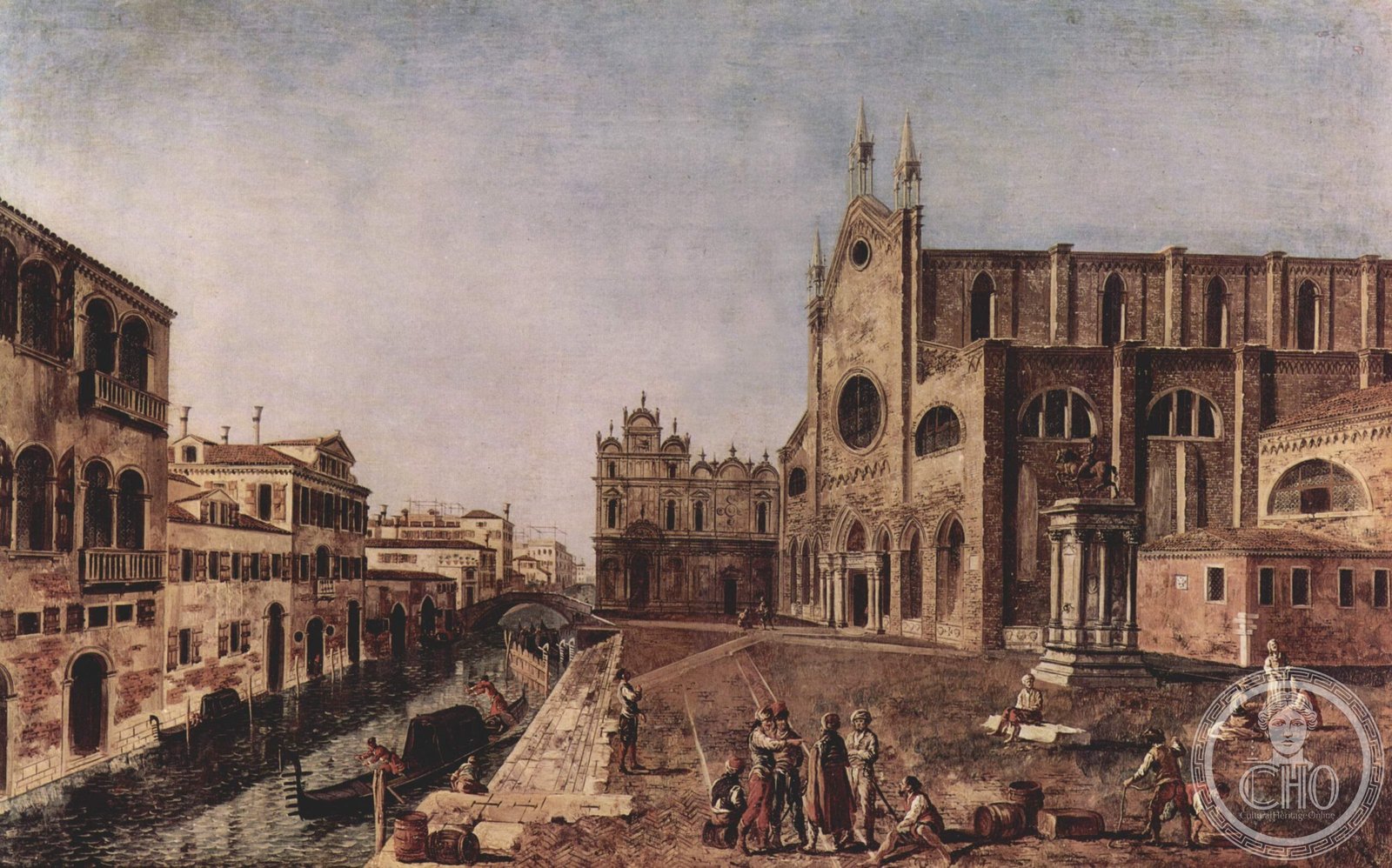
Campo Santi Giovanni e Paolo (known in Venetian dialect as Campo San Zanipolo) is one of the grandest civic squares in Venice, dominated by the vast Gothic brick basilica of Santi Giovanni e Paolo — the pantheon of the doges — and the celebrated equestrian bronze of Bartolomeo Colleoni by Andrea del Verrocchio, considered one of the finest equestrian statues in the world.
At a glance
- Type
- Civic square (campo) with Gothic basilica and Renaissance sculpture
- Period
- Basilica begun 1333, consecrated 1430; Colleoni statue cast 1496
- Style
- Venetian Gothic (basilica); Renaissance bronze (equestrian monument)
- Location
- Castello sestiere, Venice, Italy (45.4392° N, 12.3413° E)
Overview
The campo occupies a central position in the Castello sestiere, the largest of Venice’s six administrative districts, and has served as a ceremonial and civic heart of the city since the medieval period. The basilica of Santi Giovanni e Paolo belongs to the Dominican order and served as the official funerary church of the Venetian doges, housing the tombs of twenty-five of them. The Scuola Grande di San Marco, now Venice’s civic hospital, flanks the campo with its extraordinary early-Renaissance facade by Pietro Lombardo and Mauro Codussi.
History
The Dominicans received land in this area in 1246 and began constructing the present basilica in 1333, completing it after nearly a century of work. The doge Giovanni Dolfin was the first to be buried here in 1361, establishing a tradition that made the church the closest Venice came to a national mausoleum. Bartolomeo Colleoni, the great Venetian condottiere, bequeathed his fortune to the Republic on condition that a statue be erected in his honour in Piazza San Marco; the Senate honoured the spirit of the bequest while substituting the campo in front of the Scuola Grande. Verrocchio’s model was cast after his death by Alessandro Leopardi, who added the elaborate pedestal, and unveiled in 1496.
What you see
The basilica’s soaring brick facade is punctuated by three portals and large Gothic windows, the interior measuring 101 metres in length — one of the largest Gothic churches in Italy. Inside, doge tombs line the walls in a display of Renaissance and Gothic funerary sculpture that spans three centuries. The Colleoni statue, mounted on a high pedestal in the centre of the campo, captures the condottiere in full armour with an expression of imperious command that influenced generations of equestrian sculpture across Europe. The campo’s irregular paving, canal edge, and surrounding palazzi create a quintessentially Venetian urban composition.
Cultural significance
The campo concentrates an exceptional density of artistic and historical significance: a UNESCO World Heritage Site as part of Venice, it holds works by Giovanni Bellini, Paolo Veronese, and Alvise Vivarini within the basilica, alongside the doge tombs that document the political and artistic ambitions of the Serenissima over three centuries. Verrocchio’s Colleoni is consistently ranked among the five greatest equestrian bronzes in Western art.
Practical information
- Address
- Campo Santi Giovanni e Paolo, Castello, 30122 Venice, Italy
- Admission
- Basilica: paid entry; campo and exterior: free
Getting there
Take vaporetto line 4.1 or 4.2 to the Ospedale stop on the Fondamenta Nuove, then a short walk south. Alternatively, alight at Fondamenta Nuove (lines 4.1, 4.2, 12) and follow signs for Zanipolo. The campo is approximately 15 minutes on foot from the Rialto Bridge through the Castello sestiere.
Sources & resources
See the place
Find it on the map
See this place and what’s around it →📷 Become a Cultural Heritage Online photographer
Share your photos of places: they stay published under your name as the author. The more they're seen, the more you get noticed — and soon a contest will reward the most appreciated photos.
Log in or sign up free to add a photo