
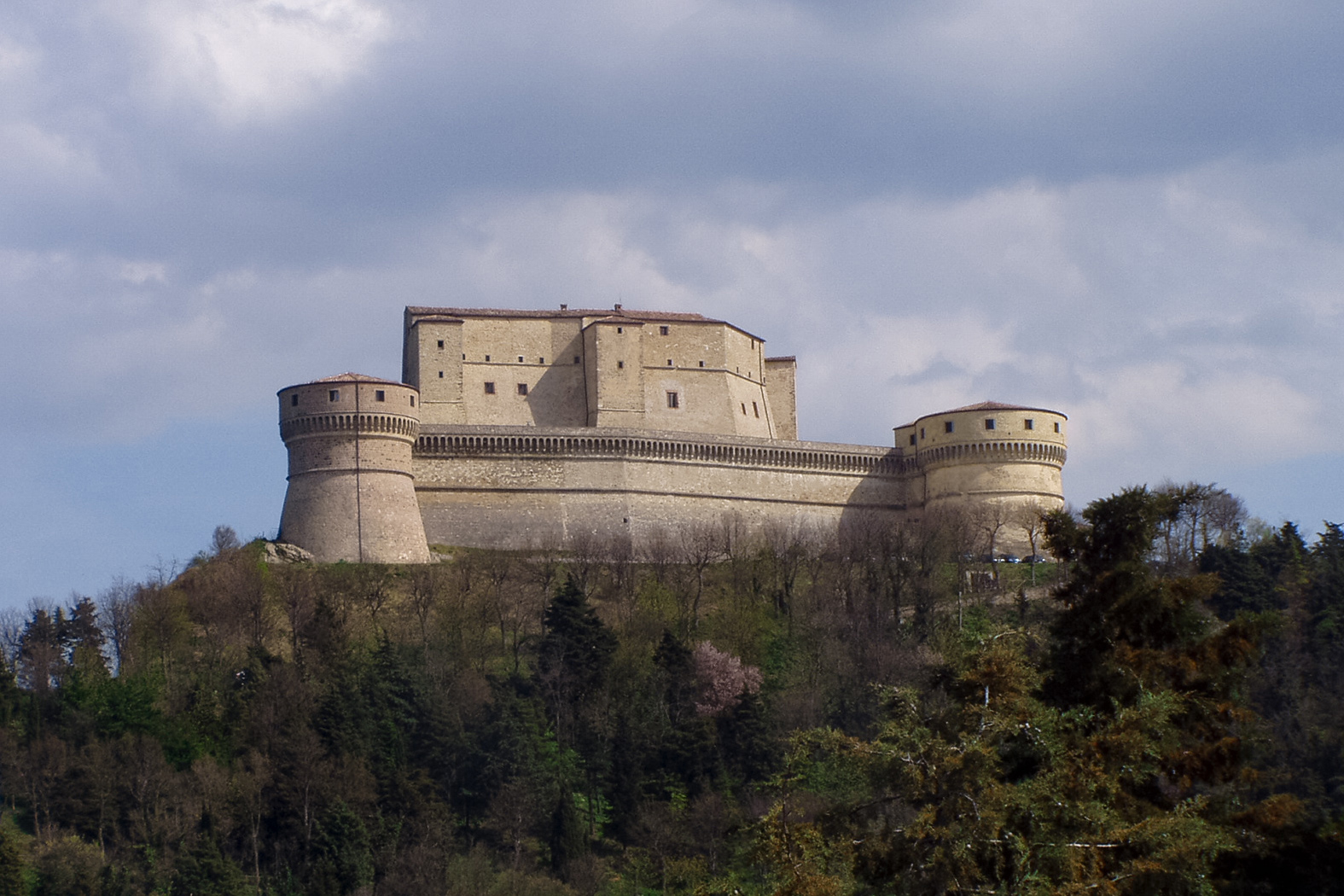
The Rocca di San Leo is a medieval fortress crowning a sheer limestone outcrop above the village of San Leo in the Montefeltro region of the Marche, near Rimini. Rising more than 600 metres above sea level and accessible in antiquity only by a narrow path cut into the rock, the fortification has been described by Dante, praised by Machiavelli, and admired by Napoleon. Its present form is largely the work of Francesco di Giorgio Martini, who redesigned it for Federico da Montefeltro of Urbino between 1479 and 1482 as one of the first Renaissance fortresses adapted to artillery warfare.
At a glance
- Type
- Medieval and Renaissance military fortress
- Period
- Early medieval origins; major reconstruction 1479–1482 by Francesco di Giorgio Martini
- Style
- Early Renaissance military architecture; artillery-adapted bastion design
- Location
- San Leo, Province of Rimini, Marche, Italy
- Coordinates
- 43.8971° N, 12.3465° E
Overview
The Rocca di San Leo stands on one of the most dramatic natural citadels in central Italy, a tall plateau of compact limestone that made the site almost impregnable before artillery made high walls obsolete. Francesco di Giorgio Martini’s redesign for Federico da Montefeltro created a revolutionary military architecture that anticipated the angular bastion systems that would define European fortification for the next three centuries. The fortress is also famous as the final prison of Count Alessandro di Cagliostro, the eighteenth-century occultist and adventurer, who died there in 1795 after being condemned by the Papal Inquisition.
History
The plateau of San Leo was fortified as early as the early medieval period, and the site was associated with Saint Leo of Mantenay, who established a hermitage there in the fourth century, and later with Saint Francis of Assisi. Control of the fortress passed through Malatesta, Montefeltro, and Papal hands over the medieval centuries. Federico da Montefeltro, Duke of Urbino, commissioned Francesco di Giorgio Martini to modernise the defences to counter the new threat of cannon fire, producing a structure of angled bastions and sloped walls that absorbed artillery impact rather than resisting it frontally. Under the Papal State the Rocca served as a high-security prison from the sixteenth century onward, holding political prisoners and religious dissidents until the unification of Italy in 1861.
What you see
Visitors approach the Rocca through the village of San Leo and ascend to the main gate via a ramp engineered for horses and artillery rather than a conventional staircase. Inside, the fortress contains a museum documenting its military and prison history, including the reconstructed cells where Cagliostro was held — among them the famous “pozzetto,” a shaft cell open to the sky. The panoramic views from the ramparts across the Montefeltro valleys and towards the Adriatic are exceptional. The fortress architecture itself, with its low angled towers and massive sloped revetments, remains one of the finest surviving examples of early Renaissance military engineering in Italy.
Cultural significance
The Rocca di San Leo holds a place in both the history of military architecture and the cultural memory of the Italian Renaissance: Dante cited the site in the Divine Comedy, and Machiavelli praised its defences in The Art of War. As one of the earliest practical applications of the new bastion system in Italy, it influenced the design of fortifications throughout Europe over the following century. The imprisonment and death of Cagliostro within its walls added a layer of Enlightenment-era mythology that continues to draw visitors interested in the history of occultism, Freemasonry, and papal justice.
Practical information
- Address
- Piazza Dante Alighieri, 61018 San Leo RN
- Access
- Open to visitors with paid admission; museum included
- Hours
- Check official website or local tourist office for seasonal hours
Getting there
San Leo is located approximately 30 km south-west of Rimini in the Montefeltro hills. By car from Rimini, take the SS258 towards Novafeltria and follow signs for San Leo (about 45 minutes). There is limited parking at the base of the village. Public bus connections from Rimini are available but infrequent — check local schedules in advance. The site is not practical to reach by train without a car or taxi transfer from Rimini station.
Sources & resources
Find it on the map
See this place and what’s around it →📷 Become a Cultural Heritage Online photographer
Share your photos of places: they stay published under your name as the author. The more they're seen, the more you get noticed — and soon a contest will reward the most appreciated photos.
Log in or sign up free to add a photo