
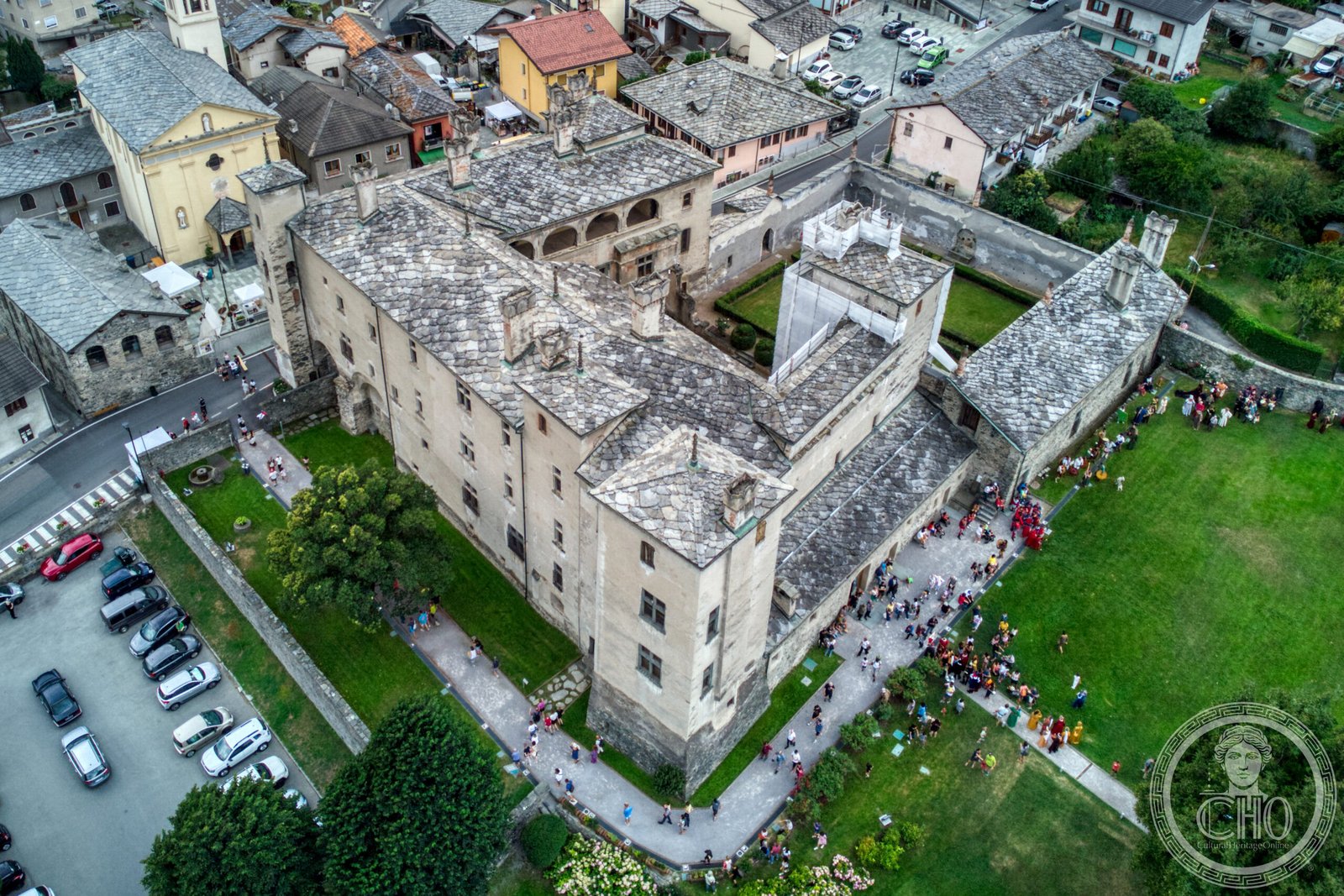
Issogne Castle is one of the most celebrated late-Gothic seigniorial residences in the Aosta Valley, located in the lower valley on the right bank of the Dora Baltea river. Rebuilt at the end of the fifteenth century by Giorgio di Challant as a refined courtly residence rather than a military fortress, the castle is renowned for its exceptional cycle of frescoes depicting scenes of daily medieval life — markets, trades, and courtly customs — that together form one of the most vivid pictorial documents of late-medieval Alpine society.
At a glance
- Type
- Seigniorial residence / Gothic castle
- Period
- Medieval origins; substantially rebuilt late 15th century (c. 1490s) by Giorgio di Challant
- Style
- Late Gothic; courtly Renaissance influence
- Location
- Issogne, lower Aosta Valley, Italy (45.6553° N, 7.6886° E)
Overview
Issogne Castle is one of the most famous manors of the Aosta Valley region, situated on the right bank of the Dora Baltea at the centre of the inhabited area of Issogne. As a seigniorial residence of the Renaissance period, it has quite a different character from the austere military fortresses typical of the upper valley, such as the nearby Verrès Castle on the opposite bank of the river. Its elegant courtyard, decorated loggia, and rich fresco cycle make it an outstanding example of late-Gothic courtly culture in the Alpine context.
History
The site has medieval origins but was fundamentally transformed in the 1490s by Giorgio di Challant, prior of the Church of Sant’Orso in Aosta and a leading figure of the powerful Challant dynasty that dominated the valley for centuries. Giorgio conceived the castle not as a stronghold but as a refined noble residence reflecting his humanist and courtly interests. After the Challant line died out, the castle passed through various noble families before being purchased in 1872 by Count Vittorio Avondo, a Turinese collector who recognised its historic value. Avondo bequeathed the castle to the Italian state in 1907, and it has been a protected monument and museum ever since.
What you see
The castle’s inner courtyard is dominated by an extraordinary pomegranate fountain and surrounded by a two-storey loggia with late-Gothic arched arcades. The walls and vaults of the ground-floor arcade are covered with vivid frescoes — a unique cycle depicting scenes of medieval daily life including market stalls, apothecary shops, a bakery, and groups of merchants and noblewomen — constituting one of the most important pictorial records of 15th-century Alpine society. The castle interiors preserve original furniture, tapestries, and decorative objects from the Challant and subsequent periods, giving it the rare quality of an almost intact late-medieval noble interior.
Cultural significance
Issogne Castle is a national monument of Italy and one of the most visited heritage sites in the Aosta Valley, drawing visitors who come specifically to study its fresco cycle — unique in the Alpine world for its focus on secular, everyday subjects rather than religious narratives. The castle exemplifies the cultural and political ambitions of the Challant dynasty, which positioned itself as a bridge between French Savoyard court culture and Italian Renaissance influence. It is managed by the Aosta Valley regional government and listed among the region’s finest examples of medieval heritage.
Practical information
- Address
- Piazza Castello, 11020 Issogne AO, Italy
- Admission
- Ticketed entry; reductions for EU citizens aged 18–25 and groups
- Coordinates
- 45.6553° N, 7.6886° E
Getting there
Issogne is located in lower Aosta Valley along the SS26 state road, approximately 60 km from Aosta and 85 km from Turin. By train, the nearest station is Verrès on the Chivasso–Aosta line, from which the castle is a short taxi or bus ride across the Dora Baltea. By car, take the A5 motorway (Turin–Aosta) and exit at Verrès.
Sources & resources
See the place
Find it on the map
See this place and what’s around it →📷 Become a Cultural Heritage Online photographer
Share your photos of places: they stay published under your name as the author. The more they're seen, the more you get noticed — and soon a contest will reward the most appreciated photos.
Log in or sign up free to add a photoIs this page about you?
This page is read by travellers and heritage enthusiasts who find it on Google. Tell us how you are connected to this place and we will take it from there.