
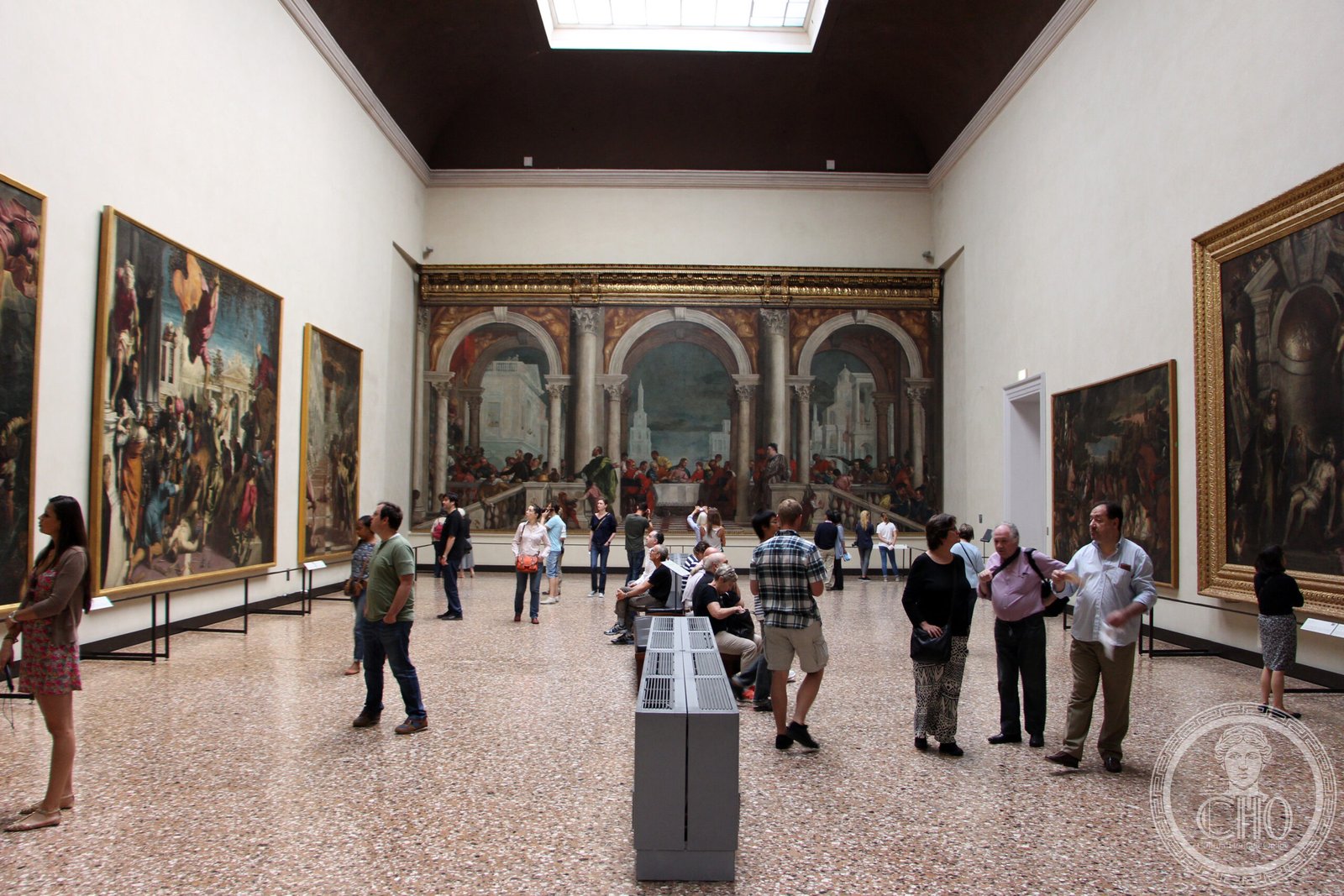
The Gallerie dell’Accademia is the principal museum of pre-19th-century Venetian painting, housed in a historic complex on the south bank of the Grand Canal in the Dorsoduro sestiere of Venice. Founded in 1750 as an art academy and reorganised as a public gallery in the Napoleonic period, it holds the world’s most comprehensive collection of Venetian masters including Giovanni Bellini, Vittore Carpaccio, Giorgione, Titian, Tintoretto, and Paolo Veronese. The museum also preserves Leonardo da Vinci’s Vitruvian Man, one of the most recognised drawings in the history of art.
At a glance
- Type
- State art museum
- Period
- Complex founded 13th–15th century (Scuola Grande della Carità); museum established 1750, public gallery from 1807
- Style
- Gothic and Renaissance Venetian architecture (Scuola Grande, church, and convent of Santa Maria della Carità)
- Location
- Campo della Carità, Dorsoduro, Venice, Italy
- Coordinates
- 45.4311° N, 12.3281° E
Overview
The Gallerie dell’Accademia occupies a complex of three interconnected buildings: the former Scuola Grande di Santa Maria della Carità, the church of the Carità, and the lateral convent of the Lateran Canons. Positioned at the foot of the Accademia Bridge — one of Venice’s three Grand Canal crossings — the museum anchors the cultural identity of the Dorsoduro neighbourhood. Its collection of approximately 800 works spans five centuries of Venetian painting, from the Byzantine-influenced panels of Paolo Veneziano in the 14th century to the grand narrative canvases of the 18th century.
History
The Accademia di Belle Arti di Venezia was founded in 1750 under the direction of the sculptor Giovanni Battista Piazzetta, initially as a school attached to the existing Scuola Grande della Carità. Following Napoleon’s suppression of Venetian religious confraternities in 1807, the complex was repurposed to house both the academy and its growing collection of artworks transferred from dissolved churches and monasteries across the city. The gallery was progressively expanded and reorganised throughout the 19th and 20th centuries, with a major renovation campaign in the later 20th century to improve circulation and conservation conditions. The current layout, designed partly by Carlo Scarpa in the 1940s–1960s, is itself considered a notable example of museum design.
What you see
The permanent collection is arranged chronologically across 24 rooms, tracing the evolution of Venetian painting from medieval Byzantine influence through the Renaissance revolution of light and colour and into the lavish decorative tradition of the 18th century. Highlights include Carpaccio’s Cycle of Saint Ursula (1490–1496), Giorgione’s La Tempesta, Titian’s Presentation of the Virgin in the Temple, and Veronese’s Feast in the House of Levi — a monumental canvas transferred from the refectory of the convent of Santi Giovanni e Paolo. Leonardo’s Vitruvian Man is preserved in the museum’s collection but displayed only in exceptional temporary exhibitions, approximately once every six years, due to its extreme light sensitivity.
Cultural significance
The Gallerie dell’Accademia is internationally recognised as the essential destination for understanding Venetian painting as a distinct tradition within the broader history of Western art. Its collection documents the unique role of Venice — its maritime wealth, its relationship with Byzantium and the Islamic world, its lay confraternities and state church — in shaping an artistic culture of unmatched chromatic and narrative richness. The museum itself, housed in buildings that survived the Napoleonic suppressions, embodies the complex history of Venetian cultural continuity and transformation.
Practical information
- Address
- Campo della Carità 1050, 30123 Venezia (Dorsoduro)
- Hours
- Tuesday–Sunday, 8:15–19:15; Monday 8:15–14:00 (check official website for current schedule and holiday closures)
- Admission
- Check gallerieaccademia.it for current ticket prices; advance booking recommended in peak periods
Getting there
The museum is directly accessible from the Accademia Vaporetto stop, served by Lines 1 and 2 along the Grand Canal. The Accademia Bridge connects Dorsoduro to the San Marco sestiere and is a 5-minute walk from Piazza San Marco via the wooden bridge. Water taxis can land at the Accademia traghetto crossing point nearby.
Sources & resources
- Gallerie dell’Accademia — Wikipedia
- Gallerie dell’Accademia (official site)
- Cultural Heritage Online
See the place
Find it on the map
See this place and what’s around it →Historical events at this place (1)
📷 Become a Cultural Heritage Online photographer
Share your photos of places: they stay published under your name as the author. The more they're seen, the more you get noticed — and soon a contest will reward the most appreciated photos.
Log in or sign up free to add a photo