
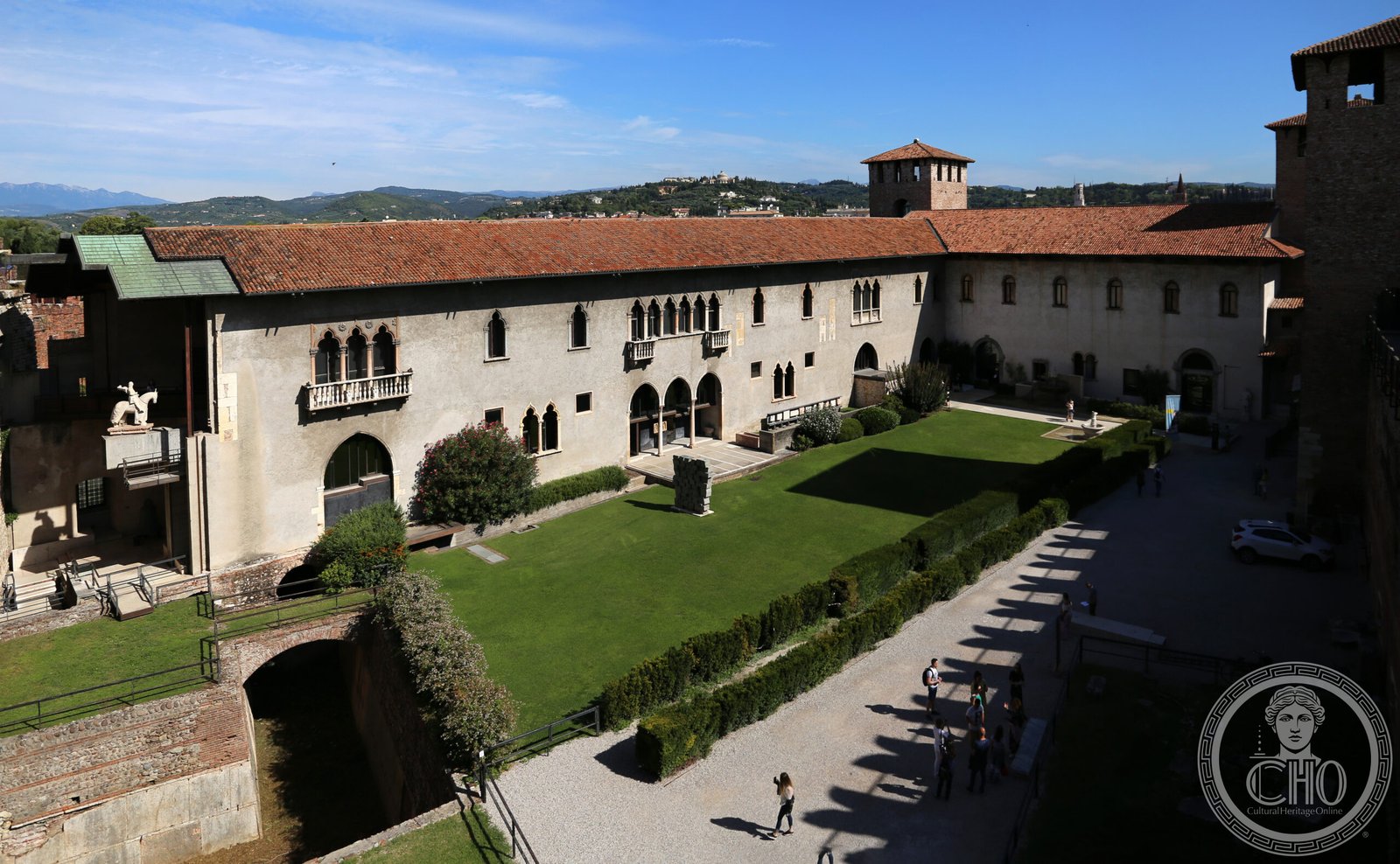
The Castelvecchio Civic Museum is one of Italy’s most celebrated art museums, housed in the 14th-century Scaligeri fortress of Castelvecchio on the banks of the Adige in Verona. The castle was built between 1354 and 1376 for Cangrande II della Scala, Lord of Verona, and converted into a civic museum in the early 20th century. Between 1957 and 1964 the Venetian architect Carlo Scarpa undertook a radical and now canonical renovation of the interiors and exhibition spaces, creating one of the defining works of museum architecture of the 20th century.
At a glance
- Type
- Municipal art museum within a medieval fortress
- Period
- Fortress built 1354–1376; museum from 1925; Scarpa renovation 1957–1964
- Style
- Scaligeri Gothic military architecture; 20th-century modernist museum design (Scarpa)
- Location
- Verona, Province of Verona, Veneto, Italy
- Coordinates
- 45.4399° N, 10.9879° E
Overview
The Castelvecchio Civic Museum holds Verona’s principal collection of medieval and early Renaissance art, including paintings, sculptures, arms, armour, jewellery, and decorative arts ranging from the Lombard period through the 18th century. The collection is particularly strong in Veronese painting from the 13th to 16th centuries and features major works by Pisanello, Mantegna, and Paolo Veronese. Carlo Scarpa’s renovation is studied worldwide as a masterclass in the integration of modern architecture within a historic structure, and the museum is as frequently visited by architects as by art lovers.
History
Castelvecchio — literally “old castle” — was constructed between 1354 and 1376 by Cangrande II della Scala as a combined palace, fortress, and refuge, connected to the right bank of the Adige by the Ponte Scaligero, a fortified bridge that still stands. After the fall of the Scaligeri dynasty in 1387, the complex was used variously by the Visconti, the Venetian Republic, and under Napoleon as a barracks and arsenal — uses that significantly damaged the medieval fabric. Systematic restoration began in the late 19th century, and the first museum was inaugurated in 1925. Carlo Scarpa was commissioned in 1957 to redesign the museum spaces, and his intervention — completed in stages through 1964 — stripped away later accretions, revealed original masonry, and introduced carefully calibrated concrete and steel fittings that have themselves become celebrated as design objects.
What you see
The fortress complex includes the castle proper, the Ponte Scaligero (one of the finest Gothic bridges in northern Italy), and a series of towers and courtyards. Inside, Scarpa’s display system places works in deliberate tension with the medieval structure: rough plaster and exposed brick coexist with raw concrete beams, bronze fittings, and precisely levelled platforms. The centrepiece of the installation is the equestrian statue of Cangrande I della Scala, presented on a cantilevered concrete shelf at the junction of two wings in a gesture that remains one of the most discussed curatorial decisions in modern museography. The collection spans from Lombard goldwork of the 6th and 7th centuries to 18th-century Venetian paintings.
Cultural significance
Castelvecchio Museum is listed as one of Carlo Scarpa’s principal works and is included in nearly every account of 20th-century architectural history as an exemplar of the respectful transformation of historic buildings. The Scaligeri fortress itself is part of the medieval defensive circuit of Verona, a UNESCO World Heritage Site since 2000, recognised for its outstanding ensemble of Roman, medieval, and Renaissance monuments. The collection is considered one of the richest repositories of Veronese art outside Rome and Florence.
Practical information
- Address
- Corso Castelvecchio 2, 37121 Verona VR, Italy
- Opening hours
- Tuesday–Sunday 10:30–18:00 (last entry 17:30); closed Monday and major holidays — check official website for current schedule
- Admission
- Paid; reduced rate available; Verona Card accepted
- Website
- museodicastelvecchio.comune.verona.it
Getting there
Castelvecchio is a 10-minute walk from Verona Porta Nuova railway station: head north along Corso Porta Nuova, then turn left along the Adige embankment (Lungadige Cangrande). By bus: lines 11, 12, and 13 stop near the museum. By car: parking is available along the Lungadige or in city car parks nearby; the historic centre is partially ZTL (limited traffic zone), so check current restrictions. Cycling along the Adige cycle path from the city centre is a pleasant option.
Sources & resources
See the place
Find it on the map
See this place and what’s around it →📷 Become a Cultural Heritage Online photographer
Share your photos of places: they stay published under your name as the author. The more they're seen, the more you get noticed — and soon a contest will reward the most appreciated photos.
Log in or sign up free to add a photoIs this page about you?
This page is read by travellers and heritage enthusiasts who find it on Google. Tell us how you are connected to this place and we will take it from there.