

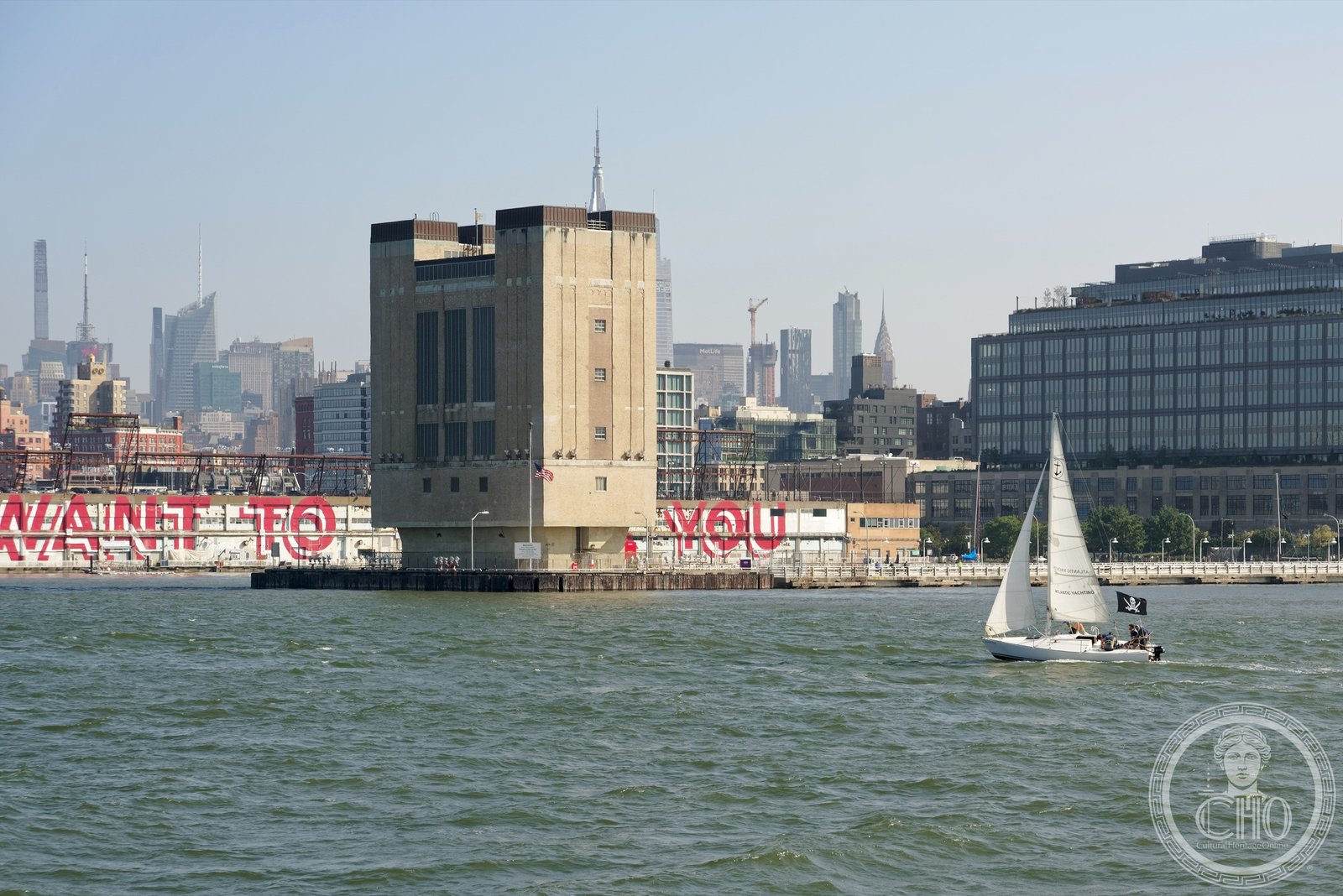
The Art Deco ventilation towers of the Holland Tunnel mark the Manhattan portal of the first mechanically ventilated vehicular tunnel in the world — and the engineering achievement that proved cars and tunnels could coexist safely under a major river.
At a glance
The Holland Tunnel opened on November 13, 1927, connecting Canal Street in lower Manhattan to Jersey City, New Jersey, beneath the Hudson River. Ventilation buildings stand at both portal ends of the tunnel — on the Manhattan side near Canal Street and on the New Jersey side in Jersey City, their Art Deco profiles a reminder that what was then the most complex engineering project in the world also demanded an architectural presence worthy of New York. The towers still function today exactly as they did in 1927: exchanging the tunnel’s air every ninety seconds, a mechanical necessity that became a civic landmark.
Key facts
- Opened: November 13, 1927
- Named after: Clifford Holland, chief engineer, who died in October 1924 before construction was complete
- Completed by: Ole Singstad, succeeding engineer
- Location: Canal Street at Varick Street, Manhattan (north tower); Jersey City, New Jersey (opposite portal)
- First of its kind: First underwater vehicular tunnel in the world to use forced mechanical ventilation
- Designation: National Historic Landmark (1993)
- Operated by: Port Authority of New York and New Jersey
History
When engineers began planning a road tunnel under the Hudson River in the early 1920s, the central problem was not digging — it was breathing. The internal combustion engine produces carbon monoxide, and a closed tunnel packed with automobiles would asphyxiate its users within minutes. No one had solved this problem at vehicular-tunnel scale before. The solution developed by Clifford Holland and his team was a system of 84 fans pushing fresh air along ducts built into the roadway floor, while exhaust air was drawn up through ceiling ducts and expelled through the ventilation towers. The engineering was so successful that it has remained the model for underwater highway tunnels ever since.
Clifford Holland did not live to see the tunnel open. He died on October 27, 1924, exhausted by the demands of the project, and the work was completed by his successor Ole Singstad. The state of New York and New Jersey named the completed tunnel in Holland’s memory — a rare honor for a civil engineer, and one that reflects how profoundly the project transformed daily life between Manhattan and New Jersey.
The tunnel opened to enormous public interest. On its first day, November 13, 1927, tens of thousands of vehicles passed through. What had required a ferry crossing — weather-dependent, seasonal, and slow — was now a seven-minute drive. The Holland Tunnel immediately became one of the most heavily used pieces of infrastructure in the United States, a status it has never relinquished.
What you see
The ventilation buildings are Art Deco structures clad in brick and stone, their massing organized as vertical towers above the roadway portals. The Manhattan ventilation building at Pier 34 (Canal Street) is the most prominent — a freestanding structure rising from the edge of the island, its horizontal banding and restrained ornamental detailing typical of the civic Art Deco that governed New York public infrastructure in the late 1920s. The towers were designed to be both functional and monumental: their height is determined by the need to exhaust air above pedestrian level, but their massing makes them unmistakably architectural objects rather than mere mechanical housings.
The portal itself — the dark oval mouth of the tunnel below the ventilation tower — is one of the most photographed images of lower Manhattan. The contrast between the brick-and-stone tower above and the industrial concrete portal below is deliberate: the architects understood that the tunnel entrance needed to announce itself as something significant, a threshold between two cities rather than merely a hole in the ground.
Practical information
- Access: The ventilation buildings are not open to public tours; they are operational infrastructure
- Best exterior views: Canal Street at Varick Street / Hudson Street for the Manhattan north tower; the Pier 34 building is visible from the street
- Tunnel use: Cash and E-ZPass tolls; westbound only (eastbound NJ to NY is toll-free)
- Pedestrians and cyclists: The Holland Tunnel does not permit pedestrians or bicycles; use the PATH train or ferry instead
Getting there
The Manhattan portal is in lower Manhattan’s Tribeca neighborhood, at Canal Street near Varick Street. The nearest subway stations are Canal Street on the 1/2 lines (two blocks north) and Spring Street on the C/E lines (four blocks north). By car, approach from the Holland Tunnel entrance on Canal Street westbound. From New Jersey, the tunnel entrance is in Jersey City, accessible via the New Jersey Turnpike Extension (I-78) or local streets from the PATH station at Exchange Place.
Nearby
- Tribeca neighborhood — The Holland Tunnel portal anchors the western edge of Tribeca, whose cast-iron warehouse district has become one of Manhattan’s most architecturally coherent neighborhoods
- Hudson River Park — The public greenway along the Hudson immediately adjacent to the tunnel portal, with views north toward the High Line and south toward the Statue of Liberty
- New York City Fire Museum, Spring Street — A converted firehouse six blocks from the tunnel entrance, housing a collection of historic fire apparatus including pre-tunnel-era equipment
- One World Trade Center (2014) — The Supertall tower is visible from the tunnel approach, a mile northeast across lower Manhattan
Sources
- Port Authority of New York and New Jersey, Holland Tunnel official history, panynj.gov
- National Park Service, National Historic Landmark designation documentation, nps.gov/nhl
- Wikipedia, “Holland Tunnel,” en.wikipedia.org/wiki/Holland_Tunnel
- Petroski, Henry, Engineers of Dreams: Great Bridge Builders and the Spanning of America, Knopf, 1995
Find it on the map
See this place and what’s around it →Record researched and written by Luigi De Marchi for Cultural Heritage Online, 2026.
📷 Become a Cultural Heritage Online photographer
Share your photos of places: they stay published under your name as the author. The more they're seen, the more you get noticed — and soon a contest will reward the most appreciated photos.
Log in or sign up free to add a photoIs this page about you?
This page is read by travellers and heritage enthusiasts who find it on Google. Tell us how you are connected to this place and we will take it from there.