
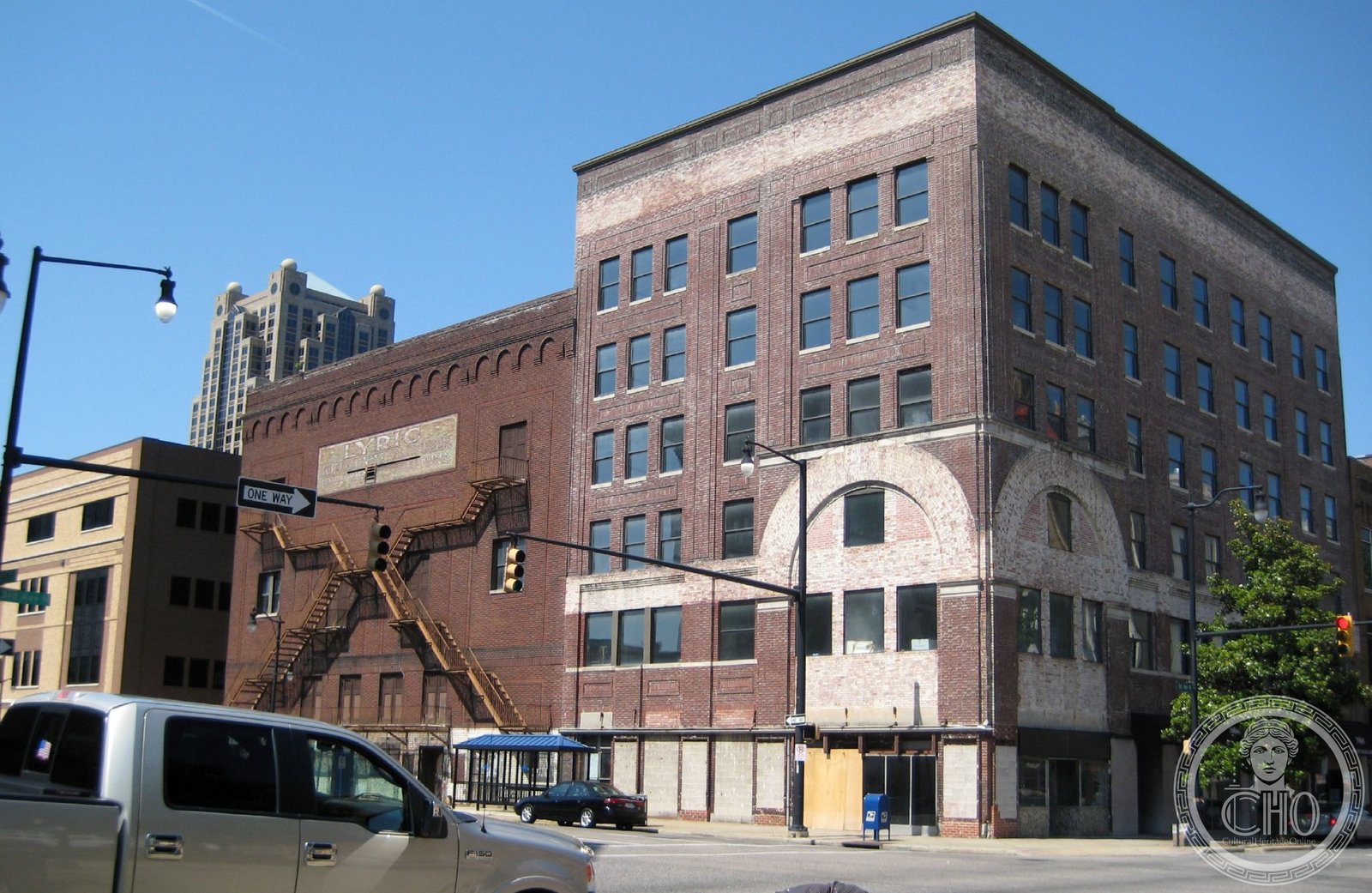
Lyric Theatre
Built in 1914 as Birmingham’s premier vaudeville house, the Lyric Theatre was the flagship of the city’s early twentieth-century Theater District and has been painstakingly restored as a living centerpiece of Birmingham’s downtown cultural revival.
At a glance
The Lyric Theatre stands at 1800 3rd Avenue North in Birmingham’s historic Theater District, a block that once anchored one of the South’s most concentrated entertainment corridors. Opened in 1914 as a vaudeville and performing arts venue, the Lyric operated for decades before closing in 1963. After more than fifty years of dormancy and deterioration, a landmark restoration funded through public, private, and federal historic tax credit sources returned the theater to active use in 2016 as a venue for live performances, concerts, and community events.
Key facts
- Address: 1800 3rd Avenue North, Birmingham, AL 35203
- Opened: 1914
- Style: Beaux-Arts / Classical Revival
- Capacity: approximately 950 seats (restored configuration)
- Listed: National Register of Historic Places
- Restored and reopened: 2016
- Current use: live music, theatrical performances, community events
History
Birmingham’s Theater District on 3rd Avenue North developed in the first decades of the twentieth century as the city’s iron and steel industry created a large urban working class with disposable income and appetite for popular entertainment. The Lyric Theatre, opened in 1914, was the flagship of this district, offering vaudeville performances and later transitioning to film as cinema displaced the variety format. In its peak years, the Lyric attracted touring performers of national stature and served as Birmingham’s main outlet for live theatrical entertainment.
The theater closed in 1963, and the building subsequently fell into a decades-long cycle of deferred maintenance and partial occupation. The surrounding Theater District experienced the same urban disinvestment that affected Birmingham’s downtown core following the steel industry’s contraction. Preservation efforts, led by the Lyric Theatre Foundation in partnership with the City of Birmingham and Preservation Alabama, assembled the financing for a comprehensive restoration using federal and state historic tax credits. The Lyric reopened in 2016, and its restoration has been credited with anchoring the broader revival of the surrounding Linn Park and Civil Rights District area.
Birmingham’s civil rights history gives the Theater District additional resonance: Kelly Ingram Park, the Sixteenth Street Baptist Church (1911), and the Birmingham Civil Rights Institute are all within walking distance of the Lyric, making the immediate area one of the most historically significant urban blocks in the American South.
What you see
The Lyric Theatre’s 3rd Avenue North facade presents a five-story composition in pressed brick with terracotta ornament, organized around a central projecting entry bay with Beaux-Arts classical detailing. The main entrance features arched openings at street level and elaborate terracotta cartouches above; the upper floors carry decorative pilasters and cornice moldings in a language influenced by late-nineteenth-century commercial classical architecture. The vertical proportions and ornamental density distinguished the Lyric from the lower-scaled commercial buildings along the block.
The restored interior retains the original orchestra and balcony configuration, with decorative plasterwork in the lobby and auditorium recovered through careful conservation work. Technical systems — lighting, rigging, acoustic treatment — were brought to contemporary performance standards while maintaining the historic spatial character of the hall.
Practical information
- Events: check the Lyric Theatre calendar for current programming
- Box office: tickets available online and at the venue on event days
- Guided tours: available on select dates; contact the Lyric Theatre Foundation
- Time needed: 20–30 minutes for exterior and lobby; 2–3 hours for a performance
Getting there
The Lyric Theatre is located at 1800 3rd Avenue North in downtown Birmingham, accessible from Birmingham-Shuttlesworth International Airport (BHM) approximately 5 miles northeast. The MAX bus transit system serves the downtown corridor; a light rail extension connecting the downtown Theater District to the UAB medical campus is in planning. Street parking and public garages are available throughout the downtown core.
Nearby
- Sixteenth Street Baptist Church (1911) — National Historic Landmark and site of the 1963 bombing; 3 minutes on foot west at 1530 6th Avenue North
- Birmingham Civil Rights Institute — museum and research center dedicated to the civil rights movement, adjacent to Kelly Ingram Park
- Kelly Ingram Park — site of the 1963 civil rights demonstrations; 5 minutes on foot west
- Alabama Theatre (1927) — neighboring picture palace at 1817 3rd Avenue North, 1 minute on foot; both theaters anchor Birmingham’s surviving entertainment district
Sources
- Lyric Theatre Foundation, Birmingham (lyricbirmingham.com)
- National Register of Historic Places nomination, Lyric Theatre
- Fly, Everett. Birmingham: The Making of an American City. Birmingham Historical Society, 1997.
Find it on the map
See this place and what’s around it →📷 Diventa un fotografo di Cultural Heritage Online
Condividi le tue foto dei luoghi: restano pubblicate con la tua firma come autore. Più vengono viste, più ti fai conoscere — e presto un concorso premierà le foto più apprezzate.
Accedi o registrati gratis per aggiungere una fotoDo you manage this place?
This page is read by travellers and heritage enthusiasts who find it on Google. Keep it accurate — and make it work for you. Free for non-profit heritage institutions.