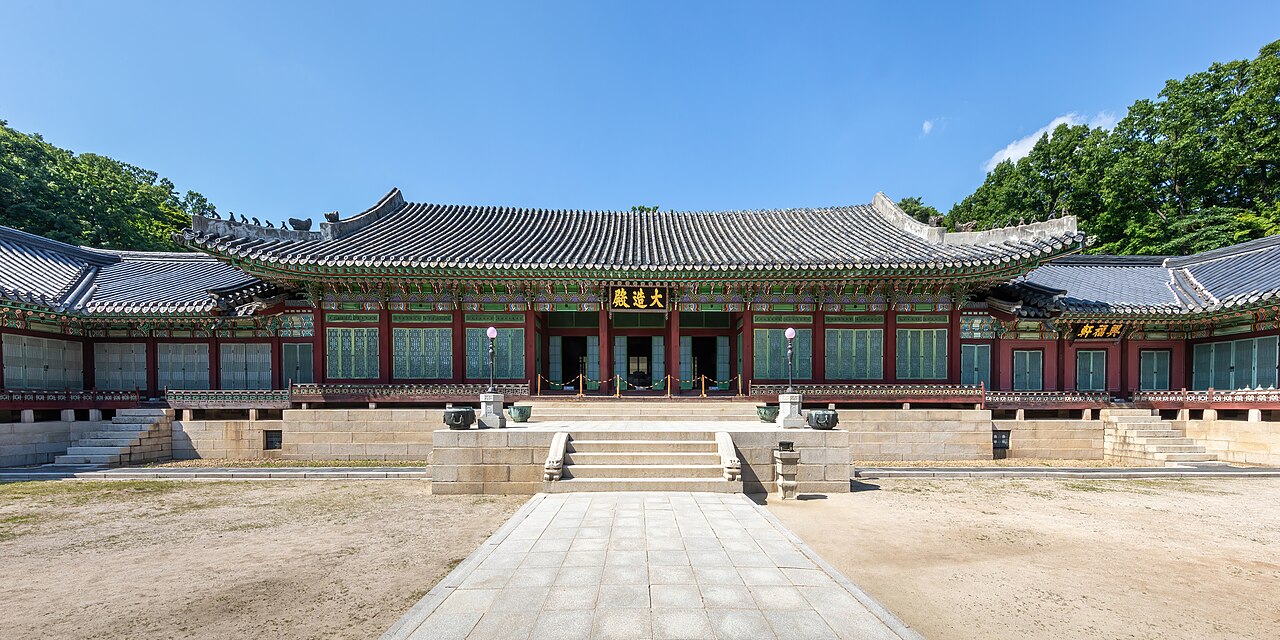
Changdeokgung Palace in Seoul was built in 1405 as a secondary royal residence of the Joseon dynasty and inscribed as a UNESCO World Heritage Site in 1997. The 43-hectare compound served as the actual seat of Joseon government for most of the dynasty, and its 32-hectare rear garden, the Huwon, is considered the finest surviving example of traditional Korean garden design. The last members of the Joseon royal family lived in the palace complex until 1989.
The Palace That Became the Seat of Power Jongno-gu, central Seoul, 5 minutes by subway from Anguk Station (Line 3)
Changdeokgung — the name translates as “Palace of Illustrious Virtue” — was constructed in 1405 on the orders of King Taejong, the third ruler of the Joseon dynasty (1392–1897), as a supplement to the main Gyeongbokgung Palace, which stood approximately one kilometre to the west. The choice of site followed the principles of Korean geomantic siting: the compound sits at the foot of a forested ridge (Bugaksan mountain, 342 metres) to the north, with lower ground to the south and a stream running along the southern perimeter. This configuration — mountain behind, water in front — is expressed by the Korean term baesanimsu and was considered essential for a palace that would concentrate royal power.
Although Gyeongbokgung was the officially designated main palace, successive Joseon kings consistently preferred Changdeokgung as their residence and place of government. The reasons were partly aesthetic — its relationship to the surrounding landscape was considered more harmonious — and partly practical: the compound’s layout followed natural terrain more closely than the rigidly axial Gyeongbokgung, resulting in spaces of varied character. The throne hall (Injeongjeon, rebuilt 1804) and the main gate (Donhwamun, built 1412, the oldest surviving palace gate in Seoul) establish the formal ceremonial axis, while other parts of the compound follow the natural topography in a more irregular arrangement.
The palace was almost entirely destroyed in 1592 during the Japanese invasion under Toyotomi Hideyoshi, known in Korean history as the Imjin War (1592–1598). Japanese forces entered Seoul without significant resistance; the Joseon king Seonjo fled north to the Chinese border, and both Changdeokgung and Gyeongbokgung were burned — reportedly not by the Japanese but by enslaved people from the palace who seized the opportunity to destroy the registration records that documented their status. When King Seonjo returned to Seoul after the war ended, he chose to rebuild Changdeokgung first rather than the main palace because its site relative to Bugaksan was considered superior for geomantic reasons. Gyeongbokgung remained in ruins until a controversial reconstruction in the 19th century under the regent Heungseon Daewongun.
Changdeokgung served as the seat of the Joseon court from its rebuilding in 1610 until 1872, a period of 262 years. During this time the compound was expanded, modified, and partially destroyed and rebuilt again following fires. The Nakseonjae complex, a smaller courtyard of residential halls built in 1847 for a royal concubine and her household, preserves the most intimate domestic scale within the compound and was the last part of the palace to remain in use: the widow of the last Joseon king, Empress Sunjeong, lived there until her death in 1966, and the last surviving member of the royal family, Yi Bangja (wife of Crown Prince Euimin), remained in Nakseonjae until 1989.
The Huwon Secret Garden: 300-Year-Old Trees and a Design That Follows Hillside Contours Northern section of the Changdeokgung compound, guided tours only
The Huwon (“rear garden,” also called Biwon, or “Secret Garden”) occupies approximately 32 hectares on the forested northern slope immediately behind the palace buildings. It is the largest and best-preserved example of traditional Korean garden design, and its inclusion within the UNESCO inscription was considered one of the primary justifications for the Outstanding Universal Value determination. The garden contains over 300 species of trees and shrubs, many of them several centuries old; 26 traditional pavilions in varying scales and conditions; and a central landscape organised around Buyongji Pond, a rectangular lotus pool with a round island at its centre, flanked by the hexagonal Buyongjeong pavilion on the water’s edge and the Juhamnu library pavilion above it on the slope.
The design principle of the Huwon contrasts deliberately with the formal garden traditions of China and Europe. Chinese imperial gardens of the same period (notably the gardens of the Summer Palace in Beijing) used artificial hills, diverted water channels, and constructed rockeries to create scenery on flat or near-flat terrain. European formal gardens of the 17th and 18th centuries imposed geometric plans on the landscape through axial paths, parterres, and topiary. The Huwon instead accepts the natural topography of its hillside site, using existing ridges and valleys as the framework for its composition. Clearings were cut in the existing forest to create open spaces around ponds and meadows; pavilions were placed at viewpoints determined by the natural topography rather than by a predetermined plan. The result is a garden whose organisation can only be understood by moving through it — it has no single vantage point from which the whole is visible, and the experience changes completely in each season.
The 26 pavilions distributed across the garden range from elaborate two-story library buildings to simple single-room shelters at the edge of ponds. Juhamnu (the Library Pavilion), a two-story wooden structure above Buyongji Pond, was built in 1776 under King Jeongjo to house the Kyujanggak royal library. The library’s collections, which included official government documents, royal diaries, and works of Korean and Chinese literature, were eventually transferred to Seoul National University and the National Archives of Korea; the building now stands empty. Eoneugjeong, a simple square pavilion in the upper reaches of the garden, is surrounded by the oldest trees in the compound, several of which are registered as Natural Monuments of Korea under the country’s cultural property system.
Access to the Huwon is controlled and limited to guided tours that depart at fixed times each day. The restriction reflects both conservation concerns (the density of visitors that unrestricted access would produce in the confined garden spaces) and the practical difficulty of managing movement through terrain that has only narrow paths. Tours are conducted in Korean and English; the English-language tour schedule is more limited than the Korean-language schedule. Advance reservation is strongly recommended, particularly in spring (when the azaleas and flowering cherries are in bloom around the ponds) and autumn (when the deciduous trees of the hillside turn red and gold). The combination of the garden’s aged trees, still ponds, and wooden pavilions makes the autumn tour among the most atmospheric heritage experiences available in Seoul.
Practical information
Changdeokgung is in the Jongno district of central Seoul. The nearest subway station is Anguk (Line 3), approximately 5 minutes on foot from the main gate (Donhwamun). The palace is open Tuesday to Sunday (closed Monday). Entry to the main palace compound requires a general admission ticket; separate tickets are required for the Huwon guided tours, which depart at fixed times and have limited capacity. English-language Huwon tours run several times daily but are fewer than Korean-language tours; check the Cultural Heritage Administration website for the current schedule and reserve in advance. The nearby Jongmyo Shrine (Royal Ancestral Shrine of the Joseon dynasty, also a UNESCO World Heritage Site since 1995) is approximately 600 metres east on foot and can be combined in a single day. Gyeongbokgung Palace (not UNESCO-listed) is approximately one kilometre west and also offers a complementary perspective on Joseon palace architecture. The Bukchon Hanok Village historic district lies between Changdeokgung and Gyeongbokgung. Spring (late March to May) and autumn (October to November) are the most visited seasons for good reason; summer is hot and humid but the Huwon garden’s shade makes afternoon visits tolerable.
Frequently Asked Questions
What UNESCO World Heritage Sites are closest to Changdeokgung Palace?
The nearest UNESCO World Heritage Site to Changdeokgung is Jongmyo Shrine, approximately 600 metres east on foot. Jongmyo is the Confucian ancestral shrine of the Joseon dynasty, where the spirit tablets of deceased kings and queens were kept and where ritual ceremonies were performed. It was inscribed in 1995, two years before Changdeokgung, and holds one of the longest-running musical and ritual ceremonies in the world: the Jongmyo Jerye, performed on the first Sunday of May each year, is a re-enactment of the Joseon ancestral rites including court music (jongmyo jeryeak) played on instruments preserved since the 15th century. The shrine’s main hall, Jeongjeon, is the longest wooden building in Korea, with 19 chambers each housing the spirit tablets of one king and his principal queens. The combination of Changdeokgung and Jongmyo can be completed in a single day, though each merits at least three hours of dedicated attention. Beyond these two, the Joseon Royal Tombs (inscribed 2009) are distributed across the Seoul metropolitan area; the closest cluster is at Seooreung and Dongureung in the outer suburbs. Hwaseong Fortress in Suwon, also a UNESCO site (inscribed 1997), is approximately 30 kilometres south of central Seoul by subway and express bus.
Why did the last Joseon royal family members continue to live in Changdeokgung after the dynasty ended?
Korea became a Japanese protectorate in 1905 and was formally annexed as a Japanese colony in 1910, ending the Joseon dynasty. The last reigning king, Sunjong (r. 1907–1910), was stripped of his governmental powers but permitted to remain in Changdeokgung with the title “Yi Wang” (Prince Yi). He died in Changdeokgung in 1926. His widow, Empress Sunjeong (1894–1966), continued to live in the Nakseonjae complex after his death and remained there through the Japanese colonial period, the Korean War, and into the early years of the Republic of Korea. Her presence gave the palace a continuous living occupation into the modern period. After her death, Crown Prince Euimin (the younger brother of Sunjong, who had been taken to Japan as a child hostage in 1907 and educated there under Japanese supervision) returned to Korea in 1963 in poor health. He and his wife, Yi Bangja (a Japanese princess), occupied Nakseonjae until his death in 1970. Yi Bangja remained in Nakseonjae, working on behalf of people with disabilities in Korea, until her death in 1989. The compound was then fully transferred to the Republic of Korea’s Cultural Heritage Administration. The presence of the royal family across this period meant that Nakseonjae was maintained as a residence rather than a museum, preserving much of its original furniture, fittings, and garden plantings.
How does Changdeokgung’s garden design differ from other historic gardens in East Asia?
The Huwon at Changdeokgung is classified by heritage scholars as an example of Korean “naturalistic” garden design, in explicit contrast to the two dominant traditions of East Asian garden-making: the Chinese tradition of constructed scenery and the Japanese tradition of abstracted landscape. Chinese imperial gardens — the Yuanmingyuan, the Summer Palace, the private Suzhou gardens — typically involve artificial landscape construction: hills built from excavated material, ponds dug on flat ground, rock formations imported from distant quarries. The Huwon instead accepted the given hillside terrain of the site, cleared existing forest where open water was needed, and positioned pavilions at points in the topography that already offered composed views. No artificial hills were built. The water features — Buyongji Pond, Aeryeonji Pond, and several smaller pools — follow existing depressions in the terrain rather than imposing geometric forms. This approach, rooted in Korean Confucian philosophy’s emphasis on working with nature rather than imposing form on it, produces a garden whose experience is inseparable from its specific topography. It could not be replicated on a different site. By contrast, the Chinese and Japanese traditions developed garden languages that were, in principle, portable: the same compositional elements could be assembled in different configurations in different locations. The Huwon’s site-specificity is one of the attributes UNESCO cited as contributing to its Outstanding Universal Value.