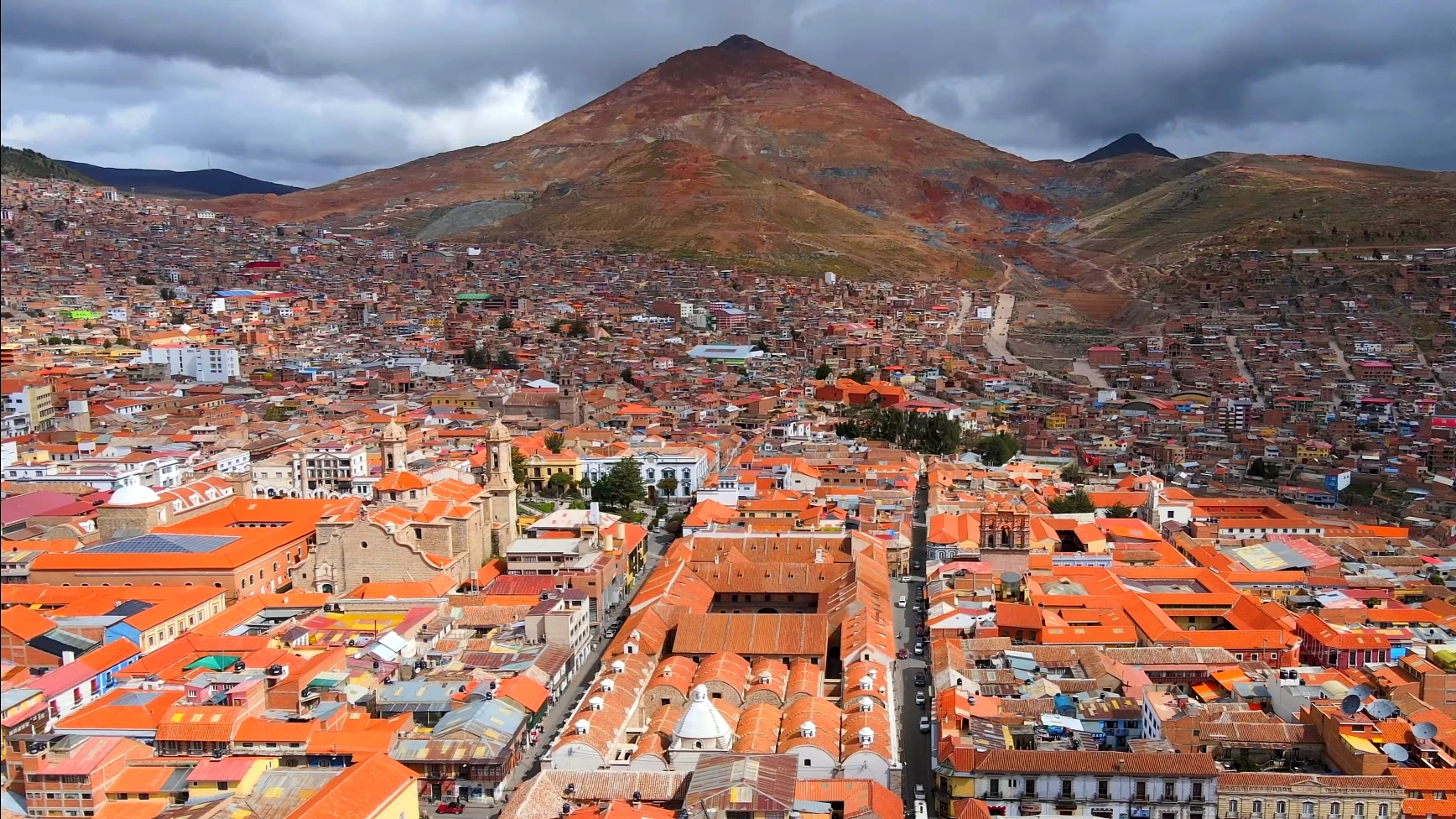
The City of Potosí, inscribed in 1987 and placed on the List of World Heritage in Danger in 2014, is the city built on the mountain of silver that financed the Spanish Empire and fuelled the Atlantic economy for 200 years — a city of 160,000 people in the sixteenth century, now struggling to reconcile tourism with the ongoing mining of a mountain whose summit is collapsing inward. The city of Sucre, Bolivia’s constitutional capital, is 160 km northeast.
City of Potosí: The Silver Mountain and the Empire’s Engine City centre and Cerro Rico
The City of Potosí, inscribed in 1987 under criteria (ii), (iv), and (vi), was founded in 1545 following the discovery of silver in the Cerro Rico (Rich Mountain) by the Quechua miner Diego Huallpa — a discovery so dramatic in its consequences that a Spanish expression entered the language: “vale un Potosí” (worth a Potosí, meaning priceless). By 1650 Potosí was the largest city in the Western Hemisphere with 160,000 residents — larger than Madrid or Rome at the time — sustained entirely by silver extraction from the Cerro Rico, which produced approximately 60% of the world’s silver output for 150 years and an estimated 41,000 tonnes of silver over three centuries of exploitation. The Casa de la Moneda (Royal Mint), built 1572 and comprehensively rebuilt 1759–1773 (the largest and best-preserved colonial building in South America), processed the silver ore into coins for the Spanish imperial economy; its massive wooden rolling mills (moved by mule and human power, producing the first machine-rolled coinage in South America) are still in situ. The baroque churches of Potosí — San Lorenzo (1728–1744, whose mestizo baroque portal combines Andean and European decorative elements in the most elaborate church facade in Bolivia), San Agustín, and the Church of the Company of Jesus — document the extraordinary wealth that silver poured into the city’s religious institutions.
Cerro Rico Mining Tours: Industrial Heritage Under Active Extraction 🚕 10 mins from Plaza 10 de Noviembre
The Cerro Rico (Potosí Mountain) is unique in global heritage tourism: an actively mined UNESCO World Heritage Site where cooperative miners still work the silver, tin, and zinc veins using methods that mix heavy machinery with tools unchanged from the colonial period. Guided tours of the working mines (offered by several Potosí operators, lasting 2–4 hours) enter the tunnels through low entrances, meet miners at work with pneumatic drills and manual tools, and observe the internal shrine to El Tío (the Devil of the mine), to whom miners make offerings of coca leaves, alcohol, and cigarettes — a survival of Andean pre-Christian mining ritual. UNESCO placed Potosí on its Danger List in 2014 specifically because the uncontrolled mining is causing structural collapse in the upper Cerro Rico; the summit area (above 4,700 m) has been partially filled with cement to prevent total subsidence, and large sections of the colonial urban fabric are threatened by tunnel collapse beneath the city streets. The mining cooperative employs approximately 15,000 miners and continues to operate over UNESCO objections.
Sucre: Bolivia’s White Constitutional Capital 🚗 ~3.5 hrs northeast
Historic City of Sucre, inscribed in 1991 under criteria (iv) and (v), is Bolivia’s constitutional capital — a city of colonial white-washed buildings (earned the nickname “La Ciudad Blanca”) built on a temperate plateau at 2,810 metres in the Bolivian highlands, where the Spanish university (Universidad de San Francisco Xavier, founded 1624, the third-oldest university in the Americas) trained the lawyers and priests who would drive Bolivian independence. The Casa de la Libertad (House of Freedom) is the hall where Bolivian independence was declared on 6 August 1825; Simón Bolívar participated in the ceremony and the country was named in his honour. The Cathedral and the Convent of La Recoleta (a Franciscan convent overlooking the city) are the finest colonial religious buildings; the Textile Museum of Sucre documents the Jalq’a and Tarabuco weaving traditions — some of the most complex textile work in the Andes, produced on backstrap looms by indigenous weavers in the surrounding villages. The Cretaceous dinosaur trackways discovered at Cal Orcko (5 km from Sucre) are the world’s largest dinosaur track site: 5,055 tracks from 294 dinosaur individuals on a vertical limestone cliff face.
Uyuni Salt Flat: The World’s Largest Mirror 🚌 ~4 hrs south
The Salar de Uyuni is not UNESCO-inscribed but is Bolivia’s most-visited natural attraction — a 10,582-square-kilometre salt flat at 3,656 metres, the world’s largest salt lake, created by the evaporation of a prehistoric lake (Lago Minchín) approximately 30,000 years ago. The salt crust, 1–10 metres thick, contains approximately 10 billion tonnes of salt; beneath it is the world’s largest reserve of lithium (estimated 21 million tonnes, approximately 50% of global reserves), currently the subject of extraction negotiations between the Bolivian government and international mineral companies. During the rainy season (December–March), a thin film of water on the salt flat creates a perfect mirror reflecting the sky — one of the most photographed natural phenomena in South America. The rust-coloured island of Incahuasi (4,000 m elevation above the flat) is covered in giant cacti up to 10 metres tall and provides the archetypal aerial photography perspective over the white salt expanse.
Practical information
Potosí is served by Juan Méndez Airport (POI) with domestic flights from La Paz (1 hr, sometimes via Sucre); the most reliable access is by bus from Sucre (3.5 hrs, frequent departures) or La Paz (7–8 hrs, overnight buses available). Altitude is the main visitor concern: Potosí sits at 4,090 metres — among the highest cities in the world — and altitude sickness (soroche) is common; allow 2–3 days for acclimatisation and avoid alcohol for the first 24 hours. The Casa de la Moneda (entry required, guided tours in Spanish/English/French, closed Monday) and the church facades are the primary daytime attractions; the mine tours operate daily from the Mercado Minero. Sucre is 160 km northeast and is more comfortable for acclimatisation (2,810 m); many visitors base themselves in Sucre and day-trip to Potosí. The best season is May–October (dry season).
Frequently Asked Questions
Is Potosí a UNESCO World Heritage Site?
Yes. The City of Potosí was inscribed in 1987 under criteria (ii), (iv), and (vi). However, Potosí was added to UNESCO’s List of World Heritage in Danger in 2014 due to damage caused by uncontrolled mining in the Cerro Rico, whose structural collapse threatens the foundations of the historic city above. Bolivia has submitted conservation plans to UNESCO, but active mining continues.
What is the mita system and why is it significant?
The mita was a system of forced labour imposed by the Spanish colonial government on indigenous Andean men between the ages of 18 and 50. Each year, one-seventh of the indigenous male population of designated districts was required to work in the Potosí mines for one year, performing the most dangerous tasks (hauling ore, managing the mercury amalgamation process) for minimal pay. Historians estimate that between 4 and 8 million indigenous workers and enslaved Africans died in the Potosí mines between 1545 and 1825 from rockfalls, mercury poisoning, and silicosis; the mine consumed so many lives that a Spanish saying emerged: “The road to Potosí is paved with the bones of Indians.” The mita was abolished with Bolivian independence in 1825.
What is Bolivia’s lithium situation and why does it matter?
The Salar de Uyuni contains approximately 21 million tonnes of lithium — the largest single reserve in the world, estimated at 50% of global lithium reserves. Lithium is the primary material in the rechargeable batteries that power electric vehicles and portable electronics; global demand is expected to increase 5–10 times by 2040. Bolivia’s government has pursued a state-controlled extraction model (through YACIMIENTOS DE LITIO BOLIVIANOS) rather than allowing direct foreign company concessions; extraction infrastructure has been constructed but production remains below initial projections. The lithium wealth has the potential to reshape Bolivia’s economy — and the environmental consequences of large-scale salt flat extraction are actively debated.
Sources
- S1 — Bakewell, Peter J. Miners of the Red Mountain: Indian Labor in Potosí, 1545-1650. University of New Mexico Press, 1984. ISBN 978-0-8263-0769-9.
- S2 — Galeano, Eduardo. Open Veins of Latin America. Monthly Review Press, 1973. ISBN 978-0-85345-991-0.
Spotted an error? Write to editorial@culturalheritageonline.com and we correct it the same day.