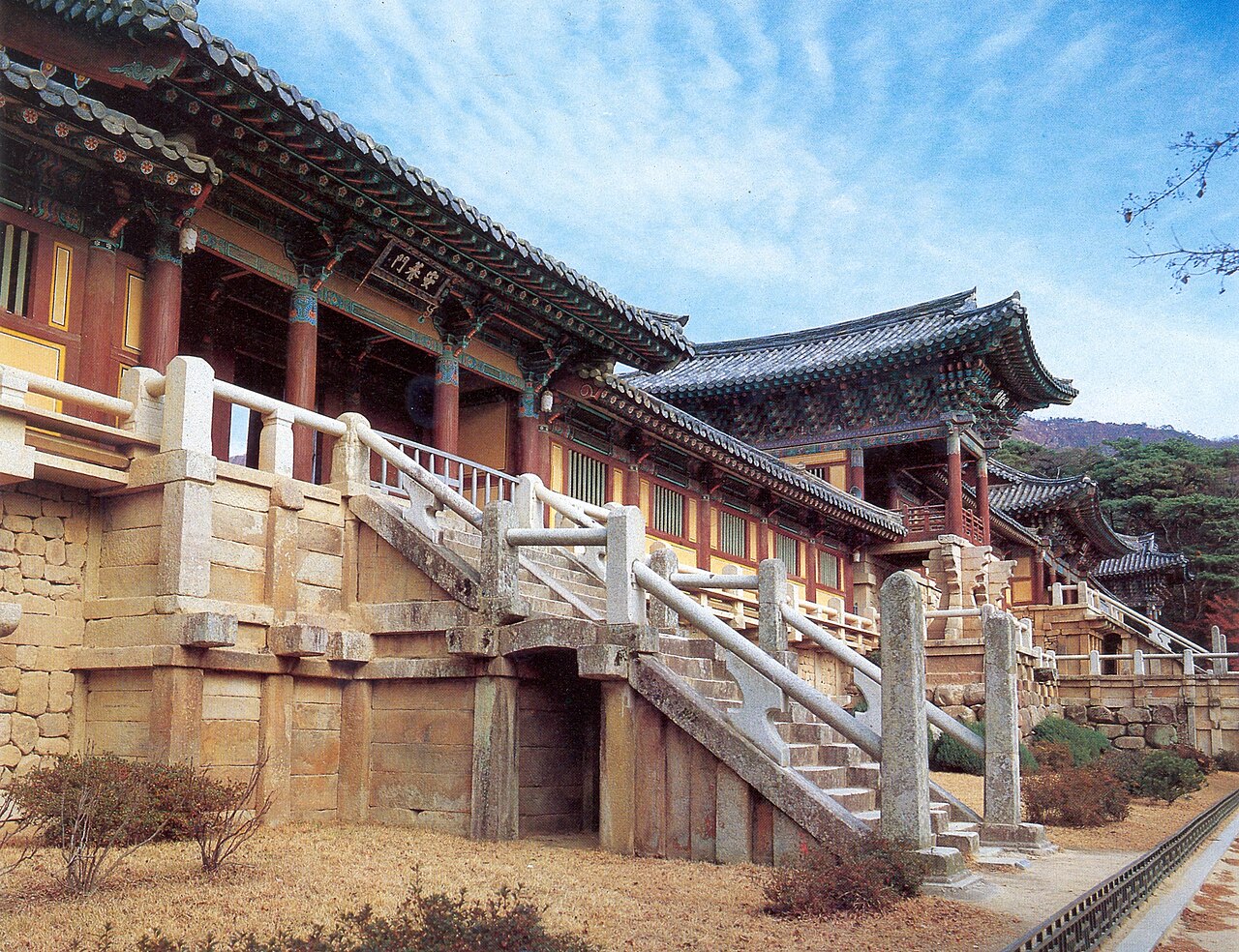
The nearest World Heritage site to Seokguram Grotto and Bulguksa Temple is the Gyeongju Historic Areas, 11 km away in a straight line, followed by Hahoe and Yangdong (24 km) and the Petroglyphs along the Bangucheon Stream (26 km), all in the Republic of Korea. Seokguram and Bulguksa, inscribed in 1995 under criteria (i) and (iv), are an 8th-century Silla grotto and the temple complex built with it on Mount Toham.
Which World Heritage sites lie closest to Seokguram and Bulguksa?
The distances below are straight lines between the reference points UNESCO publishes for each property, measured to the nearest component of a serial site. They are not road distances or travel times.
| Site | Country | Distance | Inscribed | Type |
|---|---|---|---|---|
| Gyeongju Historic Areas | Republic of Korea | 11 km | 2000 | Cultural |
| Historic Villages of Korea: Hahoe and Yangdong | Republic of Korea | 24 km | 2010 | Cultural |
| Petroglyphs along the Bangucheon Stream | Republic of Korea | 26 km | 2025 | Cultural |
| Seowon, Korean Neo-Confucian Academies | Republic of Korea | 30 km | 2019 | Cultural |
| Sansa, Buddhist Mountain Monasteries in Korea | Republic of Korea | 42 km | 2018 | Cultural |
| Gaya Tumuli | Republic of Korea | 75 km | 2023 | Cultural |
The six neighbours span most of Korea’s recorded past. The Gaya Tumuli belong to a confederacy of the 1st to 6th century CE, earlier than Silla’s Buddhist flowering. UNESCO places the Gyeongju sculptures, pagodas and temple remains mostly between the 7th and 10th centuries, and the Sansa monasteries were established from the 7th to the 9th. The Seowon, Neo-Confucian academies of the 15th to 19th centuries, and the clan villages of Hahoe and Yangdong, founded in the 14th and 15th centuries, belong to the Joseon dynasty (1392 to 1910).
Who built Seokguram and Bulguksa, and for whom?
UNESCO credits the Silla prime minister Kim Dae-seong with starting and supervising both works: the temple in memory of his parents in his present life, the grotto in memory of his parents from a previous life. Bulguksa’s own history cites the Samguk Yusa, for this account, and dates Kim’s great rebuilding to 751. The temple says he died before finishing and that the state completed the work, which took more than thirty years.

The dates do not agree everywhere. UNESCO gives 774 for the temple; the ICOMOS evaluation says construction of the grotto began in AD 751 and ended in 774, and dates Bulguksa to AD 752. The temple itself adds that the oldest records place a first foundation much earlier and suggests the complex grew gradually under several patrons rather than at one moment.
Why is Seokguram a grotto that is not a cave?
It is artificial. UNESCO describes a granite structure with an antechamber, a corridor and a main rotunda, whose domed ceiling and entrance corridor were roofed with more than 360 stone slabs, an innovative technique. In the rotunda sits a Buddha with his left hand in the mudra of concentration and his right touching the earth, looking out to sea. ICOMOS puts the figure at 3.45 metres and records that the walls around it carry relief figures of devas, bodhisattvas and the Ten Disciples.
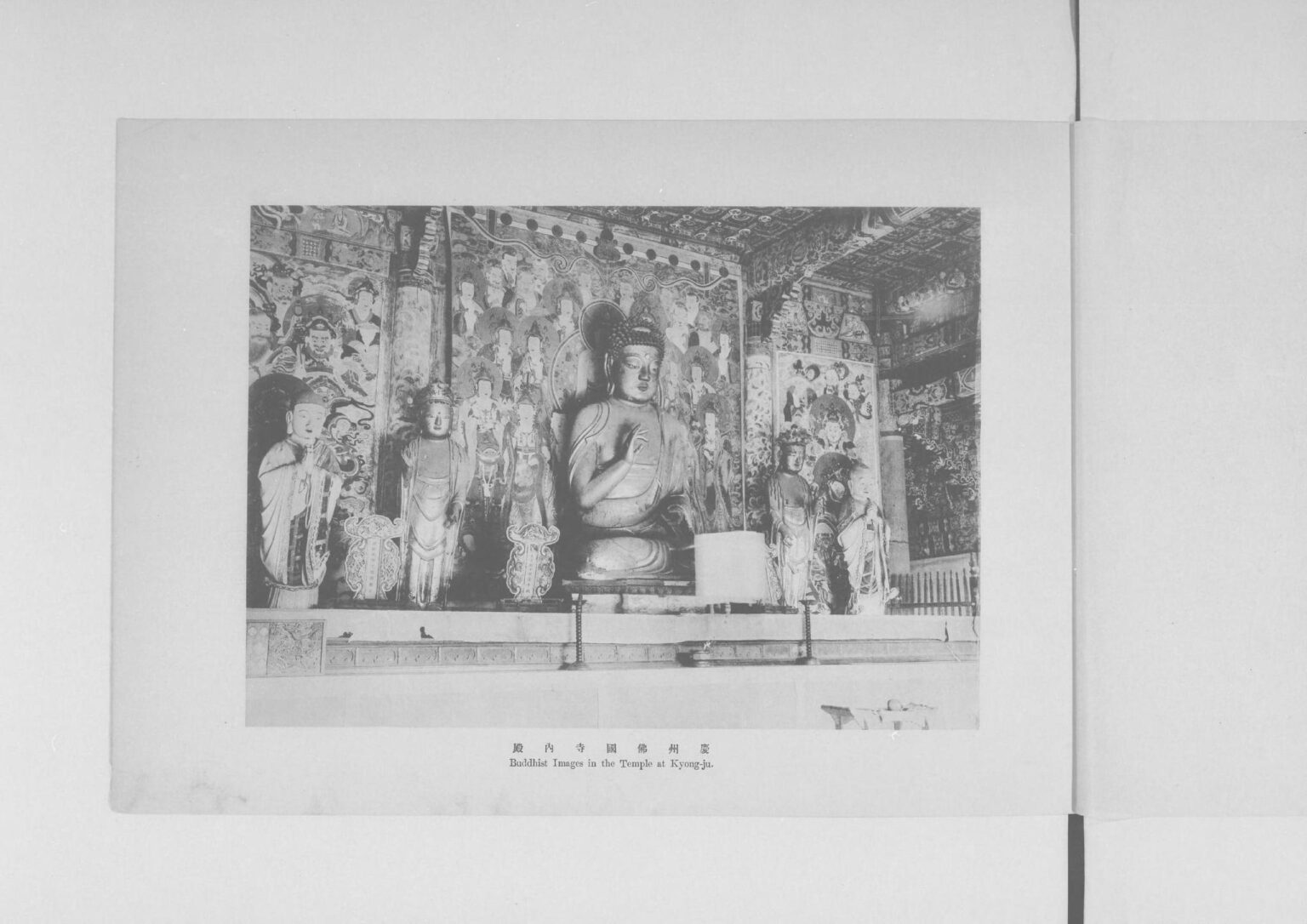
The structure has paid for its fragility. According to ICOMOS, the ceiling partly collapsed, and in 1913 to 1914 the whole grotto was dismantled and covered with a concrete dome, which caused severe distortion and deterioration. A second dome was built over it in 1961 to 1964 with a 1.2 m air space, a wooden antechamber was added and the grotto was sealed. UNESCO adds that moisture, mould and moss remain the main threats and that the interior is sealed behind a glass wall; it judges that these measures reduced authenticity of form.
What do Bulguksa’s pagodas and bridges tell us?
UNESCO says the temple grounds divide into three areas, Birojeon, Daeungjeon and Geungnakjeon, designed to represent the land of Buddha. Two pagodas stand before the Daeungjeon: Seokgatap and Dabotap. The temple explains that they illustrate a passage of the Lotus Sutra in which the Buddha of the past attests to the teaching of the Buddha of the present. It gives their heights as 10.75 m and 10.29 m, and describes Seokgatap as a standard three-storey pagoda on a two-tier base, while Dabotap is a special form whose storeys are hard to count.
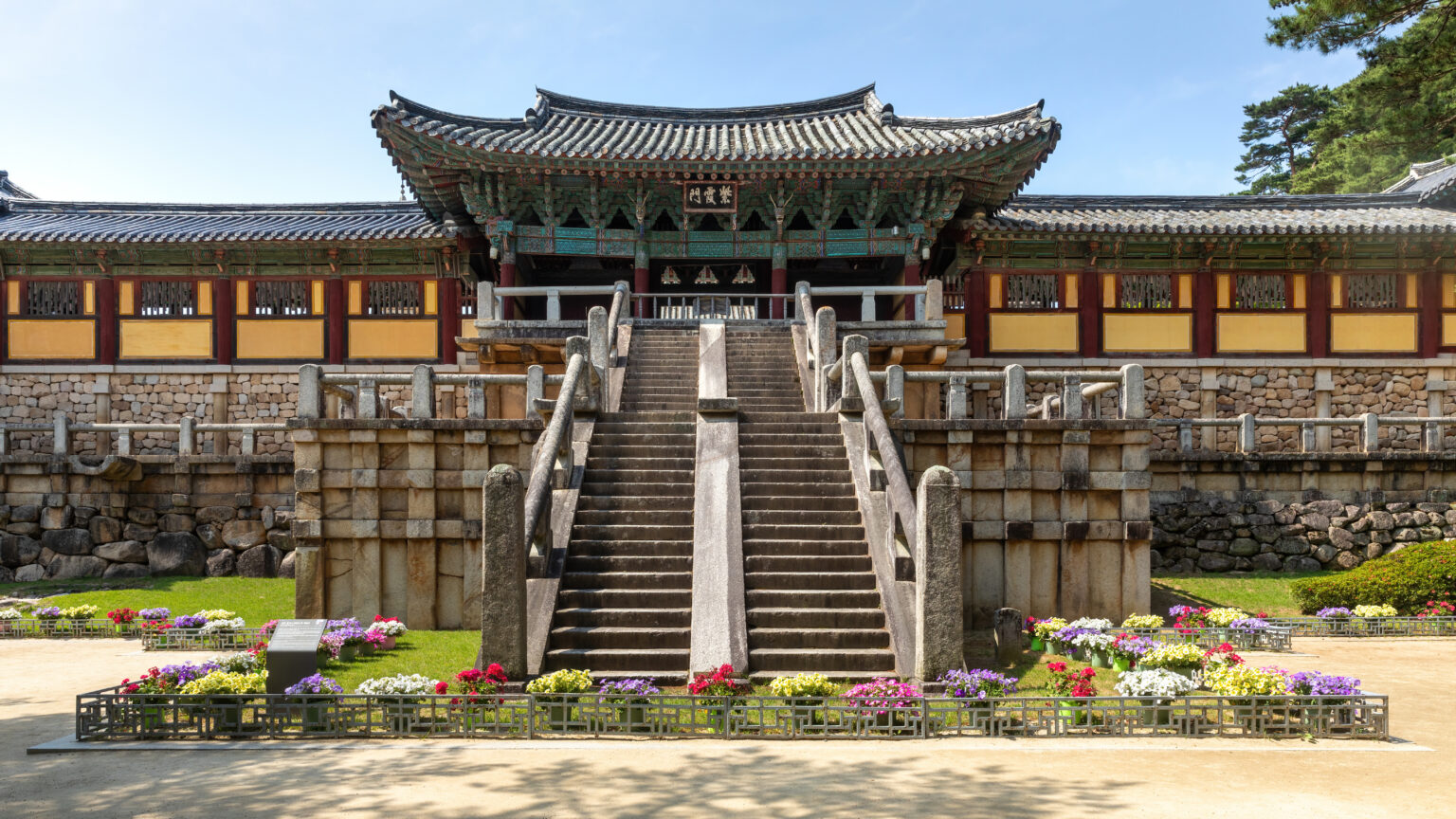
Two stone stairways lead up to the halls: Cheongungyo and Baegungyo, 34 steps in all, to the Daeungjeon, and Yeonhwagyo and Chilbogyo, 18 steps, to the Geungnakjeon. The second pair, shown in our opening photograph, has lotus petals carved on its treads. In 1966 looters damaged Seokgatap; repairing it that December, the temple records, workers found the Mugujeonggwang Great Dharani Sutra, which the temple describes, citing the Cultural Heritage Administration, as the world’s oldest woodblock print.
What did the 1593 fire change at Bulguksa?
The temple’s history says that in May 1593, during the Japanese invasion known in Korea as the Imjin War, the great complex of some 2,000 rooms burned. Reconstruction began around 1604 and about forty partial repairs followed until 1805. UNESCO notes that the wooden buildings have been repaired several times since the 16th century with traditional materials and techniques. A restoration committee was formed in 1969, work ran from February 1970 to June 1973, and halls reduced to foundations and empty ground were rebuilt.
Frequently Asked Questions
Which UNESCO World Heritage sites are near Seokguram and Bulguksa?
The Gyeongju Historic Areas are the nearest, 11 km away in a straight line, then Hahoe and Yangdong (24 km), the Bangucheon Petroglyphs (26 km), the Seowon academies (30 km), Sansa mountain monasteries (42 km) and the Gaya Tumuli (75 km). All are in the Republic of Korea.
Is Seokguram a natural cave?
No. UNESCO describes Seokguram as an artificial grotto built of granite, with an antechamber, a corridor and a main rotunda. Its domed ceiling and entrance corridor used more than 360 stone slabs. The Buddha it shelters sits in the rotunda looking out to sea.
Who built Bulguksa and Seokguram?
UNESCO says the Silla prime minister Kim Dae-seong initiated and supervised both, building the temple for his parents in this life and the grotto for his parents of a previous life. Bulguksa’s own history says he died before they were finished and the state completed them.
Why are Seokguram and Bulguksa World Heritage?
UNESCO inscribed them in 1995 under two criteria. Criterion (i): the Seokguram sculptures are a masterpiece of East Asian Buddhist art. Criterion (iv): the grotto and the temple together are an outstanding example of the Buddhist religious architecture that flourished in Gyeongju, capital of the Silla Kingdom, in the 8th century.
Sources
- UNESCO World Heritage Centre, Seokguram Grotto and Bulguksa Temple, inscribed 1995. https://whc.unesco.org/en/list/736/
- ICOMOS, Advisory Body Evaluation of the nomination of Sokkuram (No 736), September 1995. https://whc.unesco.org/document/154148
- Bulguksa (official temple website, in Korean): history, halls and treasures pages. http://www.bulguksa.or.kr/bbs/content.php?co_id=history, http://www.bulguksa.or.kr/bbs/content.php?co_id=treasure
- UNESCO World Heritage Centre, Gyeongju Historic Areas. https://whc.unesco.org/en/list/976/
- UNESCO World Heritage Centre, Sansa, Buddhist Mountain Monasteries in Korea; Gaya Tumuli; Seowon, Korean Neo-Confucian Academies. https://whc.unesco.org/en/list/1562/, https://whc.unesco.org/en/list/1666/, https://whc.unesco.org/en/list/1498/
Spotted an error? Write to editorial@culturalheritageonline.com and we correct it the same day.