
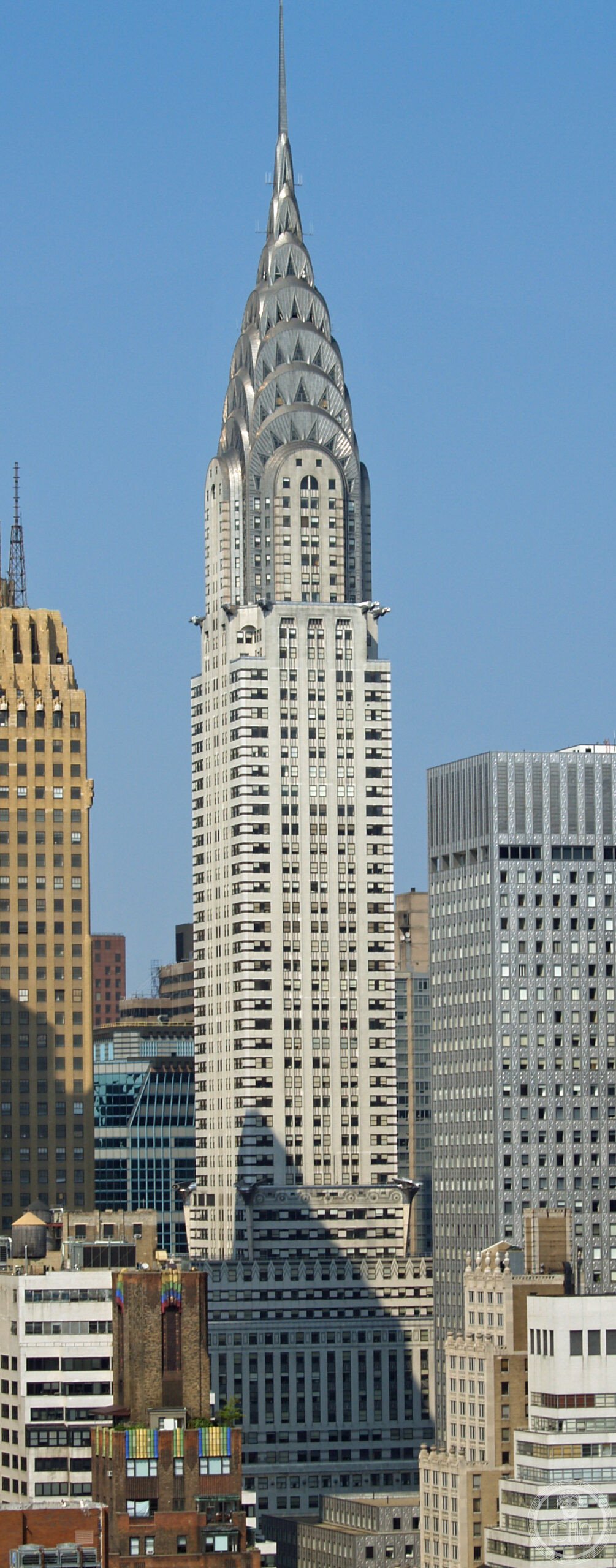

Completed in 1930 at 405 Lexington Avenue in Midtown Manhattan, the Chrysler Building is the supreme achievement of American Art Deco skyscraper design — its stainless steel crown of radiating arches and eagle gargoyle heads visible across the city’s skyline, the result of a secret plan by architect William Van Alen to outrace his rival Severance and claim the title of world’s tallest building.
At a glance
The Chrysler Building at 405 Lexington Avenue was, for eleven months in 1930–1931, the tallest building in the world: 1,046 feet (319 metres) in 77 floors, its stainless steel crown assembled in secret inside the shaft and raised through the top at the last moment to overtake the competing Bank of Manhattan (40 Wall Street) by 119 feet. Designed by William Van Alen for automobile magnate Walter P. Chrysler, the tower is a celebration of the automobile age in architectural ornament: eagle heads based on the 1929 Chrysler radiator cap project from the 61st floor; abstract hubcap and mudguard friezes encircle the lower mechanical floors; the lobby’s walls are clad in African marble and red Moroccan marble, its ceiling painted with a Transportation mural 97 feet above the ground. The building has been a National Historic Landmark since 1976.
Key facts
- Completed: 1930
- Architect: William Van Alen (1883–1954)
- Developer: Walter P. Chrysler
- Style: Art Deco
- Address: 405 Lexington Ave at 42nd St, New York, NY 10174
- Height: 1,046 ft (319 m) / 77 floors
- World’s tallest: April 1930–April 1931 (surpassed by Empire State Building)
- Designation: National Historic Landmark (1976); NYC Individual Landmark
History
The race to build the world’s tallest skyscraper in the late 1920s was as much theatre as engineering. William Van Alen, the architect Walter P. Chrysler had hired to redesign an existing Lower Manhattan project, became the protagonist in one of architecture’s great competitive dramas: a secret build-off against his former partner and now rival, H. Craig Severance, who was erecting 40 Wall Street downtown and had publicly announced its target height of 927 feet. Van Alen, knowing he would be surpassed, secretly assembled a 185-foot stainless steel spire inside the Chrysler’s own shaft, raising it through the roof in ninety minutes on 16 October 1929 to push the building to 1,046 feet — 119 feet taller than 40 Wall Street and the world’s tallest structure by a comfortable margin.
The victory was short-lived: eleven months later, in April 1931, the Empire State Building rose to 1,250 feet and displaced the Chrysler from the top of the global height rankings. But height was never the Chrysler Building’s lasting distinction. What the building gave New York was something more enduring than a record: an Art Deco ornamental vocabulary of extraordinary richness and internal coherence, drawn entirely from the Chrysler automobile catalogue and the materials of 1920s industrial production. Stainless steel (Nirosta brand), chosen for its permanence and sheen, clads the entire crown; the eagle gargoyle heads at the 61st floor are scaled-up versions of the 1929 Chrysler hood ornament; the abstract friezes of hubcaps, mudguards, and radiator caps that encircle the mechanical floors treat the automobile as a heraldic symbol — as if a medieval cathedral had replaced its saints with cars.
Walter P. Chrysler never actually owned the building under his own name: the tower was placed in a family trust to avoid corporate complications. The automobile executive paid for its construction personally, not through Chrysler Corporation. The building was sold by the Chrysler family to Massachusetts Mutual Life Insurance in 1953 and has changed ownership several times since, remaining a commercial office tower throughout. Its lobby — accessible to the public during business hours — is one of the finest Art Deco interiors in New York.
What you see
The crown is the Chrysler Building’s defining element and one of the most recognisable silhouettes in the world: seven radiating arches of stainless steel, each pierced by triangular windows, stepping back like petals to form a ribbed spike. Seen from street level on Lexington Avenue, the tower rises from a three-story limestone base through a series of setback floors to the crown, the stainless steel warming in sunlight from silver to gold and back to silver as the light shifts. The eagle heads that project from the 61st floor — four of them, one at each corner — are visible from the street as gleaming mascots a quarter of a mile overhead, their wings spread and beaks open.
The lobby at ground level is the building’s second great spectacle: enter from Lexington Avenue to find walls clad in red-veined Moroccan marble, elevator doors faced in the lotus and papyrus-inspired marquetry that is among the most beautiful inlay work in any American commercial building, and above your head — 97 feet above the floor — Edward Trumbull’s ceiling mural depicting the “Transportation” theme, with Chrysler airflow cars, airplane engines, and the building itself painted across a curved surface of extraordinary scale. Evening is the best time to see the crown from outside: the triangular windows are lit from within, and the stainless steel glows like a lantern against the sky.
Practical information
- Lobby access: Free; open weekdays during business hours; security check at entrance
- Observation deck: Not open to the public (no current public access to upper floors)
- Best time: Evening for lit crown; morning for uncrowded lobby
- Time needed: 15–20 minutes lobby + exterior
- GPS: 40.7516° N, 73.9755° W
- Nearest transit: Grand Central–42nd St (4/5/6/7/S lines), 3 minutes walk; 42nd St–Bryant Park (B/D/F/M), 5 minutes
Getting there
The Chrysler Building is at 405 Lexington Avenue, on the corner of 42nd Street in Midtown Manhattan. Grand Central–42nd Street station (subway lines 4, 5, 6, 7, S) is 3 minutes west on 42nd Street. JFK Airport is approximately 15 miles east; AirTrain to Jamaica then LIRR or subway to Midtown takes 45–55 minutes. LaGuardia Airport (LGA) is approximately 8 miles north-east; express bus M60-SBS to Astoria, then N/W train to Midtown, approximately 45 minutes.
Nearby
- Grand Central Terminal (1913) — Warren & Wetmore and Reed & Stem; Beaux-Arts masterpiece; Main Concourse ceiling; 3 minutes west; already in the CHO collection
- United Nations Headquarters (1952) — International Committee of Architects; East River; 10 minutes east
- New York Public Library — Schwarzman Building (1911) — Carrère & Hastings; Beaux-Arts; 42nd Street and Fifth Avenue; 10 minutes west
Sources
- National Park Service, NHL nomination form, Chrysler Building — nps.gov
- New York City Landmarks Preservation Commission, LP-0537 — nyc.gov/lpc
- Stern, Robert A. M., Gregory Gilmartin, and Thomas Mellins. New York 1930. Rizzoli, 1987.
- Van Leeuwen, Thomas A. P. The Skyward Trend of Thought. MIT Press, 1988. The height race and the stainless steel crown.
- Wikidata, Chrysler Building — wikidata.org
Find it on the map
See this place and what’s around it →📷 Become a Cultural Heritage Online photographer
Share your photos of places: they stay published under your name as the author. The more they're seen, the more you get noticed — and soon a contest will reward the most appreciated photos.
Log in or sign up free to add a photoDo you manage this place?
This page is read by travellers and heritage enthusiasts who find it on Google. Keep it accurate — and make it work for you. Free for non-profit heritage institutions.