
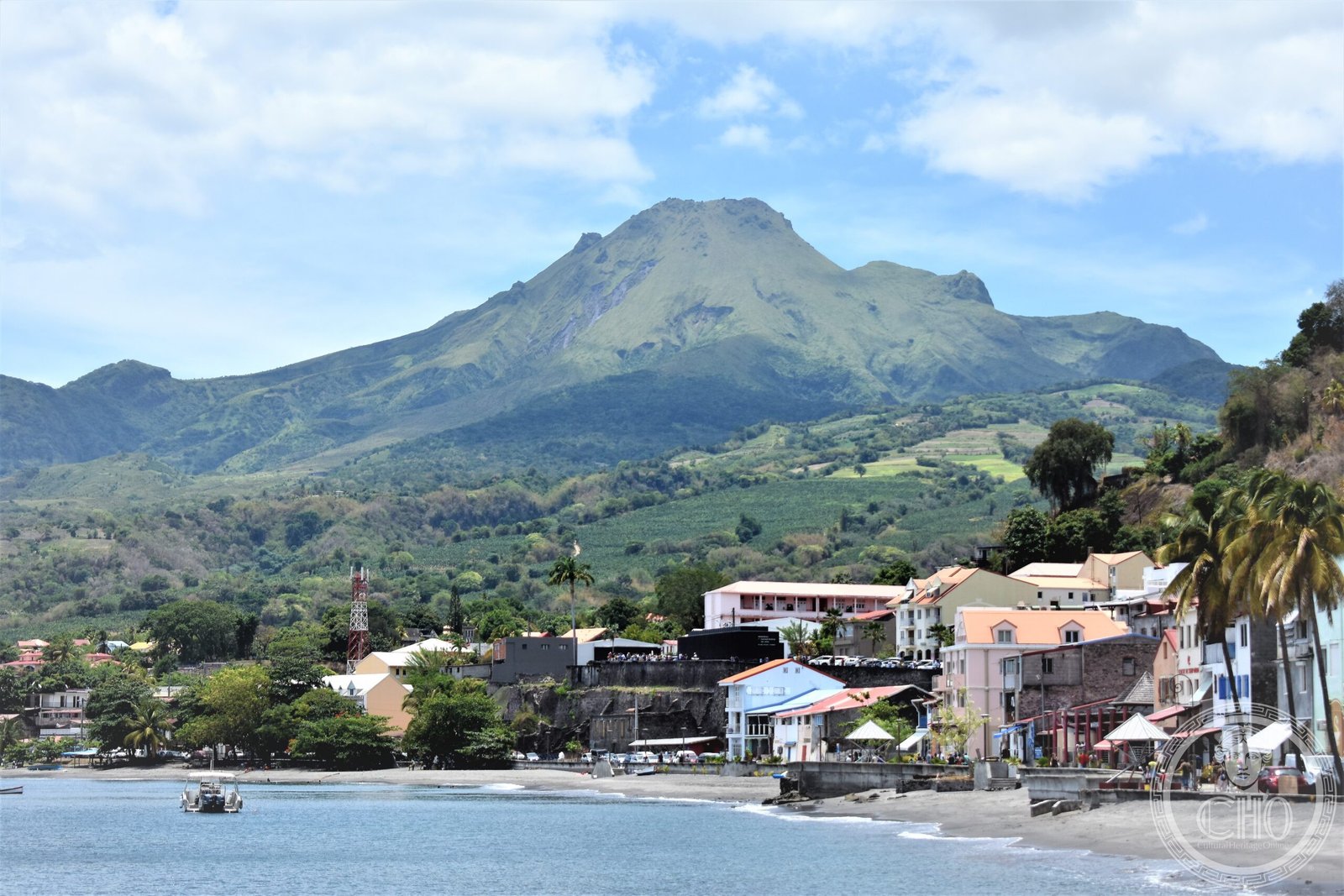
Why Mount Pelée is Unforgettable
Mount Pelée is one of the most deadly volcanoes in recorded history. On 8 May 1902, a pyroclastic surge engulfed Saint-Pierre — once the cultural capital of the Caribbean, the “Paris of the Antilles” — killing approximately 30,000 people in under two minutes. The mountain’s dramatic profile and the ruins below make this one of the most visceral volcanic landscapes on Earth.
The 1902 Catastrophe
The eruption of Mont Pelée sent a superheated cloud of gas and ash racing down the flank at over 600 km/h. Saint-Pierre was obliterated instantly. Only a handful of survivors were documented, including a prisoner sheltered in a stone cell. The ruins of the city — theatre, customs house, hospital — remain partially preserved as an open-air memorial beneath the volcano.
Volcanic Geology
Pelée is a classic stratovolcano rising 1,397 metres above the Caribbean Sea. Its most dangerous feature is the production of nuées ardentes — glowing avalanches — and dome eruptions. The northern sector encompasses the dramatic Pitons du Carbet, a cluster of ancient eroded volcanic spines whose shapes define Martinique’s silhouette.
Tropical Forest Ecosystems
Above 600 metres, Pelée is cloaked in dense montane rainforest harbouring endemic plants, rare orchids, and the critically endangered Martinique Oriole. The northern zone is one of the most biodiverse areas of the Lesser Antilles, with pristine cloud forest rarely disturbed by human activity since the 1902 evacuation.
UNESCO Recognition
Inscribed in 2023 under natural criteria vii and viii, the site was recognised for its outstanding geological significance as one of the world’s premier examples of explosive volcanism, and for the exceptional biodiversity of its tropical forests. It is France’s only UNESCO Natural World Heritage Site in the Caribbean.
Visiting the Site
The Musée Vulcanologique in Saint-Pierre holds artefacts fused by the 1902 eruption: melted bottles, deformed clocks stopped at 7:52 am, charred statues. The ruined Théâtre de Saint-Pierre and the remains of the port quarter are accessible by foot. Hiking trails climb through forest to the crater rim.
Getting There
Martinique is served by Aimé Césaire International Airport near Fort-de-France, with connections from Paris and Miami. Saint-Pierre is 25 km north of Fort-de-France by coastal road (30 min). Ferry services also connect Fort-de-France to Saint-Pierre.
Wider Context
Martinique is a French Overseas Territory and part of the EU, which brings infrastructure standards unusual in the Caribbean. Saint-Pierre itself is now a quiet fishing town rebuilding its identity as a heritage destination — its underwater wreck field from 1902 is one of the world’s premier dive sites.
Find it on the map
See this place and what’s around it →📷 Become a Cultural Heritage Online photographer
Share your photos of places: they stay published under your name as the author. The more they're seen, the more you get noticed — and soon a contest will reward the most appreciated photos.
Log in or sign up free to add a photo