
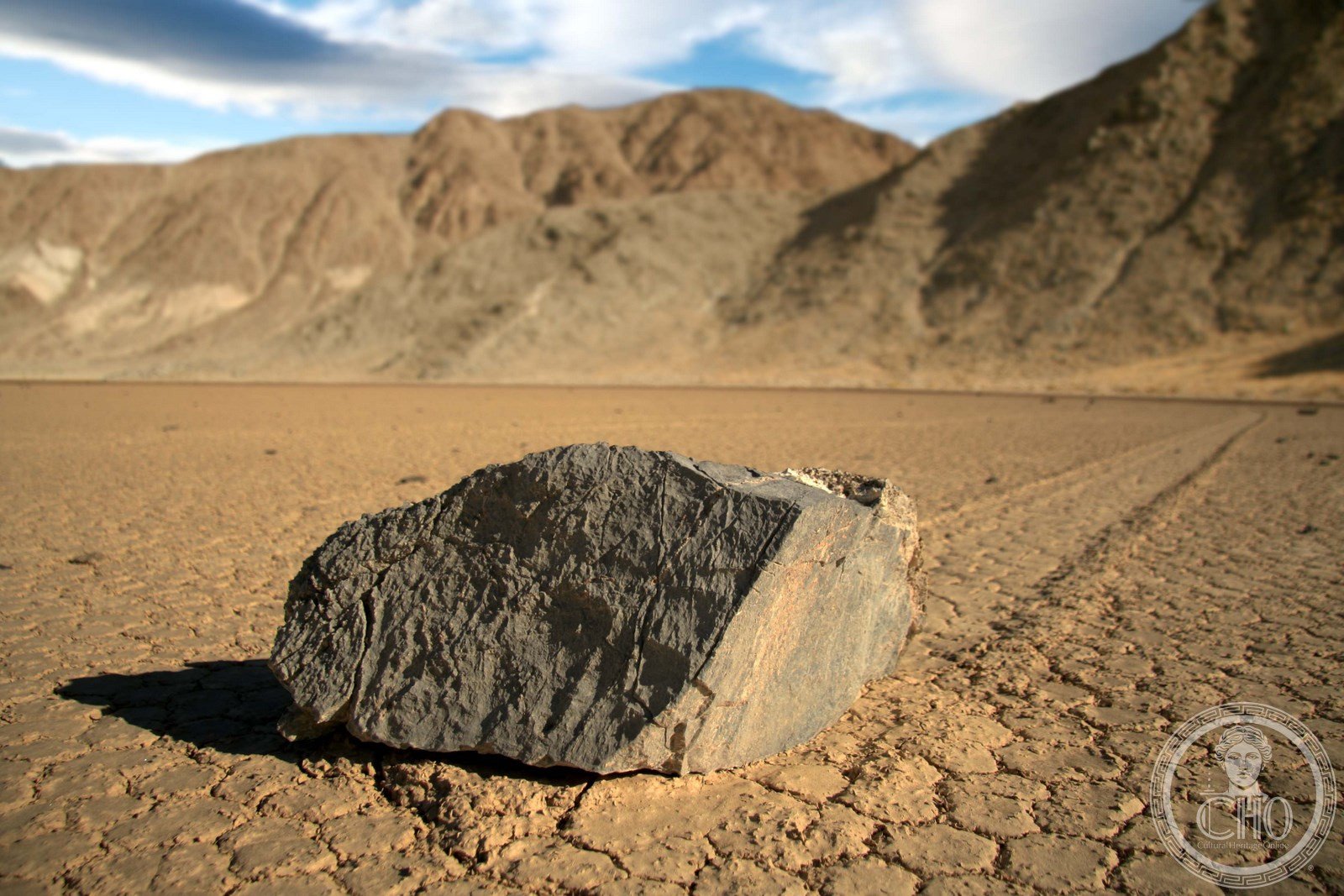
A dry lake bed where stones move across the ground for hundreds of meters without human or animal intervention, leaving behind mysterious trails that have baffled scientists for decades.
At a glance
Racetrack Playa is a geological phenomenon site within Death Valley where rocks slide autonomously across a flat, cracked playa surface. The mechanism remained unexplained until 2014, when research confirmed that stones glide on thin ice sheets propelled by wind. This rare natural process continues to attract geologists and visitors seeking to understand Earth’s dynamic surface.
History
The moving stones of Racetrack Playa have fascinated observers for decades, yet their mechanism eluded scientific explanation. In August 2014, published research definitively demonstrated that the stones slide across ice, driven by wind action, resolving a long-standing geological mystery. The phenomenon itself operates in cycles, with movement typically beginning every 2–3 years and continuing for 3–4 years.
What you see
The playa surface is a pattern of shallow furrows and trails marking stone movement. Paths vary considerably in length—from a few meters to several dozen—with widths between 8 and 30 centimetres and depths under 2.5 centimetres. Rough-bottomed stones create straight tracks, while smooth-bottomed stones trace curved or erratic paths. Stones sometimes rotate during movement, presenting different faces to the ground. The rocks themselves originate from nearby slopes: dark dolomite from the valley’s southern exposures and reddish feldspar-rich sienite from igneous formations above the playa.
Cultural significance
Racetrack Playa represents a unique window into periglacial processes operating in an extreme desert environment. The phenomenon challenges conventional understanding of sediment transport and demonstrates how wind, ice, and stone interact in ways rarely observed elsewhere. The site has become a focal point for geomorphological research and public interest in natural mysteries.
Key facts
- Location: Death Valley, California, United States
- Coordinates: 36.6810697, −117.5602581
- Movement cycles: Every 2–3 years for 3–4 years duration
- Path depths: Less than 2.5 centimetres
- Path widths: 8–30 centimetres
- Scientific explanation confirmed: August 2014
Practical information
Opening hours and admission fees are not listed; check the official Death Valley National Park website. The site is accessible year-round, though extreme summer heat makes visits challenging.
Getting there
Racetrack Playa lies within Death Valley National Park in eastern California. Access requires a high-clearance vehicle; the final approach is a rough dirt road. From the main park entrance, allow several hours for the drive. Bring water, fuel, and supplies—services are not available nearby.
See the place
Sources & resources
Find it on the map
See this place and what’s around it →📷 Become a Cultural Heritage Online photographer
Share your photos of places: they stay published under your name as the author. The more they're seen, the more you get noticed — and soon a contest will reward the most appreciated photos.
Log in or sign up free to add a photo