
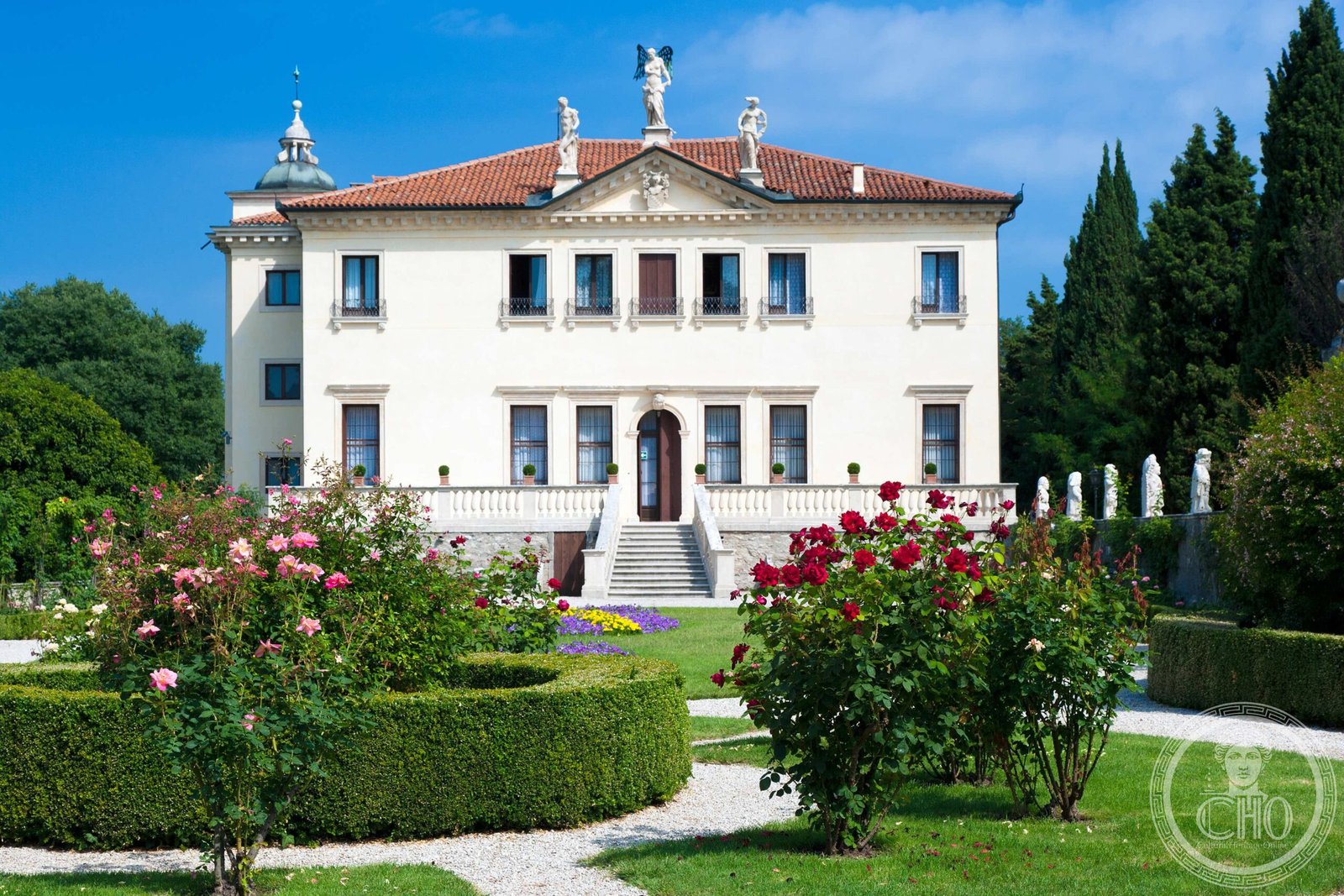
A Venetian villa celebrated for its extraordinary fresco cycle by Giambattista Tiepolo and his son Giandomenico, distinguished by seventeen stone sculptures of dwarfs that once populated the grounds.
At a glance
Villa Valmarana ai Nani stands on the slopes of San Bastian hill, near Vicenza, as one of the Veneto’s most celebrated noble residences. The “ai Nani” epithet—meaning “of the Dwarfs”—refers to the distinctive stone sculptures that once scattered the gardens, later aligned along the perimeter wall. Though privately inhabited by the Valmarana family, the villa opens to visitors six days weekly, just as its celebrated neighbour, Palladio’s Villa Capra (La Rotonda), does. The access road branches from the path to La Rotonda, mere hundreds of metres away.
History
The villa represents the apex of Tiepolo’s artistic career. Giambattista executed the principal decorative campaign across the principal rooms, while his son Giandomenico contributed significant frescoes, including the personifications above the doorways and ceiling compositions. The house remains an active residence of the Valmarana nobility while functioning as a public museum. Legend tells of the villa’s daughter afflicted with dwarfism; servants were purportedly chosen exclusively from among dwarfs so she would not perceive her condition as unusual. When a prince arrived unannounced, the girl, suddenly aware of her difference, despaired—and according to tradition, cast herself from the tower. The stone dwarfs, the tale claims, were petrified by sorrow and remain as eternal guardians.
What you see
The atrium features Tiepolo’s celebrated Sacrifice of Iphigenia—perhaps the most renowned artistic representation of that mythological moment—alongside the Greek Fleet at Aulis. The ceiling displays Diana and Aeolus. River personifications by Giandomenico crown the doorways.
The first chamber, dedicated to Homer’s Iliad, presents Achilles Renouncing Briseis in trompe-l’oeil. Thetis Consoling Achilles dominates the room: Achilles assumes the classical melancholic pose—arm supporting his head, weapons abandoned at his feet—while the sea nymph Thetis emerges from the waters.
Beyond lies the Ariostean room, shifting from Homeric to Ariostean narrative. Ruggiero Liberating Angelica and Angelica Inscribing Medoro’s Name on the Bark command attention. Tiepolo’s landscapes are serene and verdant, evoking the classical locus amoenus.
Cultural significance
The villa exemplifies the eighteenth-century Venetian aristocratic tradition of commissioning grand fresco cycles that synthesize classical and literary themes. Tiepolo’s work here represents the summit of his creative powers, uniting Homeric and Ariostean sources within a coherent iconographic program. The frescoes demonstrate the painter’s mastery of spatial illusion, narrative composition, and the integration of literary sophistication with visual grandeur—hallmarks of the rococo aesthetic at its most refined.
Key facts
- Address: Via dei Nani, 8, 36100 Vicenza
- Coordinates: 45.5353262, 11.5565496
- Website: https://www.villavalmarana.com/
- Phone: 0444 321803
- Artists: Giambattista Tiepolo and Giandomenico Tiepolo (frescoes)
- Notable works: Sacrifice of Iphigenia; Thetis Consoling Achilles; Ruggiero Liberating Angelica
Practical information
The villa is open to visitors six days per week. Check the official website for current opening hours, admission fees, and any special conditions. Guided tours may be available.
Getting there
The villa is situated on the slopes of San Bastian hill, at the gates of Vicenza. You can reach it via the access road that branches from the route to Villa Capra (La Rotonda), approximately 300 metres away. The Vicenza train station connects to regional and intercity routes; from there, local buses or a taxi can take you to the villa. Parking is available on site.
See the place
Sources & resources
- Official website: Villa Valmarana ai Nani
- Cultural Heritage Online
Find it on the map
See this place and what’s around it →📷 Become a Cultural Heritage Online photographer
Share your photos of places: they stay published under your name as the author. The more they're seen, the more you get noticed — and soon a contest will reward the most appreciated photos.
Log in or sign up free to add a photoDo you manage this place?
This page is read by travellers and heritage enthusiasts who find it on Google. Keep it accurate — and make it work for you. Free for non-profit heritage institutions.