Jamaica has two UNESCO World Heritage Sites, a compact list that spans four centuries of colonial history and one of the Caribbean’s most biodiverse mountain systems. One preserves the drowned streets of a city that fell into the sea in 1692; the other shelters species found nowhere else on Earth alongside the memory of communities who resisted enslavement for generations. From Cultural Heritage Online.
Why Jamaica’s list looks the way it does
Jamaica submitted its first successful nomination only in 2015 — relatively late by Caribbean standards — and followed with a second inscription a decade later in 2025. The result is a list of two: one mixed site (recognised for both cultural and natural values) and one cultural site, with no purely natural inscription. That balance reflects the island’s dual identity as a place of extraordinary ecological richness and deep, often traumatic, human history.
Both inscribed sites are also notably substantial in scope. The Blue and John Crow Mountains protects nearly 500 square kilometres of highland terrain. Port Royal’s inscription covers an archaeological ensemble that extends beneath Kingston Harbour, making it one of the more unusual World Heritage properties in the Americas. Jamaica’s tentative list meanwhile includes Cockpit Country and Seville Heritage Park, suggesting the list may grow in the years ahead.
The first inscriptions
Jamaica’s entry into the World Heritage system came at the 39th session of the UNESCO World Heritage Committee, held in Bonn on 3 July 2015. A single site received inscription that year:
- Blue and John Crow Mountains (2015) — inscribed under mixed criteria iii, vi, and x, recognising both its exceptional biodiversity and its cultural associations.
The second and most recent inscription followed a full decade later:
- The Archaeological Ensemble of 17th Century Port Royal (2025) — recognised as a cultural site for its extraordinary preservation of colonial maritime life.
The most visited — and the alternatives
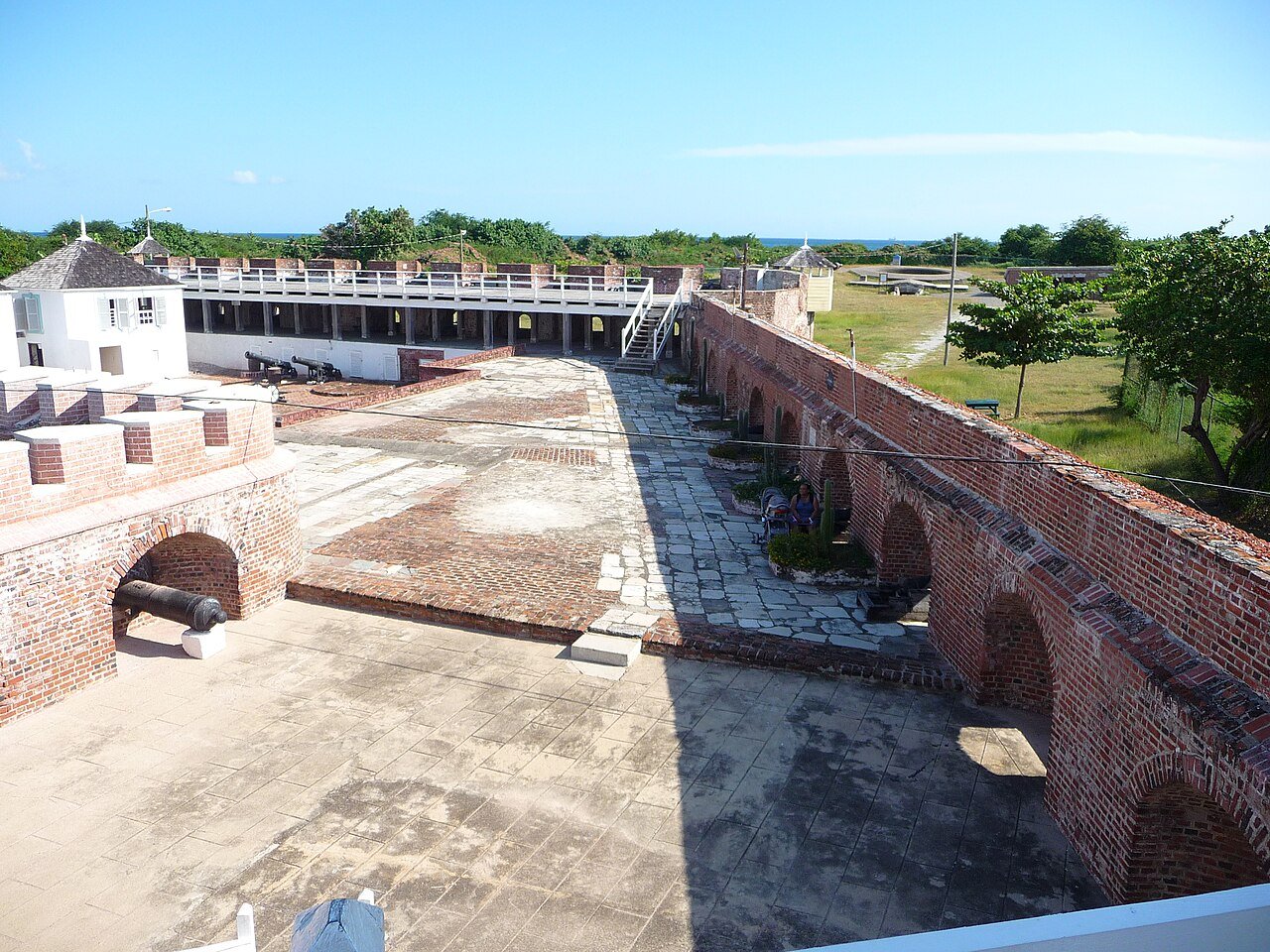
Port Royal draws the most immediate recognition: the former English colonial town that once held 10,000 residents in just 51 acres was, by the late 17th century, the largest and most prosperous city in the Caribbean. A catastrophic earthquake on 7 June 1692 caused widespread liquefaction of the sandy ground, sending much of the settlement into Kingston Harbour. The resulting underwater archaeological record has been studied systematically since 1981, yielding detailed evidence of daily colonial life that above-ground sites rarely preserve.
For visitors less drawn to maritime archaeology, the Blue and John Crow Mountains offer a contrasting experience. The range’s upper slopes shelter the Maroon communities whose ancestors successfully resisted British colonial forces over decades — the cultural criteria for the inscription acknowledge that history explicitly. On the ecological side, the park is home to the giant swallowtail butterfly (Papilio homerus), described as the largest butterfly in the Western Hemisphere, along with the Jamaican boa and the endangered Jamaican blackbird, all endemic to the island.
Natural and shared sites
Jamaica has no purely natural World Heritage Site; its only natural heritage recognition sits within the mixed Blue and John Crow Mountains inscription, under criterion x for biodiversity. The park’s 495 square kilometres of forest represent one of the most significant endemic-species refuges in the insular Caribbean, with habitat ranging from montane rainforest to elfin woodland on the highest ridges. The Jamaican hutia, a rodent found only on the island, also lives within the protected area.
Jamaica holds no transnational or serial World Heritage inscriptions as of 2025. Both properties are standalone national nominations. The tentative listing of Cockpit Country — a karst landscape in Trelawny Parish that also has deep Maroon associations — was added in 2025 and may eventually bring a second mixed-criteria site to the national list.
How to find them
Port Royal lies at the end of the Palisadoes tombolo, roughly 30 minutes by road from central Kingston; the site includes the Fort Charles museum and the still-visible remains of colonial-era structures at street level, with ongoing underwater excavation managed by the Jamaican government. The Blue and John Crow Mountains National Park is accessible from Kingston via the Gordon Town road, with the main visitor infrastructure concentrated around Hollywell in the Blue Mountains section.
Jamaica’s World Heritage sites sit alongside thousands of other places on CHO’s interactive map, with GPS and sourced editorial history for each. See also our guides to Italy’s and France’s UNESCO sites, and our piece on cultural travel beyond mass tourism.
Frequently Asked Questions
How many UNESCO World Heritage Sites does Jamaica have?
Jamaica has two UNESCO World Heritage Sites as of 2025. The Blue and John Crow Mountains, inscribed in 2015, is a mixed cultural and natural site; the Archaeological Ensemble of 17th Century Port Royal, inscribed in 2025, is a cultural site.
What was Jamaica’s first UNESCO World Heritage Site?
Jamaica’s first World Heritage inscription was the Blue and John Crow Mountains, recognised at the 39th session of the UNESCO World Heritage Committee on 3 July 2015. It received mixed designation for its biodiversity and its associations with Maroon cultural heritage.
What makes Port Royal significant as a World Heritage Site?
Port Royal was once the largest city in the 17th-century Caribbean, famous for its role in English colonial commerce and privateering. A devastating earthquake in 1692 caused much of the town to sink into Kingston Harbour, preserving an extraordinary underwater archaeological record of colonial-era daily life that has been studied since 1981.
Does Jamaica have any natural UNESCO World Heritage Sites?
Jamaica has no purely natural inscription, but the Blue and John Crow Mountains is recognised under natural criterion x for its outstanding biodiversity. The park shelters several species found nowhere else on Earth, including the giant swallowtail butterfly, the Jamaican boa, and the Jamaican blackbird.
Sources used in this article
- UNESCO — State Party Jamaica — World Heritage list.
- UNESCO — Jamaica: World Heritage Sites.
- CHO magazine — What is a World Heritage Site?
- CHO — Interactive map of heritage sites.