Haiti has one UNESCO World Heritage Site: a grouping of early-independence monuments in the northern highlands that carries a weight of historical significance unlike almost anywhere else in the Americas. Built by formerly enslaved people who had won their freedom, the fortresses and palace at this site represent a founding chapter in the story of universal liberty. From Cultural Heritage Online.
Why Haiti’s list looks the way it does
Haiti ratified the UNESCO World Heritage Convention on 18 January 1980, and its single inscription followed just two years later. The brevity of the list is not a reflection of cultural scarcity — Haiti possesses one of the richest colonial and post-colonial built heritages in the Caribbean — but of limited institutional capacity to prepare, document, and defend nominations through the lengthy UNESCO process. Political instability, natural disasters, and funding constraints have repeatedly interrupted heritage management efforts, leaving two tentative sites on the waiting list for decades.
The country’s tentative list currently holds two candidates: the Historic Centre of Jacmel, a port town whose late-nineteenth-century iron-framed commercial buildings made it a hub for the wider Caribbean, and the National Historic Park of Matheux, focused on the coffee economy and the landscape of slavery and freedom in the Artibonite and Ouest departments. The Matheux nomination, added to the tentative list in 2024, signals renewed engagement with the process. Whether it advances to inscription will depend on sustained conservation investment and institutional stability.
The first inscriptions
Haiti’s World Heritage story began in 1982 with a single, composite inscription that encompasses three linked sites in the Nord Department:
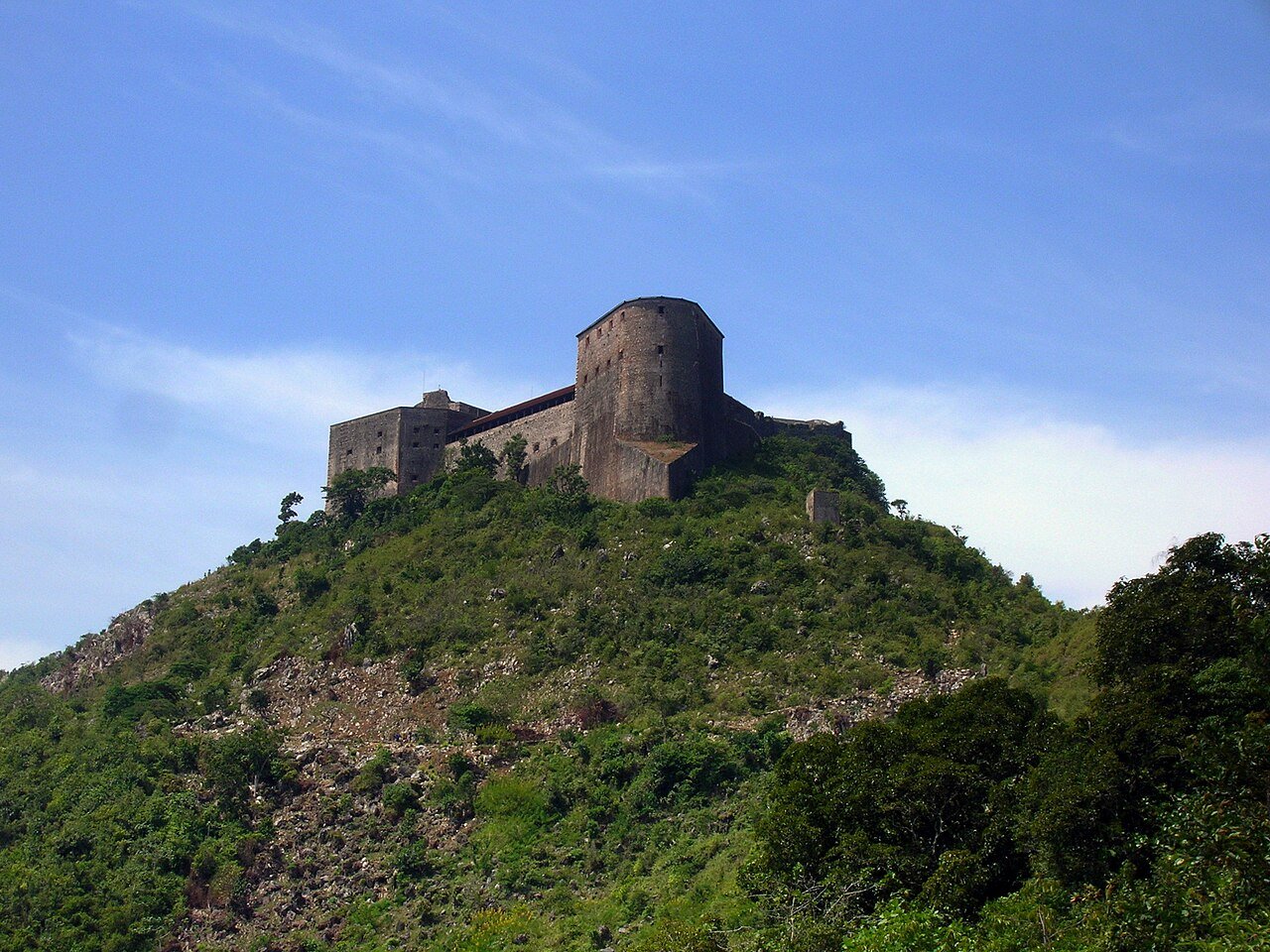
- Citadelle Laferrière — a massive mountain fortress completed around 1820, capable of sheltering up to 5,000 people, and one of the largest fortifications in the Americas
- Sans-Souci Palace — the royal residence of King Henri Christophe, destroyed by an earthquake in 1842 and left as a dramatic ruin
- Ramiers — a group of smaller batteries and outposts forming the defensive network around the main citadel
Together they form the National History Park – Citadel, Sans-Souci, Ramiers. UNESCO’s inscription recognized these monuments as universal symbols of liberty — the first large-scale constructions undertaken by people who had liberated themselves from enslavement. That framing has given the site a moral and historical significance that extends far beyond its considerable architectural interest.
The most visited — and the alternatives
The Citadelle Laferrière draws the majority of visitors who travel to northern Haiti for cultural heritage. Reaching it requires a journey to Milot, then a ride or walk up steep terrain to an elevation of roughly 900 metres, where the fortress emerges from the forest as an almost theatrical apparition. Its walls, some 4 metres thick at the base, were designed to withstand cannon fire from French naval forces that ultimately never returned. The interior still holds hundreds of cannonballs stacked in neat pyramids.
Sans-Souci Palace, at the foot of the hill in Milot, receives far fewer visitors despite being a site of equal historical depth. Henri Christophe modelled it in part on Versailles, and the scale of its surviving walls and staircases makes the ambition legible even in ruin. The Ramiers batteries are rarely visited at all — most tourists turn back after the citadel — yet they complete the defensive logic of the entire complex, and a circuit through them gives a clearer sense of how the system was designed to function as a whole.
Natural and shared sites
Haiti has no inscribed natural World Heritage Sites, and no mixed cultural-natural inscriptions. Its single designated property is entirely cultural. This reflects the focus of the 1982 nomination rather than any absence of natural value: the country’s coastal ecosystems, cave systems, and highland forests have not yet been advanced through the nomination process. No transnational or serial World Heritage inscriptions include Haiti at present.
The tentative National Historic Park of Matheux does incorporate a cultural landscape dimension, with the coffee-growing terrain of the nineteenth century forming part of the nomination’s scope, but it remains on the tentative list. If it advances, it would introduce a landscape-scale approach to Haiti’s World Heritage representation, rather than the monument-centred focus of the 1982 inscription.
How to find them
The National History Park sites are located near the town of Milot in the Nord Department, roughly 15 kilometres south of Cap-Haïtien. The Citadelle Laferrière and Sans-Souci Palace are the primary access points, and both are managed as part of the national park. Travel conditions in the region vary and should be checked against current advisories before planning a visit.
Haiti’s World Heritage sites sit alongside thousands of other places on CHO’s interactive map, with GPS and sourced editorial history for each. See also our guides to Italy’s and France’s UNESCO sites, and our piece on cultural travel beyond mass tourism.
Frequently Asked Questions
How many UNESCO World Heritage Sites does Haiti have?
Haiti has one inscribed UNESCO World Heritage Site as of 2023: the National History Park – Citadel, Sans-Souci, Ramiers. Two further sites appear on the country’s tentative list — the Historic Centre of Jacmel and the National Historic Park of Matheux — but neither has yet been formally inscribed.
What was Haiti’s first UNESCO World Heritage Site?
Haiti’s first and only UNESCO World Heritage Site, the National History Park – Citadel, Sans-Souci, Ramiers, was inscribed in 1982. It was among the earlier Caribbean inscriptions and is recognised as a cultural site of exceptional universal value connected to the history of emancipation and Haitian independence.
What is the Citadelle Laferrière and why is it significant?
The Citadelle Laferrière is a massive early-nineteenth-century fortress built in the mountains of northern Haiti under King Henri Christophe, following the Haitian Revolution. It is one of the largest fortifications in the Americas and stands as a monument to the self-determination of people who had freed themselves from enslavement, giving it historical weight well beyond its considerable engineering ambition.
Does Haiti have any natural UNESCO World Heritage Sites?
No. Haiti’s single inscribed World Heritage property is cultural in designation, and the country has no natural or mixed cultural-natural sites on the UNESCO list. Proposals for natural-heritage nominations have not advanced through the formal process to date.
Sources used in this article
- UNESCO — State Party Haiti — World Heritage list.
- UNESCO — Haiti: World Heritage Sites.
- CHO magazine — What is a World Heritage Site?
- CHO — Interactive map of heritage sites.